Building your SEO strategy – Part 1

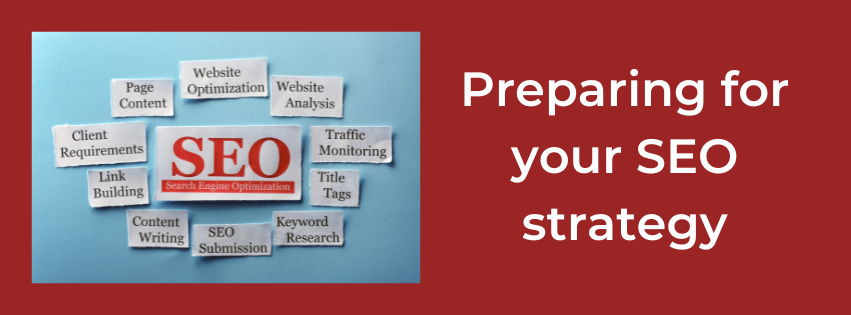
Preparing for your SEO strategy  

Whether you have a small business or are part of a bigger corporate, SEO (Search Engine Optimization) is a must for your website to help you rank higher on Google and other search engines.

Building your SEO strategy sounds complicated and may make you want to immediately zone out and not read more – but trust me, I’m going to try and keep it simple! It’s really just a plan!

Your SEO strategy is simply the process of organising your website’s content to improve your chances of appearing in search results – a way of maximising your opportunities to get organic traffic from search engine results pages, (SERPs).

Having a strategy or plan, helps you keep on track when you create your content. It helps you see that you need to create content that people are looking for and searching for, rather than creating content you think they’re looking for, or posting what you want to post.

When you just react and post without a plan, your content will appear unorganised and scattered – this is when search engine bots have a problem indexing your site, understanding exactly what you do and therefore, have a problem ranking your pages.

BUT WE CAN FIX THIS! However, as it’s such a big subject, I’m going to do this over a few blog posts, so you don’t feel too overwhelmed!

Steps to helping create an SEO strategy.

Here are few simple steps to follow:

Make a list of keywords.

This is always the first step to take. Use Google search to help you with this. OK, let’s go with an example…

You make candles – you sell them at markets and on your website – and you also use social media. You make all sorts of candles for all sorts of occasions, some standard that people can buy and some bespoke.

Your keyword search starts with Google – type in candles or put the word twice (as I did – candles candles).

Google will then suggest loads of options, such as:

  • Beeswax candles.
  • Votive candles
  • Scented candles
  • Four candles (!!! This made me smile – if you know the Two Ronnies sketch)
  • Birthday candles
  • Cake candles
  • Soy candles
  • Specialist candles
  • Candles near me

You’ll know that these are good keywords to use for SEO as they come straight from Google and so you know this is what people are already searching for.

You will find that short-tail keywords (search words using just one word – such as ‘candle’) are more popular as most people will start with just one word when looking for something specific.

Long-tail keywords (such as ‘candles for special occasions), won’t be as popular in the volume of people looking for them, but they tend to be generally easier to rank for and obviously attract people who are searching for something more specific. 

I’d say type in several different words and short phrases into Google and see what comes up – try and have a list of at least 10 keywords.

You can then check them in a keyword checker (there are some free sites out there, such as  https://www.wordstream.com/keywords or Ubersuggest) which will give you the number of people searching that keyword and whether they’re low, medium or high volume.  

Look at Google’s first page.

Once you’ve got your list of keywords, type them one at a time into Google search and look at the first 10 entries that come up.  This shows you the businesses that currently rank for that keyword, and the kind of thing (maybe a list or a business itself) that people are looking for when using that keyword. Make a note of what comes up in the search and what kind of things, such as lists or blog posts that come up.

Analyse your competitors. 

Most of us will know who our main competitors are, but to find out who Google thinks your competitors are, you can use a free tool, such as Semrush, to help you. You simply type the URL of your website into their search, then click on ‘Domain overview’ and scroll down where you’ll find a further search called ‘Main organic competitors.’ If you click on this and then click on ‘view all,’ you will get loads of information about keywords. It will show a list of all your competitors, plus the most common keywords that you share, as well as telling you how much traffic those keywords pull in.

Where you see a lot of common keywords, you’ll have your list of at least 4-5 competitors.

Keyword gap

You can now use the Semrush ‘Keyword Gap Tool.

The ‘gap’ refers to the keywords that your competitors are ranking for, but that you’re NOT ranking for.

This tool will help you identify those gaps, so you can then use them on your website or blog, therefore optimising your existing content with those keywords – or creating new pages to use them.

To use this tool, you simply put the URL of your website and then the URLs of four of your competitors and press ‘compare’ and scroll down to ‘all keywords details for…’ and click on the ‘missing’ tab. You’ll get a huge list and then it’s up to you to sort through which of those missing keywords would be relevant to your business and to your website. 

There are lots of other uses that Semrush can help you with in analysing your competitors and your website, so it’s worth going on and having a play – and it’s really interesting!

These are the first few steps for SEO and will help get you prepared to look at your SEO strategy. Next time we’ll look at how to use this new-found knowledge to help you rank on Google.

If this all feels a bit too overwhelming, I can help you with your SEO strategy through 1:1 coaching. Just contact me to find out more.

Pricing for small businesses

Whenever I talk to a small business, pricing is one of the things that most struggle with. But just as you have a strategy for your business, and spend time marketing what you do, having a pricing strategy is just as important.

Pricing can be difficult to get your head around – for example, why are some products worth so much more than others, when they basically offer the same thing?

Settling on a pricing strategy

There are different ways to settle on a pricing strategy that will work for you – and lots of things to take into consideration, such as:

  • Your customer – how much are they willing to pay for your products or services?
  • Your competition – what is your competition charging?
  • Costs – you need to know all your costs in order to be able to fix a price which makes you a profit.

 So, you need to find a pricing strategy that offers good value to your customers, competes with your competitors, and gives you a profit. This isn’t an easy concept to grasp.

Pricing strategies for small businesses

There are loads of pricing strategies out there, but these are just a few that I think are more relevant to the smaller businesses that I interact and work with.

Competitor strategy

If your products are competing with lots of other businesses who do the same as you, competitor pricing or strategy might be the best way to go. First, you need to research your competitors to find out what they charge for similar products to yours, and then monitoring their prices to ensure that your prices are the same or slightly lower.

This is a strategy that is most commonly used by supermarkets.

Penetration pricing

If you’re just starting up, or you have new products that are like your competitors, this is a popular choice. You start by offering a low introductory price for your new product, (or products if you’re just starting) and then gradually increase the price as the market gets used to your brand.

Economy pricing

If you offer low cost, budget products, this is a good pricing strategy. But you MUST ensure that you’re able to produce bulk quantities for a low manufacturing cost and still be able to turn a profit.

Price anchoring

If you sell both premium and budget products, then this may work well for you. You can put your lower-priced alternative next to a similar premium product – customers are more likely to buy the cheaper model. This gives them an immediate comparison without having to look at other brands or businesses.

Psychology pricing

It probably won’t surprise you to know that emotion influences a lot of the things we buy. Psychology pricing is the way that businesses set their prices to influence how customers perceive the value of a product or service.

The typical way of doing this is pricing just below round numbers or choosing prices that make products seem more affordable or attractive. If something is priced at £300 for example, and the same thing is priced by another business at £299, it’s more likely to be bought at the lower cost – although there is only a penny difference in reality.

You also see this in advertising, when you see for example, ‘8 out of 10 cat owners agree that this cat food is the best’. If they said ‘80% of cat owners agree….’, consumers are more likely to think – mmm, well 20% of cat owners didn’t agree, so that’s not good. Saying 8 out of 10 is exactly the same – it just sounds better psychologically.

Another example, and this is a clever one! Two companies are putting out offers on their products. One offers ‘25% off’ and the other company is offering ‘buy one, get the other half price.’

Which would you go for?

In fact, they are both exactly the same. The only difference is that the second offer saves us having to work it out in our heads. And mentioning the word ‘half’ creates an illusion that we are receiving 50% off the original price, but you’re actually getting 25% off each product.

How do I work out the cost of each of my products or services?

Deciding which pricing strategy to go with is all very well, but you also need to ensure that you make a profit on the things you are selling. If you buy products in bulk at a cheaper price and then add what you want to make on top, that’s easy to calculate. But if you make your own products or offer a service it can be a little more complicated.

Products

You need to understand what costs you have.

  • Materials – how much does it cost you to buy the raw materials to make your products?
  • How many products can you make with those raw materials?
  • Utilities – does it cost you money to produce your products (such as electricity to run machines, or maybe you use a lot of printer ink)?
  • Time – how much time does it take you to make one product? This is something small businesses often forget. To price your time, you need to set yourself an hourly rate that you want to earn from your business, and you can then divide that hour into how many products you can make in that time.
  • Packaging and postage – you need to also take this into consideration.  

Once you have all the costs above you can work out the cost of each product.  

I appreciate, as a small business myself, that the price you choose must be what your customers will pay on a consistent basis.

Services

Charging for your services is definitely challenging and one that I’ve struggled with a lot over the years. If your prices are too high, customers won’t come to you – and if your prices are too low, potential clients will think you are cheap or inexperienced. You must find the fine balance between the two.

As with a product business, your costs need to include admin and overhead expenses, as well as any materials you need to provide your service. There is no magic formula! As a service provider, you’ll probably find yourself changing your pricing from time to time, just as you’ll have to change your services to keep up with the latest trends.

  • As a service provider, you MUST know your competition. As well as looking at what they’re charging, it’s important to know exactly what they provide for that cost. You’ll find some that are cheaper than you want to be (but do they have the same experience and skills as you)? You’ll also find those that charge much more than you are expecting, (do they have more experience and skills than you do)? Once you have this info, you’ll have a broad price range to start with.
  • You also need to decide whether you will charge a flat rate or whether you will charge by the hour. This will depend on what services you offer. For example, I charge per hour for the coaching I offer, but for email set-up or social media content creation, I charge a flat rate, which has already considered the amount of time it takes me, plus overheads.  
  • You still need to know how much you expect to earn per hour – that is, how much is an hour of your time worth?

Finally, as a service provider, especially if you’re freelance, it’s worth remembering that you won’t be working a straight 8 –10-hour day and nor will you get paid for all the hours you do. Most freelancers find that only 50% of their time is billable. The other 50% is spent marketing their own business, finding new clients, and doing admin!  

Conclusion

I hope this has helped you see pricing a little more clearly, although I realise it is always going to be a bit of a grey area!

So, to recap, do your research so you know what your competitors do. Take all your costs into account, including your time. Then decide what you’d like to earn per hour and go from there.

If you need any help, as always you can drop me a message. I’m happy to help.

Should I publish my prices online?

It’s a question that I know a lot of people in business struggle with, especially if you offer a service. ‘Should I publish my prices and packages online?’

It’s actually quite a personal decision and you’re not alone in wondering if it’s the right thing to do or not. So, to help you make the right decision for your business, there are a few pros and cons to consider. Hopefully this will help you decide…

Pros of publishing your price list

  • It will cut down the number of emails you get asking you for a price. Therefore, those who do contact you are more likely to be more serious from using your services, or buying your products.
  • You might hear from people who are very excited to find out that you are within their price range, when they thought you would be way out of their reach, financially.
  • This is an important one – customers actually want to know your pricing. I know that in the past, when I’ve been looking to hire someone, I find it very frustrating if there are no prices on their website. Often, I’ll give up and find someone who does. So, transparency plays a huge part in publishing your price list.
  • It might help allay the fear of your inbox! I know the panic feeling when you get an email asking exactly what you charge. You suddenly start overthinking everything! ‘Am I charging too much?’, ‘Am I not charging enough?’ Having your price list on your website says you are sure of your rates and happy to share them.
  • Just as I may go elsewhere if there’s no price on a website I visit, so will other people. By having your prices visible, you may win out against your competitors.
  • When you do get an inquiry, they’ll be less ‘sales patter’ as they’ll already know your prices, so less likely to haggle and more about what you can do for them.
  • Having pricing will keep your bounce rates low and encourage potential customers to stay longer to browse.
  • It can improve your SEO too as words like ‘pricing’, ‘prices’, ‘costs’ are popular google search words.   
  • If you can’t give a set price for all your work, as I can’t with mine, you can simply publish a starting rate. It still gives potential customers a base rate to work from.
  • You may have a customer who, now he knows how much you charge, can save up until he can afford to hire you. This saves him the embarrassment of ringing to ask costs, then having to say he can’t afford it at the moment.   
  • Ultimately you’ll save time and energy!

Cons of publishing your price list

  • If someone comes across your website and they don’t like your prices, they will move on without ever having been in touch, meeting you or getting the chance to interact. It may be a lost opportunity, in that you may have been able to do them a deal.
  • Competitors can see your pricing and they may then choose to undercut your prices.
  • Your website will need to be updated on a regular basis with any new prices, or special offers. You could forget to put your prices up online, and then have to honour the lower price on your website.
  • Having a set price really leaves no room for negotiation and you could lose business because a client may have needed a smaller package than the one you have on offer.
  • Limiting your prices or packages can be hard to do if you are the kind of business that offers bespoke work or services. But there can always be a clause at the bottom of your list for Bespoke Services. You can have a statement that says you also do bespoke work or offer customizable services, and ask them to contact you for more details. This gives the best of both worlds!

My personal preference is to publish my price list on my website. But I do have a clause to say that I also do bespoke work and to contact me for more details. I just know that for me, looking on a website for a price and not finding one, is frustrating and will be sure to have me leaving the site.

Places like Amazon list prices, but someone who sells very high end cars may not. This will, no doubt, ensure that they attract only the target market that they’re after…one that doesn’t have to worry about money, so can easily afford one of their high end cars.

Conclusion

To be brutally honest, there is no real conclusion and only you know what is right for your business. If you sell physical products, I would definitely encourage you to include prices next to everything you sell. But if you’re a service based business, you might find it hard to create a standard price list. You need to look at your target audience and decide what will be best for them.   

Like I said, I have a price list and you can find it on my services page on my website. You might want to swing over and find out how I approached this issue as I provide a service, not physical products.

Please feel free to ask any questions or you can email me in private if you prefer, at cindymobey@outlook.com  

Get a better brand identity

We all want our businesses to stand out from the crowd. Although it takes some time and effort, it’s worth it to have a unique identity that is instantly recognisable. Your brand identity is what tells everyone who you are and what you do, as well as what they can expect when they interact with your business. It’s what helps you gain loyalty from your customers, get referrals, and build that all-important trust.

There are several things that help make up your brand identity – it’s not just about your logo, slogan, and design scheme, but also about the experience your customers get at every touch point with you.

Mission and vision for your business

The first thing to do is to think about a mission statement for your business, which is a short sentence about what your purpose is. We all know Nike’s tagline, ‘Just Do It’ but did you know that their mission statement is ‘To bring inspiration and innovation to every athlete in the world.’ So, their mission statement encapsulates everything that the company is about and wants to achieve in one short sentence. This is no mean feat, but achievable for your business with a bit of thought. You could always get a few friends round and have a ‘get my mission statement’ party…but make sure you work on the statement before you start drinking…or you could have some very interesting stuff!

It can be easier if you think of your brand as a person – what does it like or do? How does it help people? What do you want customers to remember about your business? It’s important to be consistent across everything you do and give the same high-quality service and friendly attitude to every customer, so they all have the same or similar experience. This is especially important if you’re dealing with a complaint – be consistent; apologise; find out what went wrong and why and then try and put it right, keeping the customer informed. By doing this you can often turn a complaint around into something positive and turn the complainant into a loyal future customer. I think that the main thing to remember is to always consider your branding with every interaction with a customer.

So, now that we’ve looked at the experience you want your branding to give you customer, it’s time to look at the more practical stuff – business name, logo, colours and design – these are important and help shape your brand, but you need to know what the mission statement of your business is first before you begin, as this helps everything else fall into place.

What’s in a name?

The name you choose will depend on what you do. I chose to incorporate my name in my business name. The reason for this is because with a service business like mine, people will often remember my name, but wouldn’t necessarily remember a random name I came up with. If anyone puts my name into a Google Search, they will find pages about all that I do.

You might want to use a name that incorporates what you do. For example, if I made handmade chocolates I might call my business ‘Cindy’s handmade chocolates,’ keeping it simple, or maybe ‘Cindy’s tantalising treats.’ It needs to be catchy and capture the nature of what you do. Take time to think about it as once it’s out there, that is how people will see your business.


Logo – Once you have your name, you could incorporate that into a logo – again to make your business recognisable. As well as an overall logo, you could also have smaller logos for individual product lines.


Brand Colours – The colours you choose are more important than you might think – according to research by web design and marketing company, WebPageFX, people make a subconscious judgement about a product in less than 90 seconds of viewing, and most of these people base that assessment on colour alone. In fact, almost 85% of consumers cite colour as the primary reason they buy a particular product and 80% believe that colour increases brand recognition. Wow! That’s quite powerful.


Tagline – The most important thing with producing a tagline is to be succinct. Your tagline captures what your business does and its values in one, short sentence. For example, Nike use ‘Just do it’ – L’Oréal use ‘..because you’re worth it’ – both very powerful brands with quite simple, catchy taglines that tell you what they want you to remember about them.

To help you produce your tagline, concentrate on the features of your business, how your products make people feel. Make a list of all the good things about your business …do your products enhance someone’s life?…make them feel more beautiful?…provide solutions to your customer’s problems?

Then brainstorm words that describe those things – it might be worth getting a few friends together to help you brainstorm. Once you have a few words, you can think about a tagline.


Fonts – When looking at your brand for the first time, people will notice the colours and the font – the way the brand name is written. There are so many different fonts, so try and choose one or two that enhance your business name…for example if you sell vintage jewellery, look at a vintage font.

Remember that the font you choose needs to be legible, so don’t pick something that is difficult to read. 


Tone of voice – Most big companies go for straight forward language or the ‘plain English’ approach. This helps customers easily understand what you’re saying without having to wrestle with big words, long sentences, or jargon. Keep the language simple and friendly and you can’t go far wrong!

Brand Personality

Brand personality is the overarching name that refers to a set of human characteristics that can be attributed to a brand name. It’s kind of personality traits that your customers can relate to, in that they see something they can identify with that meets some parts of their own personality. 

Finally, a brand personality evokes a positive emotional response from consumers.

So, how does brand personality work?

If consumers identify with certain personality traits of a brand, what are they? The five main types of brand personality are:

  • Excitement – carefree, spirited, playful, modern, trendy, and youthful.
  • Sincerity – Kindness, thoughtfulness and an orientation towards family values, environmental sustainability, or care for workers or communities
  • Ruggedness – Rough, tough, outdoorsy, unfussy, and athletic
  • Competence – Successful, accomplished, and influential, which is highlighted by leadership.
  • Sophistication – Elegant, prestigious, exclusive, luxurious, and sometimes even pretentious

Even though we are very much in an online age, where automation and AI (artificial intelligence) is growing, people still want to have that personal interaction or direct customer service. And research has shown that customers are more likely to buy from a brand with a similar personality to their own.

Your business’s brand personality should shine out of your posts and in everything you do. It can also influence the type of imagery you use and the way you word posts or share your marketing. It’s definitely food for thought.

Examples

Let’s take a couple I used earlier – L’Oréal tells us ‘You’re worth it.’ Their brand is about empowering women of all ages and backgrounds to believe in themselves.  They believe in the quality, efficacy, and safety of their products, and are world leaders in beauty, hair, skin, and perfume. They now target both men and women, but the tagline most remember is ‘because you’re worth it’.

Nike, on the other hand, with its ‘just do it’ tagline, targets sports people driven to achieve their goals. It’s an energetic and modern brand.

A business’s brand should appeal to its target audience and strive to have brand attributes that attract that particular audience.

This has been a very simple way to look at your brand identity and there is a lot more to it, but these are the basics that should help you on your way.

If you need any help, please feel free to contact me.

Building a brand for your small business

A Brand is the image of your business; the products or services that your customers and potential customers connect with. You don’t even have to see the name of some of the famous brands to know what they are – for example, you see the big, yellow, arches in the shape of an ‘M’ and just know that it’s Macdonald’s – or see the Apple logo and you know what it represents. Building a brand for your small business means you are marketing your business to be recognisable, so the name of your business is instantly connected to the products or services you provide.

If you have a good online presence, you’re already making a start in promoting your brand. You can use search engine optimisation with relevant keywords, which will show up in online searches, but you need to do plenty of research to ensure you are using the right kind of keywords for your business so customers and potential customers can find you more easily.

Your brand says a lot about you, the person behind your business – your brand is synonymous with your reputation. How do your customers see you? Are you seen as an expert in your field? What do you represent? What does your business stand for? When someone hears the name of your business or your name, what springs to their minds?

What is your current brand? 

Put yourself into the shoes of your customer. Type the name of your business into google search and see what comes up – then type in your name. If you were a potential customer, would you employ you? Most big companies in the UK check out potential employees’ Facebook pages – what does your page say about you? If you’re trying to build a reputable brand, be careful about what you say on social media pages – although this is controversial, if you regularly rant about your personal life in public or use expletives, does this give a good impression? Will it affect the reputation of your business?

Social media sites give you the opportunity to build your public image – it’s the one area you have total control over – you decide how you’d like your potential customers to see you. If you are selling a particular craft or product or provide a service, you’ll want to be seen as someone who knows what they’re talking about – an expert. What you post demonstrates that image to the public, so use it wisely.

How do you build a positive brand?    

Set yourself goals…

  • What do you want people to associate with you? What do you want your customers to think of you? If you were going to buy your products/services, what would you look for?
  • arrow-2889040_640A good brand demonstrates expertise. You need to show potential customers that you’re good at what you do. When you do a good job for your current customers, ask them for feedback and recommendations. When I want to buy something on EBay, I always look at feedback to ensure the seller is reputable and delivers what they say they will
  • Your natural style – this is about how you portray yourself. Are you enthusiastic about what you do? Do you show your passion for your product or services? Do some research on other people who offer the same or similar products or services as you – how do they put their personal style across to their potential customers? I’m not saying you should copy someone else’s style, but if their style is successful, it wouldn’t hurt to emulate some of it!

Website – If your name or business name isn’t on the first page of a google search, you need to do some more work on getting yourself recognised. Do you have a website? If you do, research keywords for your product/services and keep your website content fresh and interesting.

Logo – if you don’t have a logo, it’s definitely worth investing the time and money in getting one that captures your business. Then use it..on your website, on flyers, on your blog, business cards and in any advertising.

Blogdo you have a blog? If you don’t, it’s worth thinking about – it’s a way to show your expertise to your customers. Write blogs that are informative and that help people; write about your products and why they’re good; research other bloggers who do the same or similar to you – follow them, make comments on other blogs, become a guest blogger. Get exposure!

Social Mediause social media wisely. Post regularly with relevant content on your business pages; use photographs, quotes, put links to interesting articles – anything that you think your customers would find interesting or useful…or even funny – without being offensive. Remember the 80/20 rule – 80% of posts should be entertaining, engaging, educational or inpirational and only 20% selling.

LinkedIn – this is a great business to business networking site – you can comment on forums, set up your own discussion threads – all of which can help you be seen as an expert in your field.

Google Business Profile – this used to be called Google my business. Get listed on Google so your business can be found easily. This really helps with local marketing and helps people looking for a business like yours to find you in their area through Google search and maps. You can add posts and photos, it’s free and is an invaluable tool.

Building your brand takes time; google takes time to recognise any changes you make, but it’s worth the time and effort. You’ll get more business as more customers find you, like you and your brand and recommend you. This, in turn, will make your reputation grow – make your brand more recognisable….and so your business name and personal name will move up the ranks of google search and you will stand out from the crowd.

If you need any help with your branding, or if you have any questions, please feel free to email me at cindymobey@outlook.com – I’ll be happy to help.

Creating problem solving content for product-based businesses

Over the past few weeks, I’ve had a lot of people ask about how to create problem solving content. And why would you need to do that, especially if you’re a product-based business? There is a lot of information out there about problem solving for service-based businesses, so this article is for all my product-selling followers! And by writing this and creating social media content around this subject, I’m creating problem solving content!

What is problem solving content and why do you need it?

The first thing I want to say is that you need to address your customers’ problems or pain points, without them feeling you’re giving them the hard sell. This is a real turn-off!

With social media being such a popular medium, it makes sense to have some engaging content that makes them think. Everyone loves to read a story and people love to be able to express their opinions or join in with a debate, so let’s look at how you can address this.

Problem solving content captures your followers’ attention by giving them an answer to a particular question or concern they might have. And provides tangible examples to illustrate your points.

Why do you need it? It helps your customers and potential customers imagine how they can use your product and that it is something they NEED in their life! Being able to picture themselves using your product and the benefits it brings is half the battle to getting a sale.

Understand your audience’s problems.  

I know I bang on about this all the time, but the first step to creating the content is understanding what problems your customers may have. This once again boils down to knowing your target audience and what challenges they face, what they might be interested in and any obstacles they might have (or excuses) for not being interested in what you have to offer.

One of the ways to obtain this information is to ask questions or conduct polls on social media, asking for feedback from your audience. For example, you may have a very popular product – ask WHY your customers like this particular product.

And ask what else they would like to see from you.

Give your audience solutions they understand and can relate to.

Once you understand the problems or worries your audience has, it’s time to think of ways to show them the solution – one they will understand and be able to relate to.

Don’t just tell them how to solve a problem, show them. You can use case studies, examples from reviews or recommendations, or an online tutorial or short video to illustrate how your product can solve a problem. This helps make your content interesting, engaging and gives them ideas as to how your products can be used.

Let me give you a few examples for different kinds of products:

You sell jewellery – it’s always exciting to show images and maybe slide shows of your jewellery, but if you have a customer who has bought something from you for a particular occasion, ask them to send you a photo of themselves wearing your jewellery. You can then use their review with a photo – it packs more punch.

Give ideas as to how a particular piece of jewellery could work. You might sell earring and necklace sets that would be perfect for a bride to wear on her wedding day. Photograph those sets with a wedding inspired background – if you use Canva, there are wedding inspired backgrounds you can use. Then, instead of just focusing on the bride, why not show other sets that may be in different colours that could be gifted to bridesmaids? If you do jewellery with different length chains, you can say that in your content.

If you make your own jewellery, show the process in step-by-step photos or be brave and do a time lapse video, stating that you offer a bespoke service for those special pieces or gifts.  

You make hair accessories – you can use all the same ideas as for jewellery, but also you can include children in your marketing. Children love hair accessories for many different occasions, such as going to school (could you offer scrunchies or hairbands in school colours for example?), or the same with a bit of bling for parties.

When you are advertising your products, show or give ideas as to how they can be used. If you do adult accessories, (as someone with long hair that gets in my way), you could push the angle of headbands/scrunchies are not only stylish and pretty but keep your hair out of your face when you’re gardening or at the gym.

You sell gift items – this is a broad category. You might sell soft toys, handmade items or personalised items, or a host of other things. But the principle is still the same. Give potential customers ideas on how they can be used and what events they could be used for. This could be birthday’s, Christmas, Easter, Valentine’s Day, Mother’s Day, Father’s Day, birth of a baby, christening, wedding – the list is endless. But if you have products that could be adapted to all these special dates, you have a bigger market for your products.

If you have safety features or must have safety certificates for your products, mention this, so people are happy that a product is safe to gift to children for example.

You sell beauty products, personal products, or home cleaning products – there are lots of ways to show and tell that these products solve problems. For skin products or personal products, it could be that it will make your skin glow, help with skin problems, is an effective deodorant, softens your skin after shaving – the list is endless. The key here is to do videos of you using the products or having lots of before and after photos from customers, or photos of customers using your products. Reviews about how it helped solve a particular beauty or personal problem will also give you social proof that your products work and are worth investing in. Tell customers that they don’t contain any nasty chemicals and if they are allergy friendly.

The same applies to cleaning products – are they eco-friendly and don’t contain harsh chemicals?  Do they work? Create videos showing you using the products, for example on a sink – before and after. Use customer reviews to give you social proof.

I could go on with all the different types of business out there, but the principles are the same, no matter what business you are in.

Be honest with your audience.

This goes without saying, but transparency is really important. Be honest about what customers can expect from your products and their solutions. Don’t promise something you can’t deliver or you’re not sure is correct.

Always set realistic expectations.

Engage with your audience.

This is more important than a lot of people realise. Talk to your audience. When they make a comment on your post, always reply to it and if necessary ask questions and engage in a conversation. If someone asks a specific question, answer it or if you think it might be more personal, reply that you will send them a private message – and ensure that you do!

Ask for feedback on your products, your content, your videos and ask if there is anything else your audience would like to see.  

Do you write a blog or have your own newsletter?

If you write a blog, you can use it to go into more detail about a particular product. A post on social media shouldn’t be too long or people won’t read it, but if they read your blog or have signed up to your newsletter, you have a captive audience, who WANT to know more or find out more about you and your business, including your products.

So, if you create a post that you could give a lot more detail about, write a blog post about it and advertise that on your social media account. And if you have a newsletter, include a paragraph every time about one of your products and how it solves a problem. Again, you can advertise this on your social media posts. This not only offers a more in-depth service, but it also directs traffic to your website or blog.  

Final thoughts

You need to know your target audience and what they want. You must understand what kind of problems they have that your products can solve.

If you feel you are struggling with how to create problem solving content for your business, I can help. Sometimes it’s a case of ‘two heads are better than one.’ I offer an hour’s brainstorming session, where we can discuss your business, find out more about your target audience and set a plan in place to create that problem solving content that will speak to your customers and ultimately get more sales. Either message me or drop me an email to make an appointment – cindymobey@outlook.com

Now, put your thinking cap on and get creative!

Find your niche and market, market, market

If you’re going to make a success of marketing your business, you need to hone in on what is the best niche for you to be in. What will sell well? What will make you the most money?

What is a niche market?

A business niche is a focused area of a broader market that your business specifically deals with. It doesn’t matter whether your business is in a unique industry or a saturated market, it’s really important to differentiate yourself from your competition, as this is what helps you to win your audience.

You might like everything you do, but in order to be a successful business, you need to be able to distinguish your brand from your competitors, find what you are really good at and establish yourself as a dominant leader in that area. Even the biggest names can’t be everything to everyone; there are always going to be those small groups of people who need a particular product or service not met by the bigger companies…which is where the small business can step in.

What are you good at? 

This first question is probably the most important. It’s not ‘what would you like to be good at?’ You need to be really honest with yourself – where do your talents really lie? What skills do you have? What do you enjoy doing? Once you have decided what you are good at, make a list of your skills and talent in that area. For example, if you love knitting, crocheting and sewing, which one do you excel in?

Once you know which you are best at…let’s say knitting for example, then you need to look at what skills and talent you have. So, it might be knitting baby clothes, knitting adult clothes, knitting toys – put the things you enjoy making most at the top of the list and so on, down to the ones you least enjoy.

What do potential customers need from your list? 

This is where you need to do some research. Of the things you are best at making, what is popular? You can look on Etsy, eBay, Shopify and Amazon – are the products you are good at making doing well? Make a list of the things people need from your list of what you do well…then look at these questions and do some research.

  • Do you solve a particular problem for customers?
  • Is your product(s) something that people will come back for time and time again? This is important for repeat business.
  • If there are other people selling the same as you, can you offer something unique that they don’t?
  • Who does your product appeal to? Can you expand that to include other groups? For example, if your product appeals to an older age group, can you make it more appealing to a younger audience. The bigger your product appeal, the more you will sell.

What will people pay for?

Now you know what is marketable, which do you think people will pay the most money for…put your products in order of price…from high to low. You now have your niche – your list of the products you like to make, that you’re good at making, that have a potential audience and that are sellable.

Market, market, market

Now you have your niche and know what is marketable, it’s time to actually market it. If you are a small business, marketing is all the more important as you won’t necessarily have a huge brand following, nor the money to spend on expensive and extensive advertising. So, part of your marketing strategy will be to stand out in the crowd. I wrote this article a while ago, but it is still relevant and will give you some tips on standing out in the crowd.

How to make your business stand out in the crowd!

Hopefully you will pick up some great tips!

You should try to spend at least an hour a day promoting your business…and some things are much easier than others – here are some quick-win tips to help you promote your business that don’t cost the earth.

  • Always remember that YOU are your business. No matter what you do or where you are, everywhere is a business promotion opportunity. Your image largely reflects on your business. Although we all try not to, most of us do judge people on our first impression of them…so make sure that you always give a great first impression.
  • Your social media pages are the obvious choice for this list – they don’t cost anything and you can reach your target audience by publishing the right kind of content that will appeal to them.
  • Always carry business cards as you never know who you might meet and if you don’t carry them, you could be missing an opportunity to get someone to contact you.
  • Can you leave flyers or business cards at places where your potential customers are likely to be…at the gym, hairdressers, beauty salon – places you know that your target market hangs out!
  • Talk to people wherever you go – if you’re in the Doctor’s surgery waiting room, strike up a conversation with someone…too many of us sit in silence in these places…do you take your children to sport events? If you do, you’re likely to be hanging around with other parents…talk to them. There are always opportunities to strike up conversations and promote your business.
  • Attend networking events…again, this puts you in front of potential customers face to face…sell yourself and your business.
  • Sponsor a local event or charity – or run a small event for charity in your own home or garden.
  • Host a seminar or training event and share your skills – a great way to get your business name out there.
  • Collaborate with another business which complements yours and vice versa. For example, if you do hair for weddings, you could collaborate with someone who does make up or flowers. Promote each other’s business on social media and on your websites.
  • Give your website/social media pages a facelift to keep it fresh and don’t forget to regularly change your cover photo and profile pics so they are up to date.

There are many other small ways you can promote your business and, as I said earlier, it doesn’t have to cost the earth – the most valuable thing you can invest in your business is your time.

If you have any questions, or would like to have a chat about your niche and target audience, contact me or message me on social media. Alternatively you can email me – cindymobey@outlook.com

Using Facebook to grow your email list

Growing your email list is one of the best ways to grow your business. I know that most of us use social media, and that is one of the ways to promote your email list. In this blog, I’m going to talk specifically about growing your email list on Facebook.

Before you start

Before you begin to promote your email list, I would suggest that you create an engaging incentive. Most of us spend a large percentage of our time every day reading and answering our emails, so people don’t want to be sent an email, just for the sake of it. They want to be sent an email for a reason. One of the best reasons you can give is to have an exciting and engaging lead magnet that provides tons of value and therefore will encourage people to join your email list.

Incentives could be:

  • A discount code
  • An e-book
  • A workbook
  • A free course
  • A quiz

Whatever you choose, it will help you get more subscribers than if you just asked them to sign up for your newsletter. Everyone loves a freebie, and if that freebie delivers value, then even better.   

Once you have your lead magnet sorted you are ready to promote your email list. Facebook is a great place to do this, so here are a few ideas to help that promotion along.

Create a new Facebook page cover

This sounds obvious, but so many people don’t do this. If you have a lead magnet to promote, create a Facebook cover image to promote it. I use Canva, which is a fabulous site which gives free templates for this kind of thing and it’s super easy to use…best of all, the templates look very professional.

Once you have your new cover created and on your page, make sure you update the button on your page to link through to your lead magnet landing page. This just makes it easier for your visitors to navigate and they don’t have to go searching for the relevant link.   

Create a post

You can also create posts in Canva, so spend a bit of time creating a promotional post or graphic to promote your lead magnet. In fact, it’s a good idea to make several, with different captions – make sure that the captions talk about the pain point or problem that your lead magnet will solve. For example, my lead magnet now is a free list of 102 Facebook post ideas, which gives people great ideas without them having to think about it. I know that some small businesses struggle with coming up with ideas of what to post, and as I help small businesses with their social media and marketing, it made sense to create this to help them out.

Once you start posting your promotional posts, you will soon see which caption works best and you could use it for future ad campaigns.

As well as a promotional post, you can also create posts that simply invites people to join your email list. Don’t forget to tell your visitors how your newsletter or emails will help them – what benefits you provide and the value they will get from it.  

Use your About section

Your Facebook page has an About section, so ensure that you are using this to its best advantage. Once you have your lead magnet, you can include it in your About section, telling visitors what it is and how it helps them, with a CTA (call to action) to invite people to join your email list.

Join Facebook groups

You will know who your target market is and, if you have a business page, probably already belong to groups where they are members. If not, search for groups where they are likely to be and join. It can be tempting to join Facebook groups that are full of people who do similar things to you, and as these groups and networking in them, can take quite a bit of time, I wouldn’t advise being in too many of them!

The only way you’ll know if a group is right for you is to join and network. Join in tasks and fun competitions or silly posts. Engage in all the business posts and keep your eyes peeled for questions members might ask that you can answer and show that you are helpful and knowledgeable about your subject. Obviously, you give this information away for free! People are more likely to respect and build trust with you if they can see that you give value and are genuine … not just doing a sales pitch.

If you have a business page, you will also have a personal profile on Facebook. So, make sure that you have your work information on there, so people can click through and follow you, or have your website address link, so people can check out what you do…and have another opportunity to join your email list.

Run and ad campaign on Facebook

You can also run an ad campaign to grow your email list. The benefits of an ad campaign are that you can directly target your ideal customer, so you know you are reaching the right people.

There are two types of ad campaign…a conversions campaign or a leads campaign. If you choose a conversions campaign, you can measure how your ad is performing, and if you have the Facebook Pixel on your website, you can measure which of your ads ends up with people signing up to your email list.  

A leads campaign will simply collect email addresses on a landing page on Facebook. You will most likely generate more volume with a leads campaign, but you’ll get a higher quality of lead with a conversion campaign. You won’t know what works best for you until you try both.

Promote your blog

If you have a blog, then Facebook is the ideal place to promote your blog articles. Make sure that your blog post has a call to action to sign up to your email list or newsletter.

  • You can simply post a link to your blog in a Facebook post.
  • You can put a link to your blog post in a Facebook group, if you’re answering a question about something you’ve written about.
  • You can also create a promotional graphic, which includes your blog title on it and include a link in the caption.

If you produce evergreen blog content, re-share some of your older content every couple of months as you will pick up new followers from them too.

Run a contest

Running a contest on Facebook can really boost your engagement rate and can also help you with new followers. You give away a simple prize that is related to whatever you do. There are loads of different types of contests, such as:

  • Like a post to win
  • Comment on a post to win
  • Like and comment to win
  • Caption competition
  • Fill in the blank competition
  • Photo contest

The list is endless, so you can be creative here. The prize can be given by either doing a draw – you put all the names of the people who have liked, comments etc., into a draw to win. Then you do the draw ‘live’ on Facebook and can create some hype and a real buzz around it.

You could also give everyone a prize. For example, if you’re a service-based business, you could pull together a valuable checklist that helps do a particular thing. Everyone who enters, gets the PDF with a link to subscribe to your email list.

It’s up to you how you host your contest.

If you have a website…

If you have a website with a subscribe button, when someone signs up for your email list, redirect them to a thank you page with social media share buttons. Invite your new subscribers to share the valuable lead magnet they’ve received with their friends and family.  

Finally…

Don’t forget…

…to track the traffic that comes from your Facebook page to your website or to your email list. Then you will know what works and what doesn’t. If you use Google Analytics, you’ll be able to see what traffic is coming from Facebook. This is so valuable as you can see what kind of posts are the most popular and what drives people to sign up to your email list.

Good luck and if you need help setting up a lead magnet and email sequences, get in touch and I can help.

And, if you would like to join my email list and have monthly marketing tips delivered to your inbox, click on the link below. You’ll receive 102 post ideas for social media, and gain access to a private members’ only section on my website, where you’ll find oodles of freebies to help you market your business.

Sign up to my email to receive more marketing tips.

54 ideas for email content

Email marketing is a fabulous way for your customers or potential customers to find out more about you and your business…the brand, products, or services they care about. The great thing about email is that people have to opt-in to receive your emails in their inbox, so they are choosing to have communication from you on a regular basis.

So, let’s start with a few facts…

  • In 2025, the number of email users is expected to reach 4.6 billion (Techjury)
  • 37% of individuals have two email accounts (Statistica)
  • 63% of people who open up an email try and find a discount (LXA)
  • 99% of email users check their inbox every single day (Hubspot)
  • 60% of consumers reported that they have made a purchase as a result of a promotional email (OptinMonster)
  • Automated emails can generate 320% more revenue than emails that are not automated (Campaign Monitor)
  • Mobile devices account for nearly 60% of all email opens (Luisa Zhou)

Also, according to The Radicati Group, “Email remains the most pervasive form of communication, while other technologies such as social networking, instant messaging, chat, mobile instant messaging are also taking hold, email is still the more ubiquitous form of business communication. In addition, email is integral to the overall Internet experience as an email account is required to sign up to any online activity, including social networking sites…”

How do I produce new ideas every month?

This is the big question that I’ve been asked several times, so after a bit of research and hard thinking, I’ve produced a list that I think will help you tailor your email to your audience, to keep them engaged and to keep them coming back for more, month on month.

But, before I give you the ideas, think about these three questions first. You shouldn’t just throw any old content out there – it must fit your brand and your target audience.

  1. Will your email hit the spot with your target audience?
    You know your customers, so you need to make sure that any content you publish is right for them and will add value to them and their lives.
  2. What are your goals for your email?
    You need to know why you’re setting up an email list. It could simply be that you want to have more engagement with your business or to help you increase sales. Once you know what your goal is, think about how you want your audience to respond. It’s important to pick content ideas that will help you achieve your goals.
  3. Does your content fit with your brand?
    In the same way that you pick the content to target your audience and help you achieve your goals, you also need it to fit with your brand. Does the content align with the core values of your business?

I always bang on about the 80/20 rule when I talk about content for social media posts. That is, all content should consist of 80% engaging, entertaining, educating and inspiring your target audience, and only 20% sales.

The same applies to content for your email marketing. So, with this in mind, I’ve created a list for you, under those separate headings.

What content can I put out there?

Engaging ideas

This is where you can share things that help your audience to get to know you and your brand. Be authentic and show your personality. This helps your audience relate to you, feel cared about and valued, and to find out what your brand stands for.

  • Share things that you love – this could be images, music, articles, or stories that you come across.
  • Introduce yourself and tell your audience about your business. What is your ‘why?’ Why did you start your business and why do you do what you do?
  • What inspires you? This could be individual inspiration for particular products or services that you offer.
  • Show behind the scenes videos or photos of your business. You could video you making a product, packing an order to a customer, or unpacking an order and showing each individual item to camera.
  • Share a ‘day in the life’ and take your audience through a typical day for you.
  • Tell your story and share a list of things you wish you’d known before starting your business.
  • Share something that didn’t work for you, (we’re all human), and how you rectified it. Or share an obstacle you’ve come across and how you resolved it.
  • Write about your children or your pets and how they make you happy or mad (!) and tell a funny story about them.
  • Share a charity you support and why it’s so important to you.
  • Share your most popular posts from social media.
  • Talk about any courses you’ve done or any certification you have. You might have done something to upskill – share it!
  • Ask your audience questions – if you’re thinking of a new product or service, ask their opinion.

Entertainment ideas

These things help show your fun side. Make your audience laugh, think, or test them in some way. Content that you share to entertain doesn’t have to link directly to your business or your products/services. It’s about showing the authentic you. Although it doesn’t have to link to your products/services, it is important that it will appeal to your target audience.

  • Holidays, such as Valentine’s Day, Easter, Christmas. Share funny stories or facts.
  • Memes and jokes – share something that makes you laugh – just be aware of things that could offend your audience.
  • Contests – share a contest through your email list, set out what it is and what they must do – and tell them the winner will be announced in your next email. This will ensure they open and read the next email you send!
  • Quizzes – set up a quiz with a set of questions and offer a small prize for the winner…to be drawn at random. You can publish the results in your next email.
  • Share a case study of one of your products from the perspective of a customer. Ask a customer if you can interview them and feature them in your email as a case study.
  • Host a poll – ask a question and have multi-choice answers.
  • Share the link to an article or post you’ve read that you have found interesting/entertaining.

Educating ideas

There will always be something that you can teach your audience. Whether you’ve been in business for years, or just a few months, you will know how to do something that others don’t. Your business will be unique, even if you do a similar thing to other businesses, because you are unique and have your own set of values, interests, and ways of doing things!

  • Provide hints and tips to help your audience
  • Create a video showing your audience how to do something
  • Create a series of videos or photo shots, showing the creation of a product or service, from start to finish, with an explanation for each stage.
  • Give tips on what NOT to do, related to your business.
  • Create a template or checklist that your readers can download for free.
  • Create a beginner’s guide to something you know all about. It can be in PDF format and doesn’t have to be a book!
  • Share an infographic.
  • Share trends in your industry or interesting articles about your niche.
  • If you see a new legal thing that impacts your type of business, share it for others to see.
  • Share any blog posts you’ve written that month, or any articles that your business is featured in.
  • Share facts.
  • Share an actionable idea that will make your audience’s life easier.
  • Tell your audience how your products or services can make their lives better – what problems do you solve for them?
  • Share a book you’ve read and why you like it, especially if it’s something that teaches your audience how to do something.

Inspirational ideas

There are lots of different definitions of inspiration and what that means. Here’s just a few from some of the bigger dictionaries.

Another way to describe inspirational content is motivational. This is the way I tend to thing of it. If something motivates me, it inspires me to do something different or something new – or just makes me think!

So, with all of these in mind (wow!), here are a few ideas:

  • Share inspirational or motivational quotes.
  • Share a case study that you feel is inspirational.
  • Do you have testimonials about your products or services? Share them!
  • Tell a story about how you overcame something. It could be an illness, a sports injury (and your journey back to health), an obstacle in your business or something from your childhood.
  • Show what inspires you. It could be a photo of your favourite place…it could be something or somewhere that makes you feel safe.
  • Talk about the things that help you stay inspired and why. It could be that you do daily meditation or yoga. You might enjoy getting out in the fresh air and hiking or the kind of exercise you’re into.
  • Talk about your hobbies – for example, if you love taking photos, share the ones that inspire you and say why. Share your passion with your audience.
  • Share your bucket list – you could have serious or silly aspirations on your bucket list!

Sales ideas

Finally, you can talk about your products or services from a sales perspective.

  • Share an offer or discount
  • Talk about new products and how/why you created them.
  • Link to your website, price list, online shop, or blog.
  • Give the link to your subscription page and ask them to share it with their friends and family – or anyone they think would be interested in your products or services.
  • Give an incentive to buy your products – do you have a loyalty card like they give in coffee shops? E.G. Buy 10 coffees, get one free.
  • Give a freebie as part of a competition – or just give a freebie because your readers are loyal customers/followers.
  • Focus on one product and tell your readers all about it. What are it’s features and more importantly, what are its benefits? How will your product make their lives better or easier?
  • Share images of your products, maybe share a best seller, with price.
  • Create a video of some of your best-selling products and share it in your newsletter.
  • Share any media coverage or articles written about your business.
  • If you attend an event, write about it and how well your products sold.
  • If you have a stall at a local market, share photos and experiences.
  • Ask customers to send you photos or short videos holding or using your products.

I really hope that this blog post has helped you think of new and innovative ways to get content into your email. Thank you for reading and I hope you are inspired to get started with email or give yours a good re-vamp.

Sign up to my email newsletter to get valuable marketing help and tips – and you’ll also receive 102 ideas for social media posts, as well as access to a ‘members only’ area on my website full of free resources.

Why an email list is important for small businesses

When you first start your small business, probably the last thing on your mind is setting up an email subscription list. You’re more about getting your business set up, selling, and getting to grips with basic marketing and social media. But setting up your own email list is crucial to a small business and can seriously help you grow your business.

Social media is great and is a growing medium for small businesses. But, as lots of us have realised over the past year, the algorithm can make it difficult to keep consistency and, at the end of the day, you don’t own your social media account, and it can be closed at any point without any consultation with you.

If you have your own email subscription list of customers, it belongs to you. You own it, you run it and it isn’t going to suddenly disappear overnight, or a new algorithm suddenly do something you weren’t expecting.

Also if you use Social Media, you will know the frustration of wondering how many people actually see you posts – I see small businesses commenting all the time that their reach is not good and not as many people are seeing their posts. With email, you know that your email will drop into your subscribers email inbox. Will they open them? Yes, if you always deliver value and if you use enticing titles to make them want to open it.

Some stats

Email marketing is totally worth your time and investment because, as well as being cost-effective, it gives you the power to reach your customers in a place that most of them visit every day – their email inbox.

Let’s look at a few stats…

According to a study by The Radicati Group, that has been tracking email user stats since 1993, the number of people who use email is set to hit 4.37 billion worldwide in 2023, which represents more than half of the global population. You probably rely heavily on email for your small business already, sending out invoices, notifying buyers of their delivery dates, or confirming an order.

64% of small businesses use email marketing (Campaign Monitor). Although social media marketing remains the most common platform for building brand awareness, Email Marketing is a close second. The same applies to gaining new customers – social media marketing is still top, but email marketing close on its heels.

Hubspot Blog Research tells us that the most effective strategies for email marketing campaigns are subscriber segmentation (78%), message personalisation (72%), and email automation campaigns (71%). And the last stats I’m going to share, 50% of people buy from marketing emails at least once per month, (Salecycle), and 59% of respondents say that marketing emails have influenced their purchases.

Why use email marketing?

If you’re a small business, you probably have social media accounts. You post daily, targeting your ideal client. But your posts will be aimed at a large number of people. Email marketing is aimed at a specific group of people – those that choose to opt-in to your email, so you can make your emails much more personal and targeted. You know you’re talking to an audience that are already on board with what you offer.

You can also further segment that audience and send more targeted information based on their personal preferences. And email is more personal, you can write to your audience in a more friendly and personal way, so they really feel valued. It makes for excellent customer service!

We all get email spam every day, but if a person has opted into your email, they’ve given you permission to email them. This makes it legal, and they know what they’re signing up for. Now, I’ve signed up to email lists before and within a few months, have unsubscribed. The reason? Because they bombard me with constant emails, trying to sell me their latest ‘whatever.’ And not just one or two emails along the same subject line but loads – every day – for weeks! I hate this, so it’s not something I advise! I have a subscription for my business, but I only send a couple of emails when someone signs up – then I do a monthly email newsletter. To me, that’s enough…you may or may not agree!

Further stats from Salecycle says that Friday is the best day in terms of emails being opened – either first thing in the morning or after 8pm – good to know if you send weekly emails. And that the 29th of the month is the best single day for e-commerce type emails. I’m guessing that’s because it’s the end of the month and most people get paid at the end of the month.

Brand Recognition

Email marketing is great for your brand. Each email can be branded with your colours or images. But not just that, you can give your subscribers valuable content, helping them solve their problems – be it around marketing (like I do) or around a product or service you offer. If you are consistent with your content, your subscribers will begin to recognise your emails and even start to look forward to receiving them.

You can also use your email to get feedback on your products or services. You can ask them if they like the content you send, or if there is something else they’d like to see – or would they like to learn something different from you?

This will not only make your subscribers feel important and make them feel that you care, but also will give you new ideas for content and possibly even ideas for new products or services.

Budget-friendly

Email marketing is budget friendly. You can start your email using a site such as MailChimp or Mailerlite, although I prefer Mailerlite. Both have free versions for up to a certain number of subscribers, which is a perfect start for your business, with no financial outlay.

The bigger businesses can afford to spend time and money on advertising space, but when you first start out with your small business, you won’t have that luxury. Email marketing is the perfect choice to get you in front of a genuinely interested audience.

The other good thing is that once you have set up your initial subscription email and follow up emails, it can be automated, so you just need to have the link on your social media pages or website with the sign up and your hosting site does everything else for you. It does require a bit of time commitment to set it up, but it is worth it. Then you can write your monthly, weekly, or whatever email when you have time and schedule it to go out when you want it to.

The other good thing about a hosting site is that you have the relevant stats to help you. You can see who opens your emails, and whether they click on any links.

Traffic to your website

As well as being a great way to connect to your customers, email marketing is also great for getting increased traffic to your website. You can include links to your blog posts, and of course to your website or online shop, where you sell your products or services.

Be seen as an expert in your field

Email marketing can help you establish yourself as an expert in your field. Your customers have subscribed because they want to hear from you. They like the content you send them. For example, if your audience love what you do on social media, they will sign up for your email because they’ll want to hear more.

You can use your email content to establish yourself as an expert. You can ask questions and use the email to answer them, giving solutions to all your subscribers, who may have the same problem or question.

You can talk in more detail about what you do and offer and show more clearly the solutions that you provide.

Perks

Everyone likes something for nothing! And we all like to belong to a group and feel that we are valued or special. I belong to quite a few groups on social media, but there are only a few I feel really connected to. Your customers want to feel that connection too, so you can use your email to build relationships and build excitement around what you do.

You can offer exclusive deals to your subscribers – perks of belonging to your ‘group.’ We all love a freebie or a special deal, so make sure that you thank you subscribers by offering them something unique that they won’t get from other areas – such as your social media pages.

For example, when people sign up to my email list, I give them a free list of 102 social media post ideas. Once they sign up, this is automatically sent to them. They also benefit from free checklists every few months, and find out about anything new within my business before I publish it on social media.

If you are a product-based business, you could offer your subscribers a 20% off voucher or a free gift in return for signing up.

This kind of offer is called a lead magnet – it attracts customers to sign up, and there is the potential that they could then become regular customers.

Test the water

Another benefit is that you can test the water for new products, services or even just ideas for new products or services. You can ask for an opinion or ask what really interests your audience.

It could be that you are going to have a stall at a big event, or you are running an online event. You can ask your email subscribers what they think…and you can use your email to advertise these events so that your audience know where you will be and can come along and meet you in person…be it via Zoom or face to face.

Conclusion

Email marketing reaches your audience no matter where they are in the world – it goes to their personal devices. So, no matter what time zone they’re in, your email will reach your audience 24/7.

It’s easy to set up and manage, and you will be reaching your ideal audience because they WANT to be contacted.

You own your email list, and it won’t be affected by algorithms or social media reach.

It’s personal, so you can segment your audience, and send them more detailed information. It’s much more personal than social media.

And it helps you sell your products or services and encourage traffic to your website, blog, or online shop.

What are you waiting for? Make this year, the year you set up yours and start reaching your ideal clients on a more personal basis.

If you need help, I offer a service to set up email via Mailerlite for you, or I can give you some coaching sessions on managing your email and content. You can email me at cindymobey@outlook.com