Social Media Posting With Purpose

Posting on social media is an important part of any small business, and we all know the importance of having engaging content. It helps build a relationship and rapport with your followers, can drive traffic to your website, blog, or shop, and can convert followers into customers.

But what if you’re unsure of what to publish, or have just simply run out of engaging ideas? You’re definitely not alone and having a social media content strategy can help you get right back on track. This article will help you understand how that works.

Posting effective posts

How do you know if your posts are going to be effective? You can look at your insights to find out what has been popular before – and this does help you see what kind of post your audience likes to see. But there are also ways to help your post appeal to your audience.

Your caption – describe what your audience are seeing in the image you publish. Draw attention to it by using a question or a headline. Apparently, 150 characters or around 15 words gets the most clicks.

Emoji – you can add an emoji to add a bit more interest to your post – it has been found that emojis attract the eye and, if you use relevant ones, can make you more relatable to your audience. And you can use the arrow or pointing finger to point the eye to your links.

Call to action – this is important as it tells your audience what to do next. For example, if you are publishing a post about a particular blog or article, tell them they can read more by clicking on your link.  

Mention or tag other businesses – or other accounts you have (if you’re posting on FB, mention your IG account for example). Add links – this helps for added visibility and reach. Mentioning other businesses is a great way to promote engagement, not just with those businesses you tag, but encourages others to look at those businesses. It also helps to increase your exposure, as the business you mention might share your post, or do one of their own mentioning you.

Hashtags – add relevant hashtags, (ones that relate to the topic of your post) as well as hashtags related to your business. Use a variety of hashtags and don’t always use the same ones.  

Images or videos – always use high quality photos, GIFs or video clips that will resonate with your target audience.

Repurpose your existing content.

Have you thought about repurposing content you’ve used before? You can simply reuse a post you’ve published in the past or repurpose it into something else. For example, if you have written a blog post, you can take some information from that and write new posts; you can make a video from a post you’ve done before or make posts from video you’ve done before.

You can also share posts that resonate with your business from other people’s posts.

Know your social media channels.

We all have our favourite social media channels. Different people use different channels to achieve their different goals and behaviour can vary greatly between the channels.

Facebook – has the largest and most diverse audience. Because Facebook shows a huge range of content to its users, including ads, news, entertainment, and anything you may have previously shown an interest in, Facebook users tend to scroll a lot. By typically, will only spend a few seconds viewing a post, so it’s crucial to have posts that capture their attention. Facebook is also one of the best channels to put links to your website, blog, or shop.

It’s advised to post at least once a day – twice if possible, for maximum coverage and using just a couple of hashtags.

66% of the UK population and more than 70% of the US population use Facebook. Although the highest number of users are between 18-34, the numbers of older people using Facebook is growing fast.

Instagram – is a very visual channel. Colourful posts with graphics and short video are the most popular, but not as good in getting people to your website, blog, or shop. But a tip is to have your own branded hashtag and to use that as that will help your engagement…and could encourage others to use your hashtag.

More than 60% of Instagram users are between the ages of 18-34, so it’s a younger demographic than Facebook, so worth bearing that in mind when posting. It’s advised to post 3-7 times a week when you’re establishing your brand and more once you get a solid audience. And you can use up to 30 hashtags, but most advise between 5-10 as being the best number.   

TikTok – is about using short video and having fun. There is a huge number of influencers on TikTok, so your brand is more likely to be picked up by one of them on TikTok than on other channels. Sound is also a huge feature of TikTok, and users are more likely to engage with and remember your brand if they like the music you’ve selected.

Posting 1-4 times a day is recommended, and using 3-5 hashtags or more, so long as they are relevant to your post.

Twitter – is about short, sharp posts, as you can only use up to 280 characters, so message need to be clear, concise and to the point. You can post video, but it should also be clear, short and to the point.

Hashtags should be kept to the bare minimum – 1-2 per post. It is recommended to post 1-2 times a day and no more than 3-5 per day.  

LinkedIn – LinkedIn is a more professional channel, and your brand should be more business-like. Keep posts brief and use bullet points and line breaks to get your information across. Visuals and video get more engagement. It’s the norm to share links to articles you’ve written, websites you may have contributed to, or links to your own website or blog site.

LinkedIn has a targeting tool, where you can target people based on language, location, company size, industry, and a lot more.

There’s no hard and fast rule about posting, but it is recommended to post no more than 1-5 times a day (but only if you have quality content) and no less than once a month. Hashtags should be restricted to 1-2 per post.

Threads – is a brand-new channel, that only launched in July 2023. Posts are mainly text based, but you can post reels and stories. It offers a space for real time updates and public conversations.

There’s not enough data at the moment but recommended that posts are 3-5 times a week minimum. Threads doesn’t support hashtags at the moment.  


What type of content should you publish?

I always advise having a variety of content to keep your followers engaged. 80% of posts engaging, educating, entertaining and inspiring, with only 20% of posts selling or promoting your business.

You can achieve this by posting things like tips in your niche, FAQs, ‘did you know’ posts, behind the scenes, your story, personal posts, before and after photos, photos of your products or services, case studies, blog posts, links to website or shop, inspirational quotes or educational quotes, funny memes/jokes. The list is endless…and don’t forget you can promote events you’re going to be attending and any promotions, contests, giveaways, or specials you may have going on in your business.

You can also look at the special days each month, (which I have published on my Facebook page) to see if anything is relevant to your business – or that you can be creative with and make it relevant.

You can also use days of the week through hashtags – such as #ThrowbackThursday and do posts around those.  

Variety is the key to posting. That’s why it is a good idea to have a content strategy and content calendar, so you can plan exactly what you want to do and when to coincide with anything important happening in your business, niche, or industry.

When to post

Despite what you may read on the internet, when to post is linked to your own personal business and how you like to run your business. Most small businesses tend to post first thing in the morning – and I find I get more engagement if I post early.

But it largely depends on your audience. If you are UK based, and you have a lot of followers in the US, posting early won’t necessarily catch their attention as they’re in a different time zone, so it might be worth posting again later in the day to coincide with their morning.

You can look at your insights on each of your social media channels to find out when is the best time to post for your business – and it shows you when you’re likely to get the most engagement.

Batch create posts and schedule.

A big time saver for small businesses is to batch create your posts. That simply means creating a week’s worth of posts in one go – this helps you to be more consistent and you can choose to theme each week if you want to.

Scheduling posts is also a big time saver, as once it’s done, you don’t have to worry about it, (although I would advise checking that your scheduled posts have published as this sometimes doesn’t happen)!

Even if you do batch create posts and schedule them, I’d always advise leaving space for reacting to something, or adding in an extra post or two during the week in real time.

Reply to comments!

This is obvious, but it’s really important to reply to the comments you get on your social media posts. Social media is about being social – and engaging with your audience, so what better way to engage with them than replying to comments and getting a conversation going.

If a post of yours is shared, it’s also a good idea to go to that share and leave a comment to say ‘thank you’ for sharing.

I hope this post has been useful and has made you think about your social media posts. There’s a lot more to it than just making and pressing that ‘post’ button.

If you struggle with posting and want some help with a content strategy for your particular business, I can help you get yours up and running. Just drop me a message on my FB or IG, or email me at cindymobey@outlook.com and we can arrange a free 30 minute call to talk about your business and how I can help.   

Christmas in July – tactics to get ahead of the game

I know – it’s still six months to go, but with Christmas being the biggest and busiest time of year for most small businesses, now is the time to be thinking about how you’re going to promote your products and services in the lead up to December.

It’s a big time of year for consumers too, and with all the financial burdens people have right now, it’s very likely that Christmas shopping will start early – in fact most consumers will have finished their Christmas shopping by the end of November. So, as a small business, you need to be prepared.

What better way to be prepared, than running a Christmas in July campaign. This article will give ideas for marketing promotion to help you bring a smile to customers’ faces and spread a bit of holiday cheer. If you use fun and quirky Christmas images and themes, it will make your business stand out from your competitors.

Tips to create a successful Christmas in July promotion.

You don’t have to just sell Christmas products in your July promotion. You can use all the hype and imagery to sell products that may not have been as successful as you hoped.

  • Sell old stock at a reduced price – as a ‘Christmas in July special’.
  • Use Christmas imagery in your social media posts and take photos of your current non-Christmas stock in Christmassy surroundings.
  • Give sneak peeks of some of your Christmas items – and let people know they can pre-order any of the Christmas items now.
  • Offer a gift with any pre-ordered Christmas gifts over a certain amount of money spent – something like stickers or small keyrings/magnets to encourage sales.
  • Offer Christmas gift vouchers, so people can buy a voucher for family or friends so they can choose their own gift when you launch your Christmas products…stress they can use the gift voucher to buy any existing products too.
  • Host a giveaway for anyone who buys from you on a certain day of your July promotion – for example, anyone who buys on that specific day gets entered into a draw for one of your exclusive Christmas items.
  • If you have a physical shop, you could host a Christmas themed evening, where customers are invited to come along to see your products before they go on sale. Set the scene with Christmas decorations and holiday snacks.
  • Do a special Christmas Stocking post – giving ideas for customers of your products suitable for Christmas stocking gifts.
  • You could hold a ‘live’ Christmas in July event on your social media page – showing in real time, the products you have on sale – and your Christmas products. Give suggestions for how they can be used or who they would be perfect for – so customers can picture to whom they would gift your products.
  • If you write a blog, promote your Christmas in July event on there, and if you have an email list, don’t forget to mention it, and invite your subscribers along.
  • If you have an email list, you could offer your email subscribers a sneak peek before you post, giving them an exclusive first look at your products.     

Social media posting

Marketing, no matter what time of year, is all about building relationships. Injecting a bit of fun into your posts, with fun images or you in a Santa hat with sunglasses on talking about your Christmas products, will all go a long way to engaging your audience.

If you choose to go with any of the tip ideas from above, make a few posts around each thing, so you can repost throughout July – or during the week you choose to do your promotions, such as a post around gift vouchers etc.

The best thing about this kind of event is that it doesn’t cost you anything other than a bit of time to prepare. It’s a great way to help combat that summer slump and is the perfect opportunity for you to showcase new products, as well as a reason to push your existing products.

I’m sure that you can come up with lots of original and engaging ideas to get your audience buzzing – people love a reason to celebrate, so give them that perfect reason with your Christmas in July promotions!

If you like this blog post, please follow for more, or share on your social media pages.

As always, if you need any marketing help, drop me an email at cindymobey@outlook.com

Why you need an elevator pitch!

An elevator pitch is a brief way of introducing yourself and your business. It’s great for making connections and getting your key points across in a succinct manner (no more than 30 seconds).

The reason it’s called an elevator pitch is because 30 seconds is roughly the amount of time you’d spend in an elevator (lift) with someone going from floor to floor. Once you have your pitch ready, it’s great for networking events, or anywhere you meet people for the first time, and they ask what you do. How would you describe yourself and your business in that short amount of time?

How does it work?

First, an elevator pitch is not about making a sale or closing a deal. It’s about being engaging and friendly, clear, concise, and informative. Quite a lot to get into 30 seconds. It’s just about capturing the attention of the person you’re talking to – and you can finish by giving them a business card or flyer.

Get started.

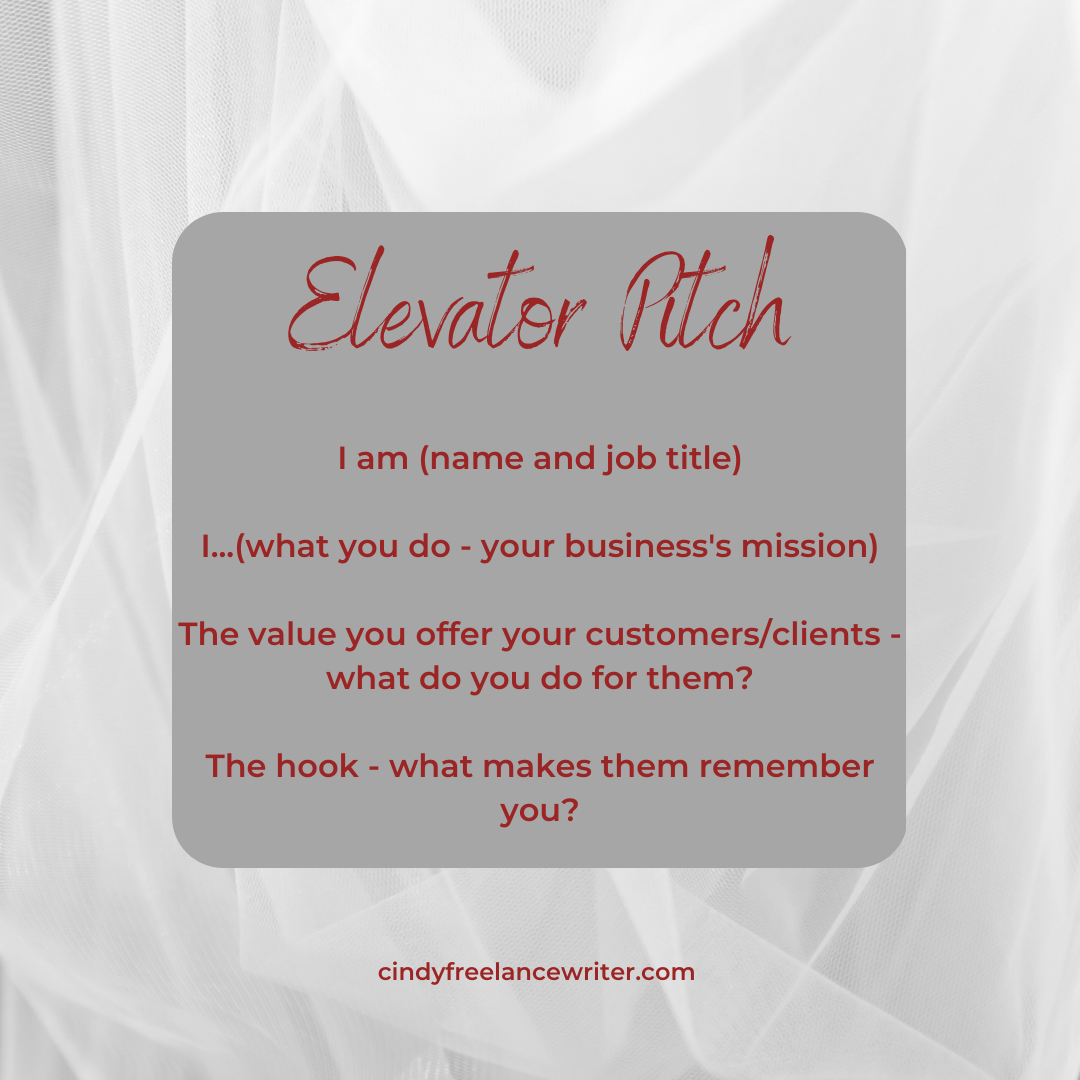
  1. Introduce yourself, ‘I’m Cindy and I’m a marketing coach and copywriter for small creative businesses.’ Don’t waffle, just say it how it is.
  2. Next, is your mission – a clear understanding of what you do. ‘I share how to create engaging content, understand marketing tactics and how to promote their business online.’
    Now you know who I am and what I do – very basically!
  3. Then, it’s about the value you offer – what makes your business stand out? What value do you offer your customers? ‘Through 1:1 coaching, we work closely together to understand their business and how it works. I teach them the tools and skills to manage their marketing themselves and support them through the whole process.’
  4. Finally, it’s the hook – what will make them remember you and want to know more? This could be a fascinating fact or statistic about your product or service to keep your listener engaged. ‘My clients tell me that after each session, they feel super motivated, feel they can get to grips with their marketing and are raring to go to put the things they’ve learnt into practice and watch their business grow.’
  5. Now, put it all together and read it through. It might need tweaking here and there. Time yourself, so you know it’s no more than 30 seconds, and you’re good to go.

“I’m Cindy and I’m a marketing coach and copywriter for small creative businesses. I share how to create engaging content, understand marketing tactics and how to promote their business online. Through 1:1 coaching, we work closely together to understand their business and how it works. I teach them the tools and skills to manage their marketing themselves and support them through the whole process. My clients tell me that after each session, they feel super motivated, feel they can get to grips with their marketing and are raring to go to put the things they’ve learnt into practice and watch their business grow.”  

I timed myself reading this and it was almost exactly 30 seconds!

How to use it.

You can use your pitch on your website, in the social media ‘about’ section, or even as a post to remind people of what you do. You can put it on flyers or promotional material. You could even use it at a job interview, if you adapted it for that purpose. That’s the good thing about a pitch – you can adapt it to different situation and scenarios. For example, if you wanted to use it to try and get more business or sell your products, you could add a call to action at the end of your statement, asking them if they’d be interested to hear more, or if they’d like a call at a later date.

You don’t have to learn your pitch, word for word, or it will sound stilted and rigid…it’s just designed to help you, so you’re clear and don’t stumble when you’re next asked, ‘And what do you do?’

I hope this has been helpful and if you would like help with marketing or content creation for your business, drop me a message at cindymobey@outlook.com

How polls on social media can help your business

Using a poll is great way to understand what your customer wants. The answers you get can give you an insight into what your customers think of you and your business; what kind of service they want; and it gives them a chance to share their perspectives with you. If your survey or poll is engaging, then your customers are more likely to participate and spread the word about you.

What is a poll?

A poll is a fun and interactive way to ask a question. Your followers must choose from a set of answers, you can choose that they can give one answer or several – it’s up to you. When they tap on the answer they want, they can see how the voting has progressed so far. Here’s an example:

Question – Marmite – love it or hate it?

Answer 1 – love it.

Answer 2 – hate it.

Answer 3 – I’ve never tried it!

What are the objectives of a poll?

Conducting a poll can just be for fun, to help you engage with your followers, as per the example above. Or, you can use a poll to gain information you’re your followers or target audience.

  • You might ask opinions on a new product idea you have.
  • If you’re a blogger, you could ask what subjects they might be interested in – giving a list to choose from.
  • You could get feedback on something – for example, your website or shop, such as, Is it easy to navigate? Can your customers find what they’re looking for? Is there any product they’d like to see you offer?
  • If you’re thinking of setting up an event, a poll is useful to find out what kind of event people like before you invest your time and money.  
  • You can use a poll to spark a conversation. Ask a fun question about your products or services. For example, if you sell cakes you could ask, ‘What do you think of putting vegetables into cake, such as Chocolate and Courgette cake?’ Then give some generic answers, and add an ‘other’ option. This could give you ideas for posts later that week – take it out of the poll and into a conversation or debate on your social media page.     

What are the benefits?

  • Polls give you instant answers, so it’s a really quick and easy way to gauge opinion on something. They’re good in that followers don’t have to think of an answer, they just have to tick a box – although you can choose to have an ‘other’ option where people can give their opinion.
  • It takes minimum effort from participants.
  • Polls stand out visually on your page.
  • It gives your page increased engagement and can help grow your customer base.
  • It helps you gain valuable feedback or market research for your business.
  • If you have an ‘other’ box with free text, you can ask for permission to quote someone’s reply, which leads to personal engagement with that person.
  • Polls can help you identify and solve issues or pain points for your customers.
  • It can help generate leads.
  • It can give you new ideas for your business or for products or services.
  • It helps you build your community.

I hope this has been useful and given you some food for thought about how polls might be able to help you and your business. If you do a poll with a purpose and not just for fun, don’t forget to do a follow up post, giving details of responses and any observations – and don’t forget to thank your followers for taking part.

If you need help with polls or any other forms of marketing, drop me a message or email me. I offer a free 30-minute discovery call.

How can I be more consistent?

I’m always seeing quotes or posts telling people in business to be consistent:

“To be successful, you have to be consistent” Unknown

“Consistency is the key. If you can’t be consistent, then you can’t be anything” Tony Gaskins

“If you want to be successful, you need consistency and if you don’t have it, you’ve got no chance.” Paul Merson

That’s great then, just be consistent and you’ll be a success, you’ll be able to do anything you like, and you’ll have a chance! But what does it mean to be consistent? How can you be consistent?

This week’s blog post takes this fabulous ‘buzz word’ that we see everywhere – and finds out about it in a bit more detail…

What is consistency?

The Cambridge Dictionary defines consistency as ‘the quality of always behaving or performing in a similar way, or of always happening in a similar way.’

That sounds straight forward, right? But to be consistent in business takes time and effort. To be consistent you must constantly replicate positive behaviour or performance every day, until it becomes second nature – until it becomes a habit.

How to be consistent?

Being consistent in business isn’t just about posting every day on social media, it’s the whole performance of your business. It’s about being organised and working on things that work best for you and your business.

Here are some ideas to get you started:

Use a planner

  • Use an online planner, a diary, or a notebook to plan your day. Write down the times of meetings
  • Keep a to-do list – things you MUST do today, and things that it would be good to do today. Work through them one task at a time. Multi-tasking can be distracting and time consuming, and very often, none of the tasks get completed.
  • Jot down any ideas that spring to mind during the day
  • Include time to eat and time to do something for you – it might be a short walk at lunchtime, or yoga or meditation time before you start work. Whatever you choose factor this into your day.
  • At the end of the day, write down the most important tasks that you must complete the following day. Put them in order of importance/urgency, so when you work through your list, you are doing the most important task first.
  • I have gotten into the habit of planning my content (roughly) a month in advance. I then know what blogs I will write and what posts I will want to do to compliment the blog.

Have a schedule

When you work for someone else, your day has structure, and you work to a schedule. If you get into the habit of doing this when you work from home, you will get more done and be more consistent.

Have a set time to work and a set time to have lunch or rest. And always try to have a cut off time, so you’re not working stupid hours into the evening or at weekends.

Many of us want to work from home for ourselves so that we get more work/life balance. Often you will find you have less of this, and more stress, so it’s important to keep to a routine that works for you.

Ensure your goals are SMART

When you are setting goals for your business, make sure that they are SMART.

SPECIFIC – MEASURABLE – ACHIEVEABLE – RELEVANT – TIMELY

You can find out more about this in one of my previous blogs – click here.

Focus on one thing at a time

I’ve mentioned this briefly already but try to focus on one task or goal at a time. Don’t make things harder for yourself by trying to do too much at once. If the goal you’re working on is too much or too overwhelming, cut it down into smaller, more manageable chunks and work on those, one at a time.

Get rid of distractions

When you’re trying to concentrate on one task, particularly if the task is really needed but a bit dull, it’s easy to be distracted. If you recognise that you are easily distracted, try to remove those distractions.

For me, email and social media are my biggest distractions. If I can see that someone has messaged me or that I’ve received an email, I can’t resist ‘just’ looking at it to make sure it’s not important. So, when I’m writing or working on something that needs a lot of concentration, I switch off my emails on my desktop (which is where I work) and put my phone/iPad on silent and put it away from where I’m working so I can’t see it…or I just switch them off. I also unplug my landline as I get too many cold calls and find them so irritating, they become a distraction.

Now I can concentrate as I won’t hear the ‘ping’ of a new message, nor will I see one.

Personally, I like silence when I’m writing or doing something that needs me to really concentrate, but when I’m doing the more regular stuff that I’m used to, or something that is almost second nature, I like to have music in the background. You may be different and may need noise to concentrate. Just do whatever works best for you.

Be comfortable

You might think that this is strange one if we’re talking about consistency, but if you’re hungry, thirsty, or uncomfortable, you won’t be able to concentrate on your work.

  • Choose a comfortable, light space to work in.
  • Eat at regular times so you’re not hungry.
  • Have a bottle of water handy, or your favourite drink, so you can just reach for it if you need it.

Automate when you can

I’m talking mainly about social media here…and for me, blog writing. I tend to batch create my posts (and those of my clients), for the following week. I usually do this towards the end of the week. It takes me a couple of hours to plan the following week’s messages and posts, decide what I’m going to post on what platform and what day, then create the posts.

Then I spend some time scheduling the posts, so I don’t have to worry too much about them during the week. I only schedule one a day, but sometimes I think of something else during the day and I’ll post that manually.

I do the same for blog writing – I tend to write a couple at a time, and I always have one in reserve in case something happens, and I need to post something quickly or change the blog post I’d planned.

Celebrate every win!

No matter how big or how small, celebrate those wins. Celebrating your achievements will make you feel good about yourself and your business and give you a well-earned boost. And shout about it – share those wins with your followers. Happiness and enthusiasm are contagious and you’re sure to brighten up someone’s day – as well as your own.

Along with this comes….

Forgive your failures

We’re all human and none of us is perfect. Being consistent isn’t easy and does require time and effort. If you fall off the wagon from time to time, don’t fret about it. You will get tired, you will sometimes feel like you can’t be bothered, but that’s OK. It’s normal to feel like this.

However, what WILL keep you consistent is recognising this, taking a deep breath, and getting back on track as quickly as possible. Forgive yourself and move on!

Conclusion

These are just some ideas to help you become more consistent and stay that way. Consistency breeds trust: people recognise that you are dependable and to some extent, predictable (in a good way!)

Above all, look after yourself. Make sure you eat and drink regularly – and take a break to get some fresh air every day.

If you need help with any aspect I’ve talked about in this post, feel free to message or email me. I offer a free 30-minute consultation.

Features vs Benefits of your products/services explained

When you think about marketing your product or service, most people think about marketing the features, as opposed to the benefits. But it’s the features that sell whatever you have for sale. This week’s blog post looks at features versus benefits, why both are important and how to market these things separately.

One of them looks at what your product or service does and includes everything that you’ve worked hard to develop and bring to market. The other looks at HOW your product or service will improve your audiences’ lives.

What is a feature?

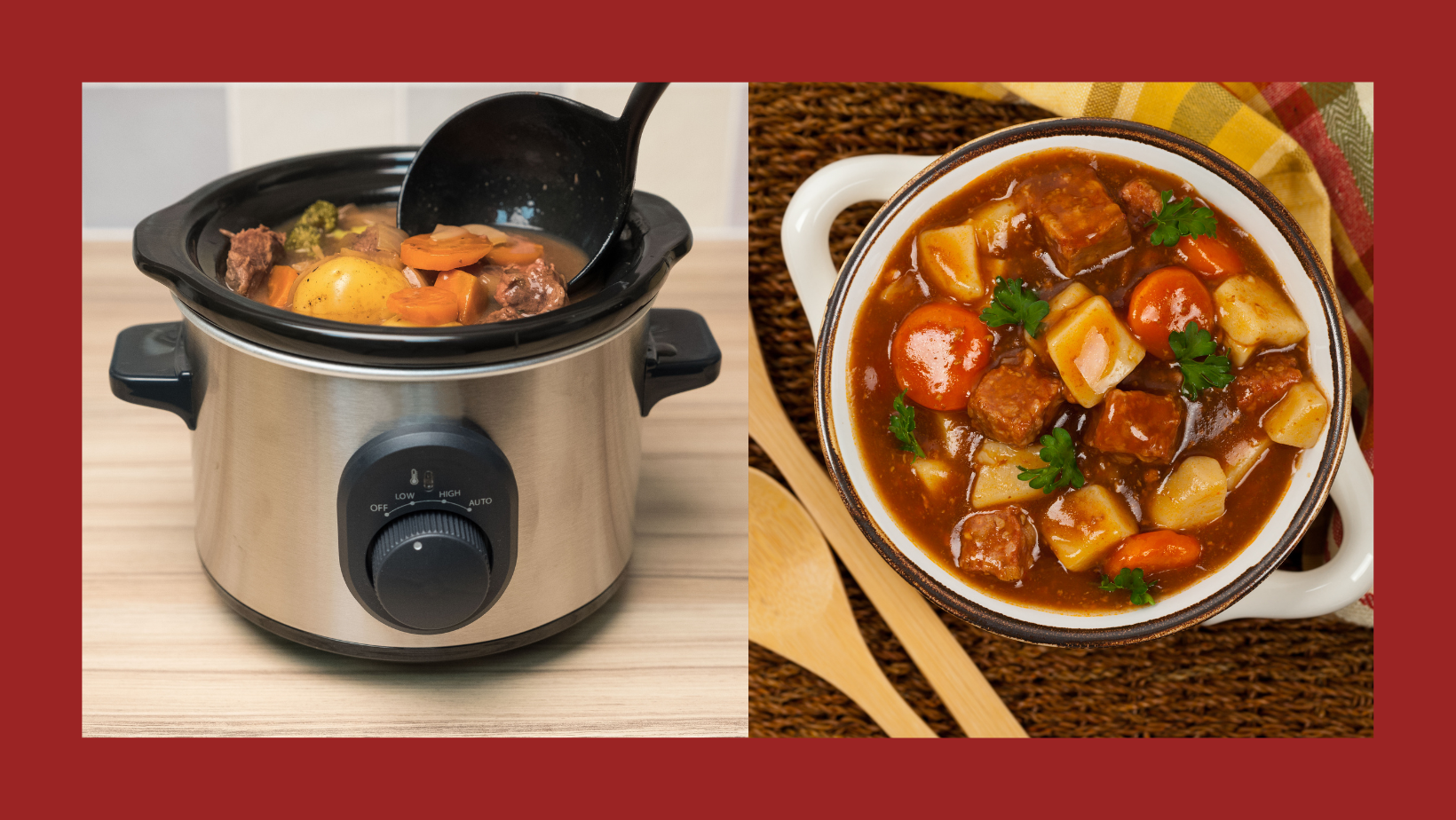
Let’s look at a very simple example…a slow cooker. So, you’ve decided you want to buy a slow cooker. The first thing you’ll look at is the features – this is the description that you will find about the product. For a slow cooker, this could be:

  • A choice of sizes and capacity to suit your family
  • Glass bowl or ceramic bowl
  • Oval or circular shape bowl? This will depend on what you want to cook in it.
  • Digital settings with a timer
  • What are the settings – usually low, medium, and high, but some only have low or high.
  • Easy to clean
  • Sturdy handle 
  • Versatile – can cook a huge range of foods

All these things describe what your slow cooker can do, what it looks like and how it works.

What is a benefit?

Again, let’s look at the slow cooker as an example. The benefits are the outcomes that slow cooker users will experience.

  • It saves you money
  • It saves time in the kitchen
  • Less preparation time – you can get it ready and leave it to do its thing
  • If you set it in the morning, you have a hot meal to come home to in the evening
  • Less clearing up, you only have one pot to wash, not several
  • Less chance of burning food
  • A slow cooker gives off less heat than a conventional oven, so not so hot in the kitchen
  • As food cooks slowly, meat falls off the bone and the food has more time to infuse with herbs and spices, so can be tastier
  • Ideal for the busy person who doesn’t have time to spend hours preparing and cooking in the evening
  • If there are several of you in your household, you don’t have to all eat at once – you can leave it on low and people can eat when they want to
  • It’s not just for soups and stews – you can cook a variety of dishes – even bake bread or make jacket potatoes, cook cakes, and even rice pudding!

Marketing your features and benefits

When you set out the features and benefits of a product or service, as I did with the slow cooker, it seems obvious, but it can take ages to think about this when you have your own product or service you want to sell.

Marketing is hard; just because you know why your product or service will make your ideal customer’s life better, doesn’t mean that they will. You need to carefully examine what your features are and what your benefits are.

Let’s face it, when we’re trawling the internet looking for that special something we want to buy, we don’t care about the business, how long it took to make or produce; we don’t necessarily think about the person behind the business who must make the trip to the post office to post the item. All consumers really care about is what’s in it for them? Why should they buy your product or service compared to others on the market?

When you are pulling together your marketing strategy for your business, its products, or services, you need to keep in mind ‘what’s in it for your customer?’ This should be the question you continually ask yourself.

Try using a feature/benefit matrix

A feature/benefit matrix is a great way to address these things and make you think seriously about each of the features your product or service has – then produce three things that are benefits of that feature.

Once you have these set up, you can think about the messaging you will use to illustrate those features and benefits to your target audience. And what call to action you will use to help you get your message across.

FeatureBenefit 1Benefit 2Benefit 3MessageCall to action
Feature 1       
Feature 2       
Feature 3       
Feature 4       

Below is a couple of examples using this matrix for our slow cooker.

Feature  Benefit 1Benefit 2Benefit 3MessageCall to action
Digital timerYou and your family can eat when they want toYour meal will be ready when you get home from workSaves time on preparation and cleaning upGreat for busy households. You never have to worry about making sure all your family are home at the same time ‘or their meal will be cold or burnt’Buy now – check out our different slow cookers
Easy to cleanFood doesn’t burnDishwasher safeDigital touchpad easier to clean than knobsSaves you time and effort. Just one pot to clean, not loads of washing up.Buy now – link to website
VersatileCook soups and stewsBake cakes and dessertsBake breadAll in one option. It’s not just for soups and stews. You can make cakes and desserts, perfect for entertaining.Download your eBook with over 100 recipe ideas

You get the idea! There are lots of phrases I’ve heard that illustrate that from a selling perspective, it’s best to focus on benefits:

  • Features tell and benefits sell
  • Sell the sizzle, not the steak

This really tells you it all. Whilst the features tell people about the product or service itself, the benefits are what people are really interested in – the ‘what’s in it for me’ part.

Whilst the steak is important, it’s the sizzle that will sell – what it smells like, tastes like – evoking that emotion in the buyer to entice them to buy. It’s the description of what it’s like to eat the steak that will sell it – not just the picture of a steak on a plate.

Conclusion

I hope this has helped you to distinguish between the features and benefits of your products/services. Now it’s your turn! Take one of your products or services and think about the features – then make a list of the benefits that feature brings to your ideal audience – and use that in your marketing to sell your item.

If you need help with your marketing strategy, and how to best sell your products or services, using the feature/benefit matrix, or just don’t know where to start with your messaging, give me a shout. I can help you see things clearer, so you can focus on your target audiences’ what’s in it for me question.

Email me at cindymobey@outlook.com

Take your marketing from mediocre to marvellous

The one thing that most small business owners have in common is the dream about what their business has the potential to grow into. They want it to be a success and know they can do it if they work hard.

However, sometimes it’s hard to focus on what is important and you sometimes lose the focus on the future and how to keep moving forward. How many times do you find yourself wondering if it’s all worthwhile? How often do you feel like just jacking it all in and doing something else?

You know that in this digital age, especially since Covid raised its ugly head and everyone had to find more innovative ways to reach their customers, that having quality content online that engages your audience is crucial. But that really is only half the picture. You also need to ensure your audience is exposed to this content, and that means building a successful content strategy beyond social media posts.

This week’s blog looks at how you can work ON your business, NOT IN your business, and take it from mediocre to marvellous.

Resolve your mediocre marketing

Mediocre is quite a depressing place to be in marketing. Lots of businesses pay more attention to how they look than what they’re saying, or how they’re saying it. I’m not saying everyone does this, of course, but instead of focusing on what makes us unique, we are all guilty at some time or other of saying what people expect us to say or do.

So, what can you do to resolve your mediocre marketing?

All small businesses have lots of balls in the air. Not only do lots of you have a family to look after, but you also have everyday things to keep on top of too. Some of you are running your small business as a side hustle, as well as holding down a full-time job, and you can find yourself being pulled in all directions. This can lead to a mindset of ‘hoping for the best,’ which in turn can lead to you being unproductive – and it’s exhausting!

One of the answers is to work smarter instead of harder. Here are some things to think about:

Have a plan

If you read my blog regularly, you will know what I’m going to say; you need a marketing plan.

At this point, you might just switch off. Is it because you find the thought of having to plan a bit overwhelming? It’s probably the last thing you want to hear…again!

But not having a marketing plan makes your job harder and juggling all the harder to handle.

If you have a marketing plan, you can focus on the things that are necessary. In ‘The Trend Report: Marketing Strategy 2022, reported by CoSchedule, it was found that people who have a plan to market their business are 313% more likely to report success than those who don’t.

And, although it may seem very overwhelming, it really isn’t.

What should a marketing plan contain?

For starters, it doesn’t have to be 100 pages long – that won’t help you at all. It needs to be clear and short, realistic, and repeatable, as well as easy to understand so you can tweak it as you see fit in future months.

It needs to show:

  • Your Vision/Mission statement
  • The four Ps – products, pricing, place (where you’re going to sell what you do), and promotion (how you’re going to sell your products or services).
  • Market analysis – look at your competitors
  • Target market – who you are aiming your products/services at
  • Your goals or objectives
  • Your promotion strategies
  • What budget you have if any
  • How you’re going to measure the success of your plan

If you would like a simple to follow marketing plan, sign up to my email and receive your free ‘Marketing your small business workbook.’ This will help you get on the right track.

Don’t try to do too much

Trying to do too much can also cause you to do less. For example, I know businesses that are on five or six social media channels. It’s good if you have the time to manage them all, but my experience is that you’re likely to lose your motivation and abandon them one by one.

Trying to be seen everywhere is not easy to maintain long term, especially if your business is just you. So, I would always advise to focus on just a couple of social media, or online channels and do them well.

Be consistent, add plenty of value to your customers and have a goal – what you expect to achieve from your social media activity.

One of those online channels doesn’t have to be social media – it could be email marketing. To build a lucrative email list, it’s advised to have a lead magnet that entices people into subscribing to your email. I realise that email isn’t for everyone, but if your business is steadily growing, you engage with your audience regularly online, (and may be finding this is taking up too much of your time), the next option is to create an email subscription, where you can talk directly to your customers every week or month.  


Not everyone is your audience

I know I’ve posted about this recently on my social media pages, but one mistake that lots of small businesses make is to try to sell to everyone. Not everyone is your target audience, and by trying to target everyone, you risk selling to no one.

You need to know your audience, build a couple of buyer personas and tailor everything to them.

Don’t spend too much money

The word ‘budget’ is something guaranteed to send fear into most small businesses hearts. It’s not one of our favourite words, but it is important. Having a budget, no matter how small, can help your business.

There are so many digital marketing apps it is all too easy to keep subscribing to new apps. But while they might be individually cheap, they add up.

Look very carefully at what you spend your money on. Do you spend a lot on app or analytics tools? I do subscribe to Canva, and it’s worth every penny as I use it every day, but I have recently stopped subscribing to a few, as they were just a waste of money.

It is worth spending money on things you will use and will help you make your business more successful.

Here are a few ideas on what you can spend your marketing budget on:

  • A website (some people prefer to spend on things like Etsy or Shopify rather than a website as lots of the marketing can be done for you, but I feel it’s better to have your own website with built-in e-commerce, as you own it yourself
  • A registered domain
  • Training – so you learn more about things associated with your business
  • Paid ads – this needs very careful consideration to get the right kind of ad
  • If you are service based, you might want to invest in scheduling and measurement tools
  • Hire some professional help, such as a marketing coach, someone to help you with your business/marketing/social media strategy, or someone who can build your website, write blog posts, or set up your email marketing.

Don’t forget about your existing customers

Did you know that your existing customers are your biggest sales opportunity? Happy customers are loyal customers and are five times more likely to buy from again, and four times more likely to act as referrals.

Looking after your existing customers is worth the effort as losing customers who are no longer engaged or hear from you, are more costly. It’s harder to find new customers than it is to keep existing ones.

Keep your customers engaged with your business by offering them gifts, or discounts, listen to their feedback and act on it, or maybe think about creating some sort of loyalty programme.

Stay up to date with technology

This is a hard one, but most of what you do as a small business will be routine. There will be some daily tasks that need to be done to keep your business running smoothly. The more effective you become in completing these tasks, the more time you must work more on your business. For example, instead of physically posting on social media every day, batch make your content for the week and schedule it. You then only have to do this once a week.

Keeping up with the latest tools you can use to help you can ultimately save you time and money.

Mix up your marketing activity

Check out your insights on social media to find out what kind of posts work best for you and what doesn’t. Change the type of posts you do, try, and include things like reels and video, as well as short and long posts. Post your blog articles, and remember to use posts that entertain, educate, engage, and inspire your target audience, as well as selling posts.

Take a step back

In this article, I’m not telling you what to do, but what I am trying to encourage is to take a step back and look at the bigger picture. It gives you time to assess what works and what doesn’t work for you.

It’s very easy to fall into the trap of doing the same things, just because that’s the way you’ve always done it, or because that’s what everyone else does. But in business, time is precious and it’s good to remember to:

  • Create a clear marketing plan so you can focus on essential activities
  • Only concentrate on the social media platform that you love and that you enjoy
  • Sell to a targeted audience rather than trying to sell to everyone
  • Make your budget work for you in the most efficient way
  • Make your existing customers your priority. They will be the ones to buy more, give reviews, and are more likely to refer you to their friends and family

This is basically what a marketing strategy is all about and will help your business go from mediocre to marvellous! If you need help in pulling together your strategy, please feel free to take advantage of my free 30-minute discovery call, where I can give you some tips to help your business

The Art of Persuasion

What is the art of persuasion? It is the ability to get others to see things as you see them, and it’s a key need for businesses of any size. From encouraging your customers to buy your products or services, to showing how your products or services are NEEDED by your target audience, the power of persuasion is key. And this is where marketing your business comes in.

I’ve recently read an article about Dr. Robert B. Cialdini, who wrote a book called ‘Influence: The Psychology of Persuasion’ in 1984. This feels like a long time ago now, but the ideas and principles he talks about in his book are even more relevant today, from a business perspective, than they were back then. In fact, the book and its principles has been hailed as crucial to marketing, especially around the area of converting people to customers. So, I thought I’d investigate this further, as I’d never heard of him.

Cialdini’s ‘6 principles of influence’ are:

  • Reciprocity
  • Commitment/consistency
  • Social proof
  • Authority
  • Liking
  • Scarcity

Do some of these sound familiar? Social media wasn’t a ‘thing’ back then, but we all know the term ‘social proof’ these days from our dealings with social media.

More than 30 years after publication, these six principles have been adapted to Internet Marketing, specifically around conversion rates. So, let’s dive in!

Reciprocity

This is about giving something to get a little something in return. According to Cialdini, this first principle of persuasion states that human beings are wired to return favours and pay back debts – to treat others as they’ve treated us. For example, if someone sends us a Christmas or Birthday card, we feel that we have to reciprocate – it’s almost a sense of social obligation.

But it is possible to use the desire to reciprocate to influence the behaviour of others. To do this, you need to give someone an unexpected gift – the value of the gift is unimportant, it’s about the act of giving. So, how does this work in business?

I’m not suggesting that you give all your customers a gift and expect something in return, it’s about the principle. For example, you have an email that you want people to sign up to – if you offer an incentive, some sort of gift or freebie, this will encourage them to sign up. If you write a regular blog and give really valuable information to your audience, when you put a call to action at the end asking them to sign up to your email, they are more likely to do so as they enjoy your blog and would like to hear from your more regularly.

Similarly, if you share consistent, regular, useful content, then when you launch a specific course, publish a book, or talk about your coaching, people are more likely to sign up.

Commitment

This is around people wanting their beliefs to be consistent with their values. For example, if someone thinks of themselves as a healthy, fit person, they are more likely to eat and do things that would be deemed as healthy.

So, from a business point of view, if you can convince potential customers to act a certain way, or think a certain way, they’ll be more likely to do that again in the future. For example, if you take cake into work for your co-workers and get a huge, positive response telling you how delicious it is, you’re likely to do that again – and eventually become known as the ‘cake baker.’

You can do this with business. I’ll use the email example again. If someone signs up to your email newsletter to get the freebie that you are offering, they will receive your weekly or monthly emails. Once they have signed up, they’ll likely start seeing themselves as customers and will eventually convert to a customer. All I would say about this is that it’s very important you don’t take advantage of them and manipulate the situation.

Consensus – Social Proof

This is evident on social media. It’s about feeling validated based on what other people are doing. We are all basically unsure of ourselves and identify with the people around us. If you work in an office and your co-workers offer to stay late to help with something urgent, it’s very likely that you’ll do the same.

If you see a restaurant advertised by a photo of their food photographed by one of your friends, with a caption saying how lovely it was – it’s extremely likely that you’ll want to try it too.

We humans are social by nature and generally feel the need to conform to the groups we belong to. This can also be used in business.

Here’s a great example. Hotel guests have the right to clean towels every day, but the cost of laundering is huge, so hotel owners would prefer it if their guests reused their towels. It has been found that a simple sign that says, ‘8 out of 10 hotel guests choose to reuse their towels’ is more effective and persuasive than a sign that says, ‘Reusing your towels helps the environment.’.

Authority

Generally speaking, it’s the tendency of humans to obey figures of authority – even if they’re not right. If someone wears a uniform, it’s even more likely we’ll accept what that person says – for example, police officer, Dr, nurse.

That’s why a lot of big brands bring in celebrities to advertise their products or services. Celebrities are influencers – they have an influence on the fans that follow them. And you’ll see toothpaste advertised by someone in a white coat pretending to be a dentist – but we don’t challenge that, we just accept it.

People who are authoritative, credible, and knowledgeable experts in their particular field are more influential and persuasive than those who are not. Cialdini recognised that the reason for this is that authority and credibility are some of the core building blocks of trust, so when we trust people we are more likely to follow them.

From a business perspective, building trust and credibility with your customers is crucial, but it’s also possible to build some of that authority and credibility through the recommendations of your satisfied customers. So, always a good idea to ask for a recommendation or review. And if you give them a recommendation, it’s very likely they’ll reciprocate and recommend you!

Do you see how that works?!

Liking

Does it really matter if you like someone or not? According to Cialdini, it affects the chances of you being influenced by that individual. It’s human nature that we’ll be much more likely to like people who pay us compliments, or like those who have similar interests to us.

This is something that marketing campaigns definitely take advantage of. The people they use in their ads are specifically chosen to appeal to their target market. The more the potential customer identifies with and likes the person, the more likely they are to be influenced by them.

To make this work in business, you simply need to be liked by those around you…networking helps with this, and we do it without even thinking about it. We see small businesses that we like and automatically pay compliments and start building relationships. But this does take time, you need to nurture and build those relationships before you can try to influence anyone.

I think out of all six powers of persuasion, this was the one that, once analysed, I was most surprised by! This is something most of us do in normal everyday lives.

Scarcity

Scarcity is about believing something is in short supply…so you want it more.

We’ve probably all been taken in by this one at some time or other. It’s that FOMO thing (fear of missing out). We’re more likely to buy something if we’re told it’s the ‘last one available’ or if a special deal is about to end soon.

Companies use this all the time. I’ve seen it most recently on a popular airline site. I was persuaded to buy my seat now, as the prices are likely to go up later – a kind of ‘lock into this price now’! It’s a great marketing ploy!

However, I would avoid doing this if it’s fake. Customers will see through you if you’re offering limited supplies or expiring discounts if you do this often.

Conclusion

These six principles that illustrate the art of persuasion can help us with small, practical, and even cost-free changes that can lead to big differences in our ability to influence and persuade others in an ethical way – so long as they are not abused!

How to market an online course

If you’re planning to create an online course, or even if you’ve already created your online course, you will need to have a robust marketing strategy in place to help you promote it to your target audience.

Before you create your online course

The first strategy really comes into play before you create your course. It’s important to know who you are aiming it at (your target market). So, how do you know this? Think about your ideal client and create a buyer persona.

So, you know who they are and what they do, how old they are, what motivates them and what interests do they have?

Create as many as you need as there may be different types of customers that you have in mind for your course.  

You can refer to these buyer personas when you’re creating your marketing content – it helps to know who your ideal client is, so you can tailor your content specifically to them.

What is your USP (unique selling point)?

Go into Google and look at courses that currently exist, that are based around the subject matter that you want to cover in your course. Make notes of what is included in those courses and how they are presented. Is there anything that they’ve missed? Are there any aspects that they’ve included that you wouldn’t?

Is there anything in the courses of your competitors that you think you could cover better or add more value to? Can you add in extra topics that your competitor doesn’t cover?

Putting a course out there means giving loads of value to the people that sign up. They want it to be jam packed with value, so they know that they’re not wasting their time and money.

Doing this kind of research will lead you to your USP…what is your USP? What is it that you do different to your competitors? What is the one thing that makes your business better than your competitors?

Once you know what that is, you can add it to your marketing messages. And the good thing is that when someone asks you what makes your course so special – or different to XXXX’s course, you have the answer!

Get information up front

Before you start making your course, you need to know if it is something that your audience want! It might be something you want to create, or something you think people will want. But, until you ask them, you don’t really know!

The best way to find this out is to ask! If you have an email list, or an audience on your blog, you can ask them what they’d be interested in learning about – you could send a survey to your email list. You can also ask people on your social media sites, or in the networking groups you belong to. Then create your course around what they want – not what you think they want.

Get to work

Once you know who your audience are and what they want, you can create your course. There’s just a little bit more research to do – what keywords or phrases will people type in to look for your course? You can research similar courses to yours, or you can use a keyword tool to look at the most popular keywords related to your subject. Then you can include those keywords in your title.

Once you are armed with all this information, it’s time to think about preselling your course. You need to treat your online course like a product launch…because basically that’s what it is.

Coming soon!

You want to try and create a buzz around your course, and one way is to create a ‘coming soon’ page. If you treat it the same way that you would treat a new product, you can’t go far wrong by building excitement and a buzz around the launch. You could just do a ‘coming soon’ page on your website, without giving away too much information…just the basic information! Then say that more details will be posted soon.

You can also use your social media pages to start some teaser information about your course. Don’t just talk about yourself and the course though – make sure that you give some valuable information to get your audience’s interest. For example, you could give away a checklist or cheat sheet that is linked to the information in your course.

You could set up a ‘sign up to show your interest’ page, either on your website, or on a hosting site, such as Mailerlite. When someone signs up to show interest, they get your freebie and an email that tells them a little bit more about the course. Then you have their email and can send them more details about the course as they become available.

If you run your own Facebook group, you can promote it there too.

You might send links to interesting articles you’ve found online about similar subjects to yours – you don’t have to just use your own content.

Start a podcast

You could start a podcast to highlight your expertise in your subject and talk about things related to your course material. Podcasts are great for interviews, so if you have done a course before, or have been running a pilot course with a targeted group of people, you could interview one of them to ask what they got from it.

If you do a podcast though, in the same way with anything that you give away, make sure that you don’t use the same information/subject matter that you’ll be using in your course, as they won’t be happy if your online course that they pay for, is the same content as the stuff you’ve been giving away for free!

Connect with your audience via an online webinar

In the same way as you can create a podcast, you can also run regular webinars…or even a one-off online webinar. You can pre-record these and cover some of the things you know that your audience struggles with – and give a solution to some of their pain points. Again, make the subject matter different to the course content you’re creating.

Running these kind of presentations gives your audience an idea of what you’re like to work with. You’ll no doubt get questions, which may give you ideas to include in your online course. It will also give you feedback, which you can use to show the value you give your audience. This all helps give credibility to your business.

Into the launch phase!

Now you’ve done the ‘coming soon’ stuff, which may have gone on for a couple of months or more, now is the time to promote the course date and more details.

You can still use all the things you used pre-launch, such as podcast, social media, your blog, or email newsletter, or even a webinar. Now is the time to ramp up the communications.

Paid Ads

Paid Ads can be an effective way to advertise your online course. Even a simple Facebook post boost can help with this kind of content. You can target them to a specific audience, they don’t have to cost a lot and you can track their success. I can’t specifically say, with hand on heart, that paid Ads are worth it or that they work, as I have never felt the need to use them myself. But it is something I will try when I do decide to create my own online course.

You just have to make sure that you factor in the cost of these Ads, as they can be quite expensive. Just make sure that whichever platform you use for Ads, that it is a platform that your target audience uses.

Team up with others

Another good way to get your course out there is to team up or buddy up with other businesses…preferably not businesses who do the same as you, but those that you know and like – you need to like or be interested in the kind of things your buddy posts in order for this to be successful – otherwise it’s just the same as doing like for like, or follow for follow, which really doesn’t work.

So, ask people who you regularly interact with and agree to like, comment on, and share their posts or stories, as well as doing shout outs to each other.

This helps you, but could also lead to partnerships in the future, especially if the business you partner up with does something that complements your business. They may even be able to be a guest speaker on your course, or be an interviewee on your podcast, blog, or webinar. The possibilities with partnerships is endless.

Teaser Mini Course

Earlier I talked about a teaser on social media for preselling. Another idea would be to create a mini teaser course, just a few weeks before your main course goes live.

This is a free short course that gives people a taste of what you do and the value you give. At the end of the teaser mini course, you can give the option to sign up to your paid course, where they can find out much more and get even more value from you.

The other thing about creating a mini course, is that the audience that sign up will realise how little they actually know about your niche and will be wanting to know more.

Offer a discount

You can also use a discount offer to entice people to sign up. For example, the first three people to sign up get 50% off – or whatever figure you decide to go for.

Create a sales page

You’ve done your ‘coming soon’ page; now it’s time to create your course sales page or landing page. A landing page is a page on your website, or on a hosting site like Mailerlite, that is dedicated to purely selling your online course. This is where you can go to town with advertising what, specifically your course will cover.

Talk about the benefits of the course – what’s in it for your audience? What problems does your course solve? What will your audience go away knowing that they didn’t know before? How will it help them or their business in future?

Include testimonials from those who did your mini course or those who have listened to your podcast, read your blogs, or have commented on your newsletter. You may have feedback from the survey you sent out that you can use. Just remember to always ask permission from the person who gave the feedback if you’re going to use it to advertise your course.

Make sure that the content of your course is really clear, so your audience know exactly what they’re signing up for.

And, don’t forget to include a CTA (call to action), such as a button saying, ‘YES, SIGN ME UP NOW!’ Always make it short and snappy and make it sound urgent, like you mustn’t wait to sign up – do it now!

Passive Income

Courses

Your online course may be a course where you are very hands-on and run individual sessions over a period of weeks or months. However, if you record a course with individual modules, you can put it on an online hosting channel, such as Udemy, which is an online learning platform (a marketplace to sell and buy courses online). You make money on this platform by uploading your course and selling it. It’s a free service for those uploading courses and can help you achieve passive income. It won’t make you millions, but it will help give you credibility and the possibility of a regular passive income.

Students on Udemy generally take courses to improve their job-related skills. I have used it several times for course on various social media channels to help me understand them better. The good thing is that you can upload a course on any subject you can think of. I’ve seen everything from cupcake decorating, to car maintenance, interior design to computer skills. There’s something for everyone and courses start from around £15. I’ve even got courses free of charge and have had some great deals during January sales.

eBooks

As well as making passive income from your online course, you could also write a related eBook and sell it on your website, or even upload it to Amazon or a similar book selling site.

Conclusion

Now it’s time for you to get started! Do your research, do a presale ‘coming soon’ campaign, choose the best strategy for you and just do it!

Let me know if you found this post useful and, as always, if you have any questions, please feel free to contact me.