Why a website is important for small businesses!

Why do I need a website?

Ever since lockdown, people are being pushed to shop local and support small businesses – and quite right too! This is possible because of the internet. Small businesses are increasingly on social media, or have online shops, but the problem is that, as a small business, you don’t own those online sites, so if for any reason your business was banned and your social media site taken down – or if an online shop site had a problem with their servers, you wouldn’t be able to do anything about it. But if you have your own website, you own it and you run it how you like.

A website:

  • gives you the opportunity to have an online shopfront and reach customers outside of your local area and it’s a great way to grow your business.
  • Could be the first impression potential customers get about your business and all you do or sell.
  • Can be found on google and other search engines, so having your own website makes you easier to find.
  • Gives your business credibility and gives you an edge over similar businesses that don’t have a website. It also helps you compete against other businesses in your niche.
  • Means you have your own domain name so you can be more easily found online.
  • Is your online catalogue or brochure, telling the world all about you and what you have to offer.     

If I want to find out how to do something or where to buy something, the first thing I do is look online. Most transactions these days take place online and therefore some of the traditional marketing techniques have been replaced with online strategies. However, a surprising number of small businesses do not have a website.

Mind boggling stats!

According to Statista, out of the nearly 8 billion people in the world, 5.35 billion of them, (around 66%) have access to the internet.

And, on average, internet users spend six and a half hours online every day.

Every second, more than 20 million people are looking on the internet, on their mobile devices or PCs, buying everything you can think of….from books to houses, from kitchen gadgets to garden tools. If you, as a business owner don’t have a website, you are missing a trick as your business won’t be found, so you are missing out on potential sales.

There is a cost involved, but it can be cheaper if you do it yourself – there are so many easy-to-follow website hosting companies that are fairly easy to set up. I paid a web designer to do mine as I didn’t have time and prefer to have someone keeping any eye on it, as well as having someone who knows what they’re doing when there’s a problem, or I want some quick updates done. I just find it gives me peace of mind!   

I know that many small crafting businesses use online shops to promote their business, and it works very well for them. Again, there are costs for this service, and at the end of the day, you don’t own your shop, so don’t have any control over it, but I understand why some find this a better option. Your online shop is still open for business 24/7, unless they have any glitches.

Promote your business 24/7!

As the title suggests, having an online presence means that your business is ‘open’ 24 hours a day, 7 days a week….even when you are asleep. Information about your business, your services, what you sell, are there at your customers’ and potential customers’ fingertips. People are always looking online – they research products before they buy and if you have an online presence, and you happen to sell what they want, you could make a sale. If you don’t have a website, you can be almost invisible in searches on search engines…and in this day and age, you can’t afford to be.

Building reputation and credibility

A website gives you the chance to highlight your abilities, your products, and services for the world to see – they can see the quality and price, and if you have an online shop, they can buy directly from you. If you don’t have a website, your potential customers will go to a competitor.

Through your website, you can be seen as an expert in your field, and through the recommendations and comments from satisfied customers, you can be seen to be reliable, trustworthy and that your products are top notch.

When you give out your business card, it will tell potential customers a little about your business. If you’ve given them your card because they’ve seen your stall at a local market, they will assume that they can log onto your website when they get home and see more of your products. Imagine their disappointment if they get home to find no website details…and of course, this will lose potential sales.

Again, you may give a link to your online shop, but it doesn’t give as much information as a website can – and you can’t have a linked email sign up, which helps you promote your products and services even more.

First impression

Not only does having a website make you more credible, but it also shows that your business is established and that you are experienced at what you do. Even if your competitors are stronger than you, a well-built, mobile friendly website can entice customers to choose you instead. You might operate your business from the tiniest desk space in the corner of your dining room, or make your products in your tiny spare bedroom, but when you have a website, your customers don’t see this. All they see is the power of your brand – size doesn’t matter!

Advertise your business

Your website is your ultimate advertising tool. For a relatively small investment in the cost of setting up your website, you can reach millions of people. It is that one brochure that the whole world has access to – no printing and re-printing when you have new products – you just add them online at the click of a button. You can include tons more information and images than you could afford to put into a brochure.

Of course, there is a place in business for brochures and flyers and advertising in local magazines or newspapers, but your online presence is always available, not just for the limited time that you can afford, or until your product set changes. It’s a fantastic marketing tool that is constantly relevant and up to date.

Save you time

Your website can tell people who you are, where you are and what you do. Without a website, you may spend endless wasted time on the telephone or email giving people directions to where you are, giving details of the products you sell or the services you offer. Your website gives all these details in one, easy to access space, available 24/7. Not only does it give these basic details, but it also gives more detailed information about your products. Then, when people do contact you, it’s generally about something more specific or to buy from you or use your services.

Reach a wider audience

Advertising in your local paper, putting out your business cards and attending markets, conventions, and networking events, are all brilliant ways of getting your products and brand out to a wider audience. However, with a website you literally have a worldwide audience. Business often comes from word of mouth, and this is a great way to get local business, but in order to expand and reach customers that don’t know you, the internet is the way forward.

Beat your competition

If you have a business, you only have to look on Facebook or on the internet to know that you have hundreds of competitors who do the same as you. If your competitors have a website, then why shouldn’t you have one? The joy of having a website is that it doesn’t matter how big or how small your business is, it will help you reach more people and increase your sales. Through your website, you can gather information about your customers. You can use your website to host an online survey to find out what your customers want, and online forms can be used to easily contact you to request a quote or ask for further information. When you know what your customers want, you can develop products or services to solve their problems or meet their needs.

Customer Service

Your customers are the most important part of your business. You can improve the service you give them by including FAQs and a Contact Us page. Customers can not only leave comments and recommendations, but they can also ask questions. You can collect your customers email addresses, and with their permission, can send them regular updates about new products. This makes them feel valued and valued customers will come back to you time after time.

I hope that I have helped you to see the benefits of having a website. You may have thought that a website is a waste of money, but it is the exact opposite. You may have to invest a little to get your website written and built professionally, but you will soon get your investment back when new customers find you and start buying from you.

If you’d like to have a look at my website, click on the link below, and as always if you have any questions, don’t hesitate to contact me.

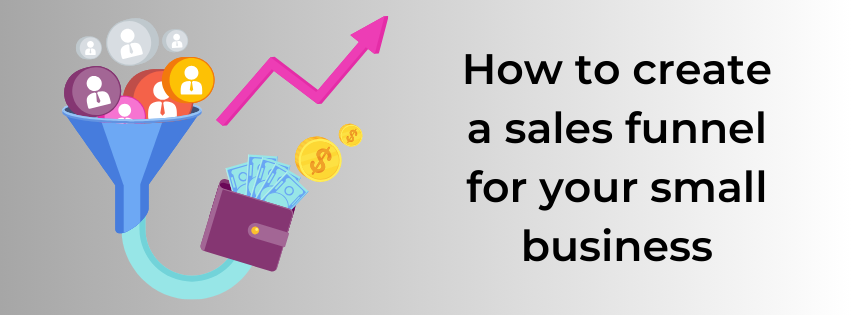
How to create a sales funnel for your small business

There is so much to do when you have your own small business and the most difficult thing that my followers tell me about is how hard it is to get sales. There is no ‘one size fits all’ answer, but a sales funnel is a way that can help push your potential customers in the right direction.

A sales funnel gives you a structure to encourage your potential customers through, on a journey which is designed to turn them into happy customers. There are lots of ways to do this, but I’m going to explain in this post how to create a simple, but effective funnel that anyone can use.

What is a sales funnel? 🥴

A sales funnel is simply a pathway you want your potential customers to take on their way to loving your products or services enough to buy them. It’s about moving them from first finding your business, to them taking their first action.

It’s called a funnel because, like a funnel, the number of potential customers will decrease as they move through each stage, so you’re left with the ones that want to buy from you.

Before you think about your funnel, you need to think about two specific questions:

  1. What is the most important problem that your products or services solve for your customers?
  2. What is the first step you want potential customers to take?

No matter what you do, you will solve a problem for your customers:

🍔 You’re a restaurant – your customers are hungry – you provide the solution.

🧵 You make greetings cards – your customers want a card for a specific occasion – you provide the solution.

💻 You provide a marketing coaching service – your customers need help and guidance on how to market their business – you provide the solution.

🎄 You have a crafting business and make Christmas items – your customers need to decorate their house/tree/cake for Christmas – you provide the solution.

I could go on, but I’m sure you see where I’m coming from.

What is the first step you want potential customers to take? You may want them to go to your website, browse your online shop, engage with your social media posts, read your blog posts, or subscribe to your newsletter. All these things contribute to you getting to know potential customers and leading them on their journey.

The four stages of the Sales Funnel

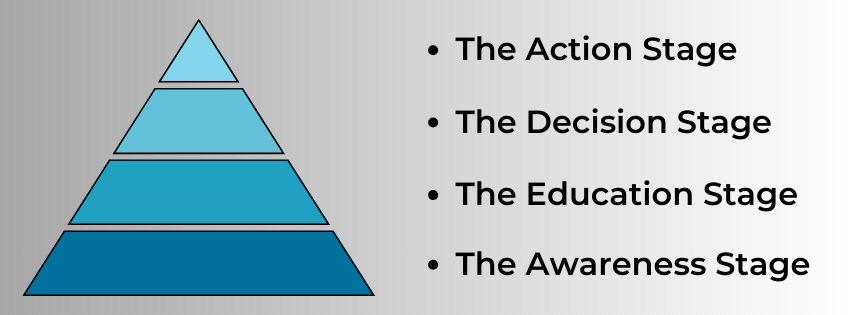
There are four different stages in the sales funnel:

  • The Awareness stage – where you are focusing on attracting potential customers. This is about promoting your business – putting out good content on social media sites, where you can highlight your expertise in what you do – be it creating products or offering a service. 
  • The Education stage – this is where you capture leads and really build relationships with those potential customers, by demonstrating how you solve their problems. This is where you want them to see that you are an expert in your field. Whether you:
    – write ‘how to’ articles to help your audience.
    – take the most beautiful photos that mesmerise your audience (and sell them on canvas, on mugs, on cards, magnets etc).
    – video yourself creating your product so your audience can see the exact process you go through.
    Through these things, you’ll show your potential customers that you are an expert at what you do, you know what you’re talking about and that your products or services can help them.   
  • The Decision stage – this is sometimes also called the engagement stage because this stage is where you truly engage your audience to take one action. If your sales funnel is working, your audience will take one small step closer to a sale. That one little ‘yes’ can bring you closer, but you must lead them there. This is where a call to action often comes in. You TELL them what you want them to do next. That could be:
    – sign up to your newsletter.
    – read another of your blog posts.
    – watch a video
    – contact you
    – go to your online shop or website
    – follow you on SM – giving them details of all your socials
    Once they say ‘yes’ to one decision, they’re likely to say ‘yes’ to others.
  • The Action stage. Just like the title suggests, this is where your potential customers take positive action and become customers. Your leads have converted to sales! This is sometimes known as the Conversion stage. During this stage, your customers will buy your products or services, or buy your online course, opt-in to your email list, request more information from you about your product or service or book a call. 

Conclusion

Sales funnels always sound very complicated, but they’re not if you follow these simple steps. 😀 You may have to adapt some of it to suit your particular business, or depending on what you want your end goal to be. I’ve used the end goal for this funnel to be ‘make a sale’ but you can use the same principle for any other goal you’d like to achieve with your business.

If you still think this is a bit overwhelming and need help in putting a plan in place, I can help you with this through a couple of coaching sessions. 👩‍🏫

Get in touch if you want to find out more, or if you want my help.

Hashtags and Facebook

Facebook is getting harder to manage due to the ever-changing algorithms. This makes it really hard for you to make your small businesses visible to your followers if you’re not paying for ads.

One of the ways to help with your organic reach is to use hashtags as they can help you improve your content’s engagement.  

Why do hashtags help small businesses?

Here are four reasons why hashtags are worth the time and effort on Facebook:

  • Posts with hashtags can be found in a Facebook search. We’ve all used the Facebook search to find what we’re looking for – for example I’ve looked for old school friends using the search bar. In the same way, you can search a hashtag. So, using hashtags on your post to make them more visible is going to help your reach.

    Using relevant hashtags will help you with your visibility – for example, a local hashtag such as #scentedcandlesswindon, can help your local visibility for scented candles. Or if you use a hashtag such as #smallbusinessweek2024, someone looking for that could come across your page.

    The people searching hashtags may not all have a genuine interest in your type of business, but if they do, they’re likely to look at your page and content.
  • If you are using other social media channels, such as X or Instagram, and running a particular campaign, or talking about a particular product or service, using hashtags on that channel, add them into your post on Facebook to keep your channels consistent. You can use the hashtag IN the post, not just at the end, so long as it is relevant. For example, if I’m doing a marketing post about Small Business Week, I could incorporate it in my post – ‘Good morning. The week is #smallbusinessweek2024, so today I’m going to talk about …….’ You get the idea.
  • Hashtags can also help to create a community on Facebook. If you share or create a unique hashtag, you can find people who have the same interests or who are in the same group as you.

    Using your own unique branded hashtag on Facebook can also increase the visibility of your business, such as the one I use #cindymobeymarketing (which is also the URL of my website). This also makes it easier for people to find relevant related content.
  • If you host an event or regularly host events, creating a unique hashtag for that event can give people an easy way to stay updated on that event. You can also do posts about the event using your own branded hashtag for your business.   

How do you know which hashtags are good for your posts?  

To decide which hashtags are good to use for your business and your posts, you need to know that it’s relevant and popular before you use it. You can do this by:

  • Checking which hashtags your followers and customers use. This means they will relate to you and if they’re searching a hashtag they regularly use, your content could pop up.
  • Use Facebook’s recommendations – when you are scheduling posts, as soon as you start to type a hashtag, you’ll get a drop down menu that will give you variants of what you’ve typed and the volume for each of those hashtags, so you’ll be able to see which ones are popular – try and use a mix of volumes.  
  • Look at your competitor’s posts on their Facebook business pages and see what hashtags they use. They might have great engagement partly because of the hashtags they use, so you can add some of them to your list. This is not stealing their ideas, it’s just doing competitor analysis, which is all part of social media marketing.

Facebook hashtag best practice

Here are a few extra tips for Facebook hashtag best practice.

  • Use hashtags in sentences. For example, if you were sharing information about an event you’re attending, such as a night market, you’ll be doing a post about that. Instead of writing ‘This weekend you can find us at Makebelievemarket on Saturday #makebelievemarket’ – use the hashtag in the sentence, ‘This weekend you can find us at #makebelievemarket on Saturday. It looks tidier and incorporates the hashtag into your sentence.
  • Don’t use spaces in hashtags. For example, you would use #makebelievemarket – NOT #Make Believe Market – as only the first word after the hashtag will count and it will be a completely different one – and not relevant to what you’re talking about!
  • Don’t use too many hashtags. It is recommended to only use up to five hashtags on Facebook posts. If you have too many, it can confuse the algorithm as hashtags act as keywords to help people discover your posts. Using fewer hashtags is also easier for you analyse which ones work best for you, as not so many to look at.

    That’s not more than five in the whole post, including any you use in the sentences too.
  • Make sure the hashtags you use are relevant to your content and your business. This seems obvious but a lot of people use hashtags for days of the week, for example #throwbackthursday. If your post is about a happy memory or a throwback of a previous product that you remember fondly, it’s relevant. If you’re writing about a new product or something irrelevant, it won’t help you with engagement if your post is found on that hashtag and that person is searching for #throwbackthursday.     
  • Check your privacy settings. If the settings on your Facebook business page is set to followers only, then you’re wasting your time using hashtags, as you need your setting to allow non-followers to view your content. All my settings on my business Facebook page are set to ‘public’ so anyone can see anything I post. Ensure that your posts are ‘public’ too.

    Please note: If you’re using your personal profile page to test your hashtags, you’ll need to make your posts ‘public’ manually.  

Measuring your hashtag use  

You can measure how your hashtags are doing by looking at your ‘Insights’ on Facebook.

  • Go to your insights and click on ‘posts.’
  • You’ll see a breakdown of your engagement rate, type of post and total reach for each post.
  • Now, it won’t give you hashtag performance, so you’ll need to work through your posts and data to find out whether your Facebook posts with hashtags work better than those without (so some testing to do), and over time you’ll be able to see which posts with a particular set of hashtags work better than other sets – again this will be through trial and error, and a bit of insight research

At first you may not see that much difference in results because you won’t have used a particular hashtag enough for it to build a connection between the hashtag and your page/business. This is another reason why fewer hashtags are easier to manage – you won’t know the results if you use shed loads!  

I hope this has helped in understanding how hashtags can work for you and your business on Facebook.  It might seem complicated, but once you get going, it will become second nature.

As always, if you need any help, feel free to message me on Facebook @cindymobeymarketing or email me cindymobey@outlook.com

Other blog posts I’ve written about hashtags include:

Are hashtags still viable in 2024

Hashtags FAQ 

SEO strategy and social media

Using social media to help promote your small business is a given. It is something that businesses automatically know they need to do to be visible online.

What’s the difference between SEO strategy and social media?

SEO (search engine optimization) is a factor in helping your social media strategy, but there is a difference between social media management and SEO. Social media management is about posting, promoting, and optimizing content on your social media channels, whereas SEO strategy is about ensuring that your social media content or website content is more searchable, so when people search particular words or phrases, your business is found.

But they have one thing in common – both require content to attract an audience. Just like email, SEO strategy and Social Media Management are all tools to reach your target audience.

It used to be that that these two things were miles apart, but in 2024 this line is becoming more blurred. With an estimated 4.6 billion people using social media in 2023, (Source – Forbes – https://www.forbes.com/advisor/in/business/social-media-statistics/ ) social media is crucial for businesses and has changed the face of information sharing, communication and audience interaction. Social media is now influencing SEO and is absolutely necessary for a website’s visibility.   

How does SEO and social media link up in 2024?

In 2024 and beyond, it’s going to be all about social media. You’ll have seen businesses that diligently post about their products and services, then they randomly post a funny cat video, and it goes viral and really pushes that brand’s visibility!

I’m not saying you should post funny cat videos (even if I do like them!), but with AI being pushed in our faces and used constantly by some businesses, SEO is not just about catching the attention of your audience or the general public, it’s about impressing those pesky bots too!

HOW DO YOU DO THAT? 

Social media is becoming more acceptable to SEO guidelines as, in 2024, it’s becoming a force that helps influence your website’s search ranking.

If your social media profile is SEO optimized, this helps make your website more visible on search engines. And Facebook and other social media channels ads can also help drive traffic to your website, which helps with visibility, click-through rates, how long people spend on your website etc.

Social Media Shares

This is another example of how the search engines decide on the relevance and quality of your social media content. If your posts get shared, you’re getting more visibility on other peoples’ pages, and this shows search engines that your posts are valuable, engaging, and interesting. Although Google says that it doesn’t consider social shares etc as a direct ranking factor, but a study done by Semrush.com showed that pages with more shares DO rank higher! So, there is a link.

And it’s not just shares – likes and comments on your social media posts are also signals to search engines that a particular business has quality, valuable information to share. The search engine, Bing, are using social media signals increasingly to help them decide the relevance and popularity of a website.

Your Social Media Profile

This is where you can really improve your visibility for search engines. You need to ensure that your social media profile is SEO optimized with relevant keywords in descriptions and bios, as well as ensuring you have a link to your website, blog, or online shop.

How can you optimize your social media for SEO?

  • First, do you have several social media sites…Facebook, X (formally Twitter), Instagram, Pinterest? Make sure that you have a consistent profile image, so you are more recognisable. Complete all the profile or bio section, making sure it is totally relevant to your business, whilst being attractive enough to appeal to your audience. Include a link to your website and, if you have a newsletter sign up page/opt-in or a particular product campaign on the go, you can do a link to that too. If you use a tool called https://linktr.ee/    you can put all your relevant links in the same area. This is a FREE tool, BUT, (there is a but), if you use your linktree link on your social media pages, you will be directing your traffic to that link and not directly to your website, which obviously effects your SEO. And users have to click to linktree, then click to your website, which takes longer. Some people do find this very useful, but I’ve decided to bin it for now and just link directly to my website – and I’ll be monitoring to see if there are any improvements in my website traffic. Watch this space!
  • You hear this all the time, but it is so important…be consistent with your posts and post regular updates. This will be different depending on what social media site you use, for example on X you need to post several times a day, but you don’t necessarily need to do this with Facebook or LinkedIn. So, post according to guidelines for each different site.
  • Create great posts. Use eye-catching images/photos that attract attention, craft a good catchy headline, and actually ASK for a share. This is good optimization, and it has been proven that these techniques work.
  • The question I’ve been asked a lot lately is around the use of hashtags. Can they help with SEO? Hashtags are keywords, so yes, they can help to categorise your content and help social media users find it. But hashtag use can be different on every social media site,
  • Take a good look at your website and ensure that your website content is optimized for social sharing. Here are a few tips to encourage visitors to share your content.
    – Create quality content with a great headline
    – Optimize content keywords
    – Include eye-catching images/photos
    – Make sure you have a call to action
    – Add social media sharing buttons to all your content – if you make it easy for people to share your content, they are more likely to do it.
    – Videos are still huge and get noticed more easily by search bots, so introduce the odd video into your content.
  • Don’t forget about all the above – it’s not enough to do it all and then walk away and leave your sites to their own devices. You need to constantly be there to engage with people who comment on your content – answer any queries, comment on their comments, and respond to any reviews you get. You can also connect with influencers related to your content – like and share their content, make comments on their pages. If you belong to groups relating to your niche, take part in conversations, give advice, answer questions – interact with people. Your responses and interaction help social media algorithms recognise that your content is active, which in turn, improves its reach. And KEEP POSTING – social media moves very quickly and it’s easy for posts to get lost among all the others.

The content you share on social media.

Your content needs to captivate your audience – it’s no longer enough to just constantly sell, sell, sell. Your followers will soon recognise that this is all you do and will either find it boring or will think that you are just interested in selling – not interested in them as a person. People like the personalised approach and that is why some social media pages are more popular than others. They engage, entertain, inspire, and educate their audience. The age old 80/20 rule that I often bang on about is relevant here. 80% of your posts should be in these areas and only 20% of your content in selling your products or services’.

Some of the most captivating posts now seem to be blog posts, videos, infographics, and podcasts, so if you try and include some of those in your social media posts, it will help with your visibility and popularity. When you post this kind of thing, ensure that you share the links to, for example, your website for blog posts, link to where your podcast or videos are, such as YouTube. These links help improve your traffic and increase your visibility. These are great social signals that let Google know that your social media site’s content is top quality, and therefore can enhance your search rankings.   

Like everything else when running your small business, social media is a crucial part of getting your messages, services, and products out to the masses. It takes time and effort to make it successful but stick with it and it will work.

Now, please share this article if you have found it useful (!) and look at my other blog posts to find more articles to help you market your small business. As always, if you have any questions or need help, just drop me an email or a message on my Facebook page (LINK) and we can arrange a free 30-minute consultation.  

Building your SEO strategy – Part 2 – Creating Content

Creating your SEO content

Following on from my last blog post, Part 1 – Preparing your content, you’ll know about keywords and how to research them and how to research your competitors and the keywords they use.

Now it’s time to put this into practice. By content, I mean anything from website pages to blog posts and even social media posts. In fact, anything that can be found online that someone out there could be searching for. And you’ll be using some of those keywords that you have researched.

  • You can either create something along the same lines as your competitor that is better than they’ve created.
  • Or you can create something completely different.

I prefer the latter and create something completely different – mainly because I know this will make me stand out more, and because I know my audience and know they like the kind of content I writer – in that I try to keep it as straightforward and easy to understand as I can. I write SPECIFICALLY for you – my readers!

How do I know what to write? Because you tell me! I take notice of comments and posts that you put on social media or listen to what you tell me when I speak to you face to face or via messenger. I try and notice the marketing things you’re struggling with, and I ask questions to find out, and often give options, so I know that what I write about will be interesting or helpful to you.

So, let’s make a start with yours…

What is SEO friendly content?

SEO (Search Engine Optimization) friendly content is created so that it helps the search engines, such as Google, rank it higher. This doesn’t mean stuffing it to the brim with keywords, it just needs to help search engines find, understand, and connect your content to the right users for the content you’ve written. 

Although keywords are important, you’ve guessed it, there’s much more to it than that! If your content is optimized well, it helps with the user experience and encourages the user to stay on your website or blog for longer, so giving you higher browsing times and engagement rates – and so helping you rank higher on search engines!

How to make your content SEO friendly

Let’s look at some of these in turn…

Create valuable content

This is not necessarily creating what you want to, but creating content that speaks to your reader, content that is valuable to them and caters to their specific needs or questions they’ve asked you.

You may have seen the odd post from me and from others you follow, where a post will simply say – ‘Ask me anything.’ If you post something like this, you will get many random questions, such as ‘what’s your favourite colour?,’ or ‘what music is on your playlist?’

But, you will also get valuable questions about your business, which will give you ideas for social media posts and blog posts – and new ideas for your business, which you will then need to add to your website.

I digress – Google’s algorithms favour this high quality, valuable content, so the more value you provide, the longer people will stay on your website or content.

Example

For example, say you are interested in baking and want to share a recipe for spaghetti bolognaise. The title you’ve chosen is ‘How to make tasty spaghetti bolognaise.’ Now, you will get some people who will click on this but try going for a slightly different angle ‘How to cook authentic Italian spaghetti bolognaise.’

This not only more appealing, but it also gives you options. You could write about the history of that dish, and you may know someone who is Italian who loves to cook, and who would be happy to be interviewed about their particular recipe and how it came to be in existence – it might be an old family recipe they’d be willing to share. This gives a story to your content, which is much more engaging.

Headlines and sub-headers

Headlines and sub-headers are great for SEO optimization. It not only enables your reader to skim your article or webpage, but the sub-headers also help them find what they’re looking for and makes it easier to read. And people tend to share things that are easy to read.

It also helps the search engine bots to recognise headlines and helps them understand more clearly what your content is about.

Having your keyword(s) in your heading or sub-heading also helps – just make sure you don’t stuff so many in that your headings or content becomes less easy to understand or messy.  

The Hook

Whilst I’m on the subject of headings and sub-headings, you also need to think about the ‘hook’ that will draw people into your article.  Using engaging words or numbers in headings has been proven to pull people into an article. So, if you had a title such as, ‘Facts about pasta,’ you could use ‘5 facts about pasta that you didn’t know’. This grabs the attention of the reader and they’re curious about those 5 facts they didn’t know! Just be sure to keep a keyword in there too.

Readability and the format of your content  

SEO is also about keeping the attention of your readers for as long as possible, so make sure the format of your content is easy on the eye. Use images, short paragraphs, bullet-points, and sub-headings so their eyes are drawn to different things. Or, if you’re writing something instructional, set it out in steps to make it easier to follow.

If you use images, optimize them by adding alt text or describe the image. This help with SEO, but also helps people who are sight impaired to understand what your images are. Use a keyword if you can, but it needs to make sense!

Add CTA Buttons

It’s always good to add a CTA (call to action) button too, so your readers know what to do next. This could be in the form of ‘Buy now,’ ‘Learn more,’ or ‘Pop over to my website.’ This makes it easier for readers to take the next step.

Add links

There are different kinds of links you can add to your content – more so for blog posts or webpages.

Backlinks – these are links that send your reader to another article or page on your website that is relevant to the content they’re reading.

External links – these are links to other peoples’ website or content, which is really helpful to ranking your content higher, especially if the links are to high-quality, reputable sites.  

If you quote stats, state where readers can find the source for those stats – usually a link to the relevant research website.

All links give your content credibility with SEO and the better your links, the higher your page will rank in search results.  

Length of your content

Advice about the ‘right’ length of content is something that changes frequently. It used to be that articles of 300 words or less were best, and that the more posts you publish, the more traffic you’d get.

These days, search engines give a higher priority to article that are longer with more quality. So, the latest advice is articles of 1,500+ words and published less often. Apparently, the reason for this is that Google tries to give priority to posts that provide more thorough answers to the questions and searches they get from their users.

You can find out which of your articles get most engagement from your analytics – which are visited the most and which are read for the longest period of time. And you can also see which generate the highest conversions – for example sign ups to your newsletter. This is how you find out what works best for you.

AND finally…

  • Make sure your website is mobile friendly and that the format looks good across all devices.
  • Ensure that your pages load quickly – when people click on your website or blog content, they won’t hang around waiting for it all to load, it needs to be there asap. A good web hosting provider will sort this out.

I hope you’ve found this article useful and not too involved – I’ve tried to keep it as easy to understand as I can.

Good luck with making sure everything you write on your blog or website is SEO friendly and if you need any help, feel free to contact me.

You can also sign up to my newsletter, where you will receive more great marketing tips and get 102 ideas for social media posts.

Building your SEO strategy – Part 1

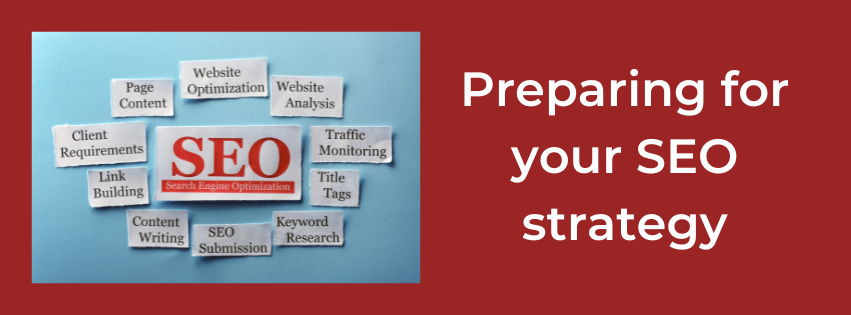
Preparing for your SEO strategy  

Whether you have a small business or are part of a bigger corporate, SEO (Search Engine Optimization) is a must for your website to help you rank higher on Google and other search engines.

Building your SEO strategy sounds complicated and may make you want to immediately zone out and not read more – but trust me, I’m going to try and keep it simple! It’s really just a plan!

Your SEO strategy is simply the process of organising your website’s content to improve your chances of appearing in search results – a way of maximising your opportunities to get organic traffic from search engine results pages, (SERPs).

Having a strategy or plan, helps you keep on track when you create your content. It helps you see that you need to create content that people are looking for and searching for, rather than creating content you think they’re looking for, or posting what you want to post.

When you just react and post without a plan, your content will appear unorganised and scattered – this is when search engine bots have a problem indexing your site, understanding exactly what you do and therefore, have a problem ranking your pages.

BUT WE CAN FIX THIS! However, as it’s such a big subject, I’m going to do this over a few blog posts, so you don’t feel too overwhelmed!

Steps to helping create an SEO strategy.

Here are few simple steps to follow:

Make a list of keywords.

This is always the first step to take. Use Google search to help you with this. OK, let’s go with an example…

You make candles – you sell them at markets and on your website – and you also use social media. You make all sorts of candles for all sorts of occasions, some standard that people can buy and some bespoke.

Your keyword search starts with Google – type in candles or put the word twice (as I did – candles candles).

Google will then suggest loads of options, such as:

  • Beeswax candles.
  • Votive candles
  • Scented candles
  • Four candles (!!! This made me smile – if you know the Two Ronnies sketch)
  • Birthday candles
  • Cake candles
  • Soy candles
  • Specialist candles
  • Candles near me

You’ll know that these are good keywords to use for SEO as they come straight from Google and so you know this is what people are already searching for.

You will find that short-tail keywords (search words using just one word – such as ‘candle’) are more popular as most people will start with just one word when looking for something specific.

Long-tail keywords (such as ‘candles for special occasions), won’t be as popular in the volume of people looking for them, but they tend to be generally easier to rank for and obviously attract people who are searching for something more specific. 

I’d say type in several different words and short phrases into Google and see what comes up – try and have a list of at least 10 keywords.

You can then check them in a keyword checker (there are some free sites out there, such as  https://www.wordstream.com/keywords or Ubersuggest) which will give you the number of people searching that keyword and whether they’re low, medium or high volume.  

Look at Google’s first page.

Once you’ve got your list of keywords, type them one at a time into Google search and look at the first 10 entries that come up.  This shows you the businesses that currently rank for that keyword, and the kind of thing (maybe a list or a business itself) that people are looking for when using that keyword. Make a note of what comes up in the search and what kind of things, such as lists or blog posts that come up.

Analyse your competitors. 

Most of us will know who our main competitors are, but to find out who Google thinks your competitors are, you can use a free tool, such as Semrush, to help you. You simply type the URL of your website into their search, then click on ‘Domain overview’ and scroll down where you’ll find a further search called ‘Main organic competitors.’ If you click on this and then click on ‘view all,’ you will get loads of information about keywords. It will show a list of all your competitors, plus the most common keywords that you share, as well as telling you how much traffic those keywords pull in.

Where you see a lot of common keywords, you’ll have your list of at least 4-5 competitors.

Keyword gap

You can now use the Semrush ‘Keyword Gap Tool.

The ‘gap’ refers to the keywords that your competitors are ranking for, but that you’re NOT ranking for.

This tool will help you identify those gaps, so you can then use them on your website or blog, therefore optimising your existing content with those keywords – or creating new pages to use them.

To use this tool, you simply put the URL of your website and then the URLs of four of your competitors and press ‘compare’ and scroll down to ‘all keywords details for…’ and click on the ‘missing’ tab. You’ll get a huge list and then it’s up to you to sort through which of those missing keywords would be relevant to your business and to your website. 

There are lots of other uses that Semrush can help you with in analysing your competitors and your website, so it’s worth going on and having a play – and it’s really interesting!

These are the first few steps for SEO and will help get you prepared to look at your SEO strategy. Next time we’ll look at how to use this new-found knowledge to help you rank on Google.

If this all feels a bit too overwhelming, I can help you with your SEO strategy through 1:1 coaching. Just contact me to find out more.

Pricing for small businesses

Whenever I talk to a small business, pricing is one of the things that most struggle with. But just as you have a strategy for your business, and spend time marketing what you do, having a pricing strategy is just as important.

Pricing can be difficult to get your head around – for example, why are some products worth so much more than others, when they basically offer the same thing?

Settling on a pricing strategy

There are different ways to settle on a pricing strategy that will work for you – and lots of things to take into consideration, such as:

  • Your customer – how much are they willing to pay for your products or services?
  • Your competition – what is your competition charging?
  • Costs – you need to know all your costs in order to be able to fix a price which makes you a profit.

 So, you need to find a pricing strategy that offers good value to your customers, competes with your competitors, and gives you a profit. This isn’t an easy concept to grasp.

Pricing strategies for small businesses

There are loads of pricing strategies out there, but these are just a few that I think are more relevant to the smaller businesses that I interact and work with.

Competitor strategy

If your products are competing with lots of other businesses who do the same as you, competitor pricing or strategy might be the best way to go. First, you need to research your competitors to find out what they charge for similar products to yours, and then monitoring their prices to ensure that your prices are the same or slightly lower.

This is a strategy that is most commonly used by supermarkets.

Penetration pricing

If you’re just starting up, or you have new products that are like your competitors, this is a popular choice. You start by offering a low introductory price for your new product, (or products if you’re just starting) and then gradually increase the price as the market gets used to your brand.

Economy pricing

If you offer low cost, budget products, this is a good pricing strategy. But you MUST ensure that you’re able to produce bulk quantities for a low manufacturing cost and still be able to turn a profit.

Price anchoring

If you sell both premium and budget products, then this may work well for you. You can put your lower-priced alternative next to a similar premium product – customers are more likely to buy the cheaper model. This gives them an immediate comparison without having to look at other brands or businesses.

Psychology pricing

It probably won’t surprise you to know that emotion influences a lot of the things we buy. Psychology pricing is the way that businesses set their prices to influence how customers perceive the value of a product or service.

The typical way of doing this is pricing just below round numbers or choosing prices that make products seem more affordable or attractive. If something is priced at £300 for example, and the same thing is priced by another business at £299, it’s more likely to be bought at the lower cost – although there is only a penny difference in reality.

You also see this in advertising, when you see for example, ‘8 out of 10 cat owners agree that this cat food is the best’. If they said ‘80% of cat owners agree….’, consumers are more likely to think – mmm, well 20% of cat owners didn’t agree, so that’s not good. Saying 8 out of 10 is exactly the same – it just sounds better psychologically.

Another example, and this is a clever one! Two companies are putting out offers on their products. One offers ‘25% off’ and the other company is offering ‘buy one, get the other half price.’

Which would you go for?

In fact, they are both exactly the same. The only difference is that the second offer saves us having to work it out in our heads. And mentioning the word ‘half’ creates an illusion that we are receiving 50% off the original price, but you’re actually getting 25% off each product.

How do I work out the cost of each of my products or services?

Deciding which pricing strategy to go with is all very well, but you also need to ensure that you make a profit on the things you are selling. If you buy products in bulk at a cheaper price and then add what you want to make on top, that’s easy to calculate. But if you make your own products or offer a service it can be a little more complicated.

Products

You need to understand what costs you have.

  • Materials – how much does it cost you to buy the raw materials to make your products?
  • How many products can you make with those raw materials?
  • Utilities – does it cost you money to produce your products (such as electricity to run machines, or maybe you use a lot of printer ink)?
  • Time – how much time does it take you to make one product? This is something small businesses often forget. To price your time, you need to set yourself an hourly rate that you want to earn from your business, and you can then divide that hour into how many products you can make in that time.
  • Packaging and postage – you need to also take this into consideration.  

Once you have all the costs above you can work out the cost of each product.  

I appreciate, as a small business myself, that the price you choose must be what your customers will pay on a consistent basis.

Services

Charging for your services is definitely challenging and one that I’ve struggled with a lot over the years. If your prices are too high, customers won’t come to you – and if your prices are too low, potential clients will think you are cheap or inexperienced. You must find the fine balance between the two.

As with a product business, your costs need to include admin and overhead expenses, as well as any materials you need to provide your service. There is no magic formula! As a service provider, you’ll probably find yourself changing your pricing from time to time, just as you’ll have to change your services to keep up with the latest trends.

  • As a service provider, you MUST know your competition. As well as looking at what they’re charging, it’s important to know exactly what they provide for that cost. You’ll find some that are cheaper than you want to be (but do they have the same experience and skills as you)? You’ll also find those that charge much more than you are expecting, (do they have more experience and skills than you do)? Once you have this info, you’ll have a broad price range to start with.
  • You also need to decide whether you will charge a flat rate or whether you will charge by the hour. This will depend on what services you offer. For example, I charge per hour for the coaching I offer, but for email set-up or social media content creation, I charge a flat rate, which has already considered the amount of time it takes me, plus overheads.  
  • You still need to know how much you expect to earn per hour – that is, how much is an hour of your time worth?

Finally, as a service provider, especially if you’re freelance, it’s worth remembering that you won’t be working a straight 8 –10-hour day and nor will you get paid for all the hours you do. Most freelancers find that only 50% of their time is billable. The other 50% is spent marketing their own business, finding new clients, and doing admin!  

Conclusion

I hope this has helped you see pricing a little more clearly, although I realise it is always going to be a bit of a grey area!

So, to recap, do your research so you know what your competitors do. Take all your costs into account, including your time. Then decide what you’d like to earn per hour and go from there.

If you need any help, as always you can drop me a message. I’m happy to help.

Creating problem solving content for product-based businesses

Over the past few weeks, I’ve had a lot of people ask about how to create problem solving content. And why would you need to do that, especially if you’re a product-based business? There is a lot of information out there about problem solving for service-based businesses, so this article is for all my product-selling followers! And by writing this and creating social media content around this subject, I’m creating problem solving content!

What is problem solving content and why do you need it?

The first thing I want to say is that you need to address your customers’ problems or pain points, without them feeling you’re giving them the hard sell. This is a real turn-off!

With social media being such a popular medium, it makes sense to have some engaging content that makes them think. Everyone loves to read a story and people love to be able to express their opinions or join in with a debate, so let’s look at how you can address this.

Problem solving content captures your followers’ attention by giving them an answer to a particular question or concern they might have. And provides tangible examples to illustrate your points.

Why do you need it? It helps your customers and potential customers imagine how they can use your product and that it is something they NEED in their life! Being able to picture themselves using your product and the benefits it brings is half the battle to getting a sale.

Understand your audience’s problems.  

I know I bang on about this all the time, but the first step to creating the content is understanding what problems your customers may have. This once again boils down to knowing your target audience and what challenges they face, what they might be interested in and any obstacles they might have (or excuses) for not being interested in what you have to offer.

One of the ways to obtain this information is to ask questions or conduct polls on social media, asking for feedback from your audience. For example, you may have a very popular product – ask WHY your customers like this particular product.

And ask what else they would like to see from you.

Give your audience solutions they understand and can relate to.

Once you understand the problems or worries your audience has, it’s time to think of ways to show them the solution – one they will understand and be able to relate to.

Don’t just tell them how to solve a problem, show them. You can use case studies, examples from reviews or recommendations, or an online tutorial or short video to illustrate how your product can solve a problem. This helps make your content interesting, engaging and gives them ideas as to how your products can be used.

Let me give you a few examples for different kinds of products:

You sell jewellery – it’s always exciting to show images and maybe slide shows of your jewellery, but if you have a customer who has bought something from you for a particular occasion, ask them to send you a photo of themselves wearing your jewellery. You can then use their review with a photo – it packs more punch.

Give ideas as to how a particular piece of jewellery could work. You might sell earring and necklace sets that would be perfect for a bride to wear on her wedding day. Photograph those sets with a wedding inspired background – if you use Canva, there are wedding inspired backgrounds you can use. Then, instead of just focusing on the bride, why not show other sets that may be in different colours that could be gifted to bridesmaids? If you do jewellery with different length chains, you can say that in your content.

If you make your own jewellery, show the process in step-by-step photos or be brave and do a time lapse video, stating that you offer a bespoke service for those special pieces or gifts.  

You make hair accessories – you can use all the same ideas as for jewellery, but also you can include children in your marketing. Children love hair accessories for many different occasions, such as going to school (could you offer scrunchies or hairbands in school colours for example?), or the same with a bit of bling for parties.

When you are advertising your products, show or give ideas as to how they can be used. If you do adult accessories, (as someone with long hair that gets in my way), you could push the angle of headbands/scrunchies are not only stylish and pretty but keep your hair out of your face when you’re gardening or at the gym.

You sell gift items – this is a broad category. You might sell soft toys, handmade items or personalised items, or a host of other things. But the principle is still the same. Give potential customers ideas on how they can be used and what events they could be used for. This could be birthday’s, Christmas, Easter, Valentine’s Day, Mother’s Day, Father’s Day, birth of a baby, christening, wedding – the list is endless. But if you have products that could be adapted to all these special dates, you have a bigger market for your products.

If you have safety features or must have safety certificates for your products, mention this, so people are happy that a product is safe to gift to children for example.

You sell beauty products, personal products, or home cleaning products – there are lots of ways to show and tell that these products solve problems. For skin products or personal products, it could be that it will make your skin glow, help with skin problems, is an effective deodorant, softens your skin after shaving – the list is endless. The key here is to do videos of you using the products or having lots of before and after photos from customers, or photos of customers using your products. Reviews about how it helped solve a particular beauty or personal problem will also give you social proof that your products work and are worth investing in. Tell customers that they don’t contain any nasty chemicals and if they are allergy friendly.

The same applies to cleaning products – are they eco-friendly and don’t contain harsh chemicals?  Do they work? Create videos showing you using the products, for example on a sink – before and after. Use customer reviews to give you social proof.

I could go on with all the different types of business out there, but the principles are the same, no matter what business you are in.

Be honest with your audience.

This goes without saying, but transparency is really important. Be honest about what customers can expect from your products and their solutions. Don’t promise something you can’t deliver or you’re not sure is correct.

Always set realistic expectations.

Engage with your audience.

This is more important than a lot of people realise. Talk to your audience. When they make a comment on your post, always reply to it and if necessary ask questions and engage in a conversation. If someone asks a specific question, answer it or if you think it might be more personal, reply that you will send them a private message – and ensure that you do!

Ask for feedback on your products, your content, your videos and ask if there is anything else your audience would like to see.  

Do you write a blog or have your own newsletter?

If you write a blog, you can use it to go into more detail about a particular product. A post on social media shouldn’t be too long or people won’t read it, but if they read your blog or have signed up to your newsletter, you have a captive audience, who WANT to know more or find out more about you and your business, including your products.

So, if you create a post that you could give a lot more detail about, write a blog post about it and advertise that on your social media account. And if you have a newsletter, include a paragraph every time about one of your products and how it solves a problem. Again, you can advertise this on your social media posts. This not only offers a more in-depth service, but it also directs traffic to your website or blog.  

Final thoughts

You need to know your target audience and what they want. You must understand what kind of problems they have that your products can solve.

If you feel you are struggling with how to create problem solving content for your business, I can help. Sometimes it’s a case of ‘two heads are better than one.’ I offer an hour’s brainstorming session, where we can discuss your business, find out more about your target audience and set a plan in place to create that problem solving content that will speak to your customers and ultimately get more sales. Either message me or drop me an email to make an appointment – cindymobey@outlook.com

Now, put your thinking cap on and get creative!

Find your niche and market, market, market

If you’re going to make a success of marketing your business, you need to hone in on what is the best niche for you to be in. What will sell well? What will make you the most money?

What is a niche market?

A business niche is a focused area of a broader market that your business specifically deals with. It doesn’t matter whether your business is in a unique industry or a saturated market, it’s really important to differentiate yourself from your competition, as this is what helps you to win your audience.

You might like everything you do, but in order to be a successful business, you need to be able to distinguish your brand from your competitors, find what you are really good at and establish yourself as a dominant leader in that area. Even the biggest names can’t be everything to everyone; there are always going to be those small groups of people who need a particular product or service not met by the bigger companies…which is where the small business can step in.

What are you good at? 

This first question is probably the most important. It’s not ‘what would you like to be good at?’ You need to be really honest with yourself – where do your talents really lie? What skills do you have? What do you enjoy doing? Once you have decided what you are good at, make a list of your skills and talent in that area. For example, if you love knitting, crocheting and sewing, which one do you excel in?

Once you know which you are best at…let’s say knitting for example, then you need to look at what skills and talent you have. So, it might be knitting baby clothes, knitting adult clothes, knitting toys – put the things you enjoy making most at the top of the list and so on, down to the ones you least enjoy.

What do potential customers need from your list? 

This is where you need to do some research. Of the things you are best at making, what is popular? You can look on Etsy, eBay, Shopify and Amazon – are the products you are good at making doing well? Make a list of the things people need from your list of what you do well…then look at these questions and do some research.

  • Do you solve a particular problem for customers?
  • Is your product(s) something that people will come back for time and time again? This is important for repeat business.
  • If there are other people selling the same as you, can you offer something unique that they don’t?
  • Who does your product appeal to? Can you expand that to include other groups? For example, if your product appeals to an older age group, can you make it more appealing to a younger audience. The bigger your product appeal, the more you will sell.

What will people pay for?

Now you know what is marketable, which do you think people will pay the most money for…put your products in order of price…from high to low. You now have your niche – your list of the products you like to make, that you’re good at making, that have a potential audience and that are sellable.

Market, market, market

Now you have your niche and know what is marketable, it’s time to actually market it. If you are a small business, marketing is all the more important as you won’t necessarily have a huge brand following, nor the money to spend on expensive and extensive advertising. So, part of your marketing strategy will be to stand out in the crowd. I wrote this article a while ago, but it is still relevant and will give you some tips on standing out in the crowd.

How to make your business stand out in the crowd!

Hopefully you will pick up some great tips!

You should try to spend at least an hour a day promoting your business…and some things are much easier than others – here are some quick-win tips to help you promote your business that don’t cost the earth.

  • Always remember that YOU are your business. No matter what you do or where you are, everywhere is a business promotion opportunity. Your image largely reflects on your business. Although we all try not to, most of us do judge people on our first impression of them…so make sure that you always give a great first impression.
  • Your social media pages are the obvious choice for this list – they don’t cost anything and you can reach your target audience by publishing the right kind of content that will appeal to them.
  • Always carry business cards as you never know who you might meet and if you don’t carry them, you could be missing an opportunity to get someone to contact you.
  • Can you leave flyers or business cards at places where your potential customers are likely to be…at the gym, hairdressers, beauty salon – places you know that your target market hangs out!
  • Talk to people wherever you go – if you’re in the Doctor’s surgery waiting room, strike up a conversation with someone…too many of us sit in silence in these places…do you take your children to sport events? If you do, you’re likely to be hanging around with other parents…talk to them. There are always opportunities to strike up conversations and promote your business.
  • Attend networking events…again, this puts you in front of potential customers face to face…sell yourself and your business.
  • Sponsor a local event or charity – or run a small event for charity in your own home or garden.
  • Host a seminar or training event and share your skills – a great way to get your business name out there.
  • Collaborate with another business which complements yours and vice versa. For example, if you do hair for weddings, you could collaborate with someone who does make up or flowers. Promote each other’s business on social media and on your websites.
  • Give your website/social media pages a facelift to keep it fresh and don’t forget to regularly change your cover photo and profile pics so they are up to date.

There are many other small ways you can promote your business and, as I said earlier, it doesn’t have to cost the earth – the most valuable thing you can invest in your business is your time.

If you have any questions, or would like to have a chat about your niche and target audience, contact me or message me on social media. Alternatively you can email me – cindymobey@outlook.com

Dos and Don’ts for your business Facebook page

Despite all the hype and buzz around TikTok and other social media platforms, Facebook is still the most-used social media platform in the world.

Facebook had 3.05 billion monthly active users and during the 4th quarter 2023, Meta reported that 3.98 billion people use at least one of their core products every month – core products being Facebook, Instagram, WhatsApp or Messenger. (Source – Statista.com)

This is great news for all of us small businesses who use our business page to promote our products or services. Facebook is an inexpensive, and largely free, effective way to connect with your target audience, but there are some things you should and shouldn’t do. This post looks at the dos and don’ts for your business Facebook page.  

DO

First, let’s look at some of the things that are advisable to do on your Facebook page.

  • Pick an easily recognisable image for your profile picture (either of photo of you or your brand logo). People want to know who they are interacting with. Don’t use photos of your pets for your business page – unless your business is about pets, and even then I would use a logo or you and your pet.   
  • Use your cover photo – feature an image that represents who you are and what your business does.
  • Ensure you complete the ‘about’ section of your page. This is your chance to tell your audience a little bit more about you and what you do – you could use your elevator pitch here.  
  • Develop a distinct voice for your Facebook page – so you sound the same as you do on your website and other social media pages. And don’t forget that you can use humour and show your personality!
  • Make sure you include links to your social media pages on your website, so people finding you there know where to connect with you on socials.
  • Post interesting and quality content – make sure that your content isn’t all about selling your product or service – use a variety of posts.
  • Post consistently on a regular basis. You can see from your insights when is the best time to post for your audience.
  • Post engaging images and ask questions to promote engagement, or do the odd fun post, such as those predictive text posts, quotes, or a funny meme.
  • Include links to drive traffic to your website, blog or newsletter sign up.
  • If you share other peoples’ content, ensure that it is relevant to your target audience.
  • If you are attending or arranging an event, post about it.
  • Celebrate your wins and share your successes.
  • Reply to and ‘like’ comments left on your posts.
  • Use hashtags to increase interaction – experts are currently recommending 3-5 hashtags on Facebook posts. Despite being allowed to use up to 30 hashtags on Instagram, the current guidelines (from 2023) suggest 3-5 – the same as Facebook. But you may find more work better for you on Instagram.
  • Mix up your posts with single image, multiple images, and video to gain the most engagement.
  • Check your post grammar and spelling and don’t forget a call to action.
  • This is a hard one but respond quickly and publicly to any customer that complains or leaves a negative comment on your posts. Don’t get angry or defensive and don’t get into specifics about the issue. Just respond positively and then take the complaint offline. This shows other customers that you care about your customers and are responsive to their concerns.    
  • Finally, measure your posts by checking your insights so you know which posts are the most engaging with your audience, or get you the most reach/comments/likes etc. You can then use this to plan your following week’s/month’s posts.

DON’T

  • Invite huge lists of people to like your page or get tied up in follow for follow posts. If people like what you do, they will follow you. Doing follow for follow may boost your followers briefly, but most will unfollow you after a short period, or just never bother engaging with your posts because they didn’t choose to follow you for the right reasons – and this is very damaging to the algorithm.
  • Constantly promote the sales of your products or services – use a variety of posts to keep your audience engaged.
  • Don’t completely flood your feed with posts – if you post several times a day, space them out.
  • Overuse hashtags. 3-5 is plenty per post – any more than that and your post could be seen as spammy. Put hashtags at the end of your caption rather than incorporating then into the caption itself.
  • Don’t post low quality images, memes, or information.
  • Don’t post anything that you wouldn’t like to see in your newsfeed.
  • Don’t be afraid to experiment with your posts to see which are the most popular.
  • Don’t forget to use your insights to help you plan posts.
  • Neglect to post at weekends – you don’t have to post on both days, but this is when most people are at home and scrolling social media.
  • Don’t use abbreviations or jargon.
  • Don’t ever ask for personally identifiable information.
  • Don’t engage in an argument on your business page – if someone has a problem, reply politely, and take it offline.
  • Don’t post anything that could damage the professionalism of your business or that could damage your reputation.
  • Finally, don’t get involved in engagement baiting.

Engagement Baiting

This could be a whole other blog post, but basically engagement baiting is goading people into commenting on posts without it being a meaningful interaction.

Facebook will prioritise posts that inspire back and forth discussion, but using engagement bait will be recognised and post will be demoted in the newsfeed.

Engagement baiting includes:

  • Vote baiting – asking your audience to give their opinion using a like, share or comment.
  • React baiting – Giving your opinion in your post, then saying ‘like if you agree’ – whoops! I’ve been guilty of this one without realising it!
  • Share baiting – Encouraging your audience to share a post if they agree with the content or share to win a prize or be entered into a contest.
  • Tag baiting – asking your audience to tag someone in the comments.
  • Comment baiting – asking followers to comment on the post.

I’m not sure I agree with all of these, but I guess it’s about the way you ask for things. Facebook’s guidance says that you can:

  • Ask for authentic input – asking for advice, recommendations, help or tips. And you can ask customer to share their tips for using your products or service or how they think they could be improved.
  • Ask questions as this promotes engagement and interaction. A study conducted by Hubspot found that posts that use the words ‘should, would, which, and who’ get the most comments and those that use the words ‘why and how’ get the fewest comments.
  • Post content that people want to talk about.
  • Provoke an emotional response – posts that surprise your audience or make then laugh, cry, or get angry.
  • Post a photo and ask for a caption.
  • Try and ‘fill in the blank’ post – this could be using predictive text or just from their own experience.  

There’s an awful lot to take in with this post and I appreciate it if you actually got to the end of it! As always, if you have any questions about this post or any of my other posts, or if you have any suggestions for future blog posts, please feel free to email me (cindymobey@outlook.com) or message me on messenger.