
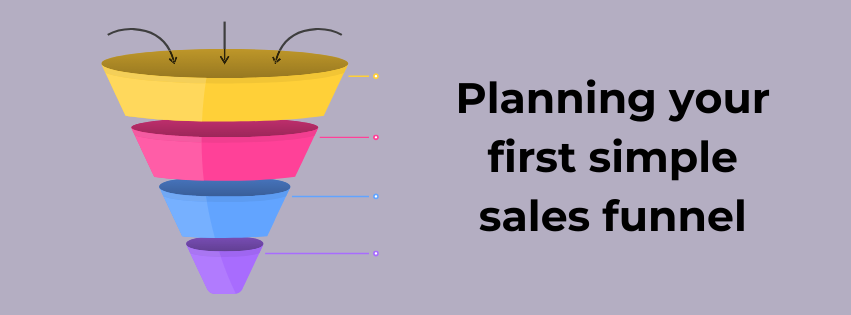
A sales funnel is the journey you take your customer on to lead them from follower who may or may not be interested in what you do, to getting a sale or a sign up to one of your services.
My last blog looked at how to create a sales funnel, which gave information about all the various steps of a sales funnel. This blog post breaks things down even more and gives you an example of a very simple first sales funnel.
Step 1 – free content
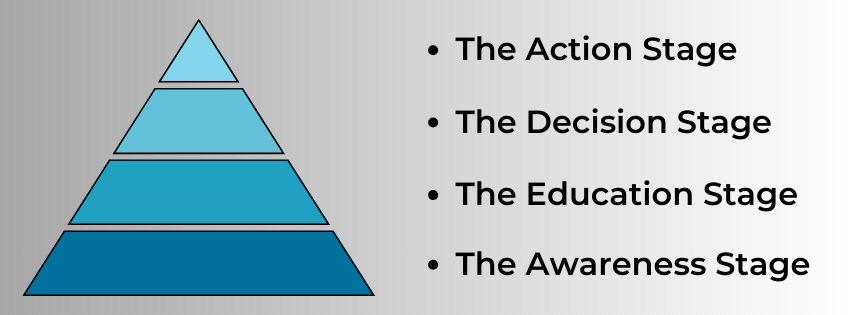
The awareness stage focuses on attracting potential customers. This typically starts online with social media posts and/or blog posts or maybe YouTube videos – FREE information that you give out. This is where your potential customers enter your funnel –the awareness stage.
Potential customers could stay at this stage for a long time – they love your content and enjoy learning the things you teach them or show them. So free content moves them into the education stage.
Step 2 – you introduce your low-cost offer.
I’m going to cover two ways to introduce a low-cost offer to entice potential customer to buy.
Social media offer
With social media, you can offer a substantial discount to get a customer through that first hurdle of buying from you. I often see ‘Tenner Tuesday’ or ‘Fiver Friday’ on Facebook. This is a risk-free and low-cost way for a potential customer to try out your products or services.
This is a good way to get that first customer, but there are no guarantees that they’ll buy again from you, because other than seeing your business and your products on social media, they may not look for you again. If you have a website or online shop, it’s important to give them details of this so that they have a further opportunity to look at your products/services.
Opt-in offer.
If you have a website, then you can set up an opt-in offer that encourages your potential customers to subscribe to your email newsletter.
Opt-in content is still available to your potential customers free of charge, but this is where you get an email address in exchange for the content. Subscribing to your email newsletter can be the first step towards the decision stage, where they say ‘yes’ to something.
So, your opt-in offer is something you give away for free to get someone to subscribe to your newsletter. What you offer will depend on the type of business you run. It could be:
- An e-Book or PDF
- A checklist
- A free small product (although I wouldn’t advise this as it will cost you money for postage)
- A small discount
- A tutorial on ‘how to’ do something
- A webinar or video series
This is called a lead magnet, because it attracts a potential customer with the free content, (like a magnet), which entices someone to give their email address (lead).
So, they sign up via your website or link you’ve put on social media, and they receive their free content, in exchange for their email address. You now have them signed up to your newsletter – and they have said that first ‘yes.’
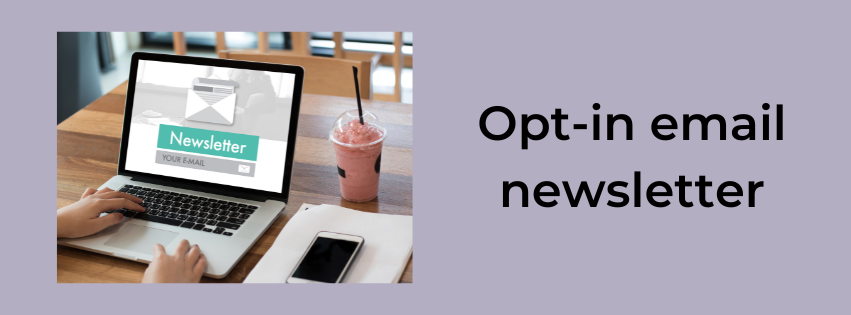
Step 3 – have a further offer within your newsletter.
When someone signs up to your newsletter, they will usually get a thank you email, with their free offer attached or a link to download it or go to it (if it’s a video or tutorial).
Then you have a small email sequence that begins to nurture that relationship, and you can suggest a further offer, which is a low-cost offer. This low-cost offer is very low risk to the potential customer, and low risk to you as it doesn’t cost you much, if anything, depending on what it is. It means that your potential customers can try out your paid offer without spending a lot.
What you offer, again will depend on what kind of business you are. For example, you could offer a low-cost webinar or tutorial, that you send them online, or that is on your website in a hidden page. It could be you offer an incentive to buy something with a discount (like your Tenner Tuesday or Fiver Friday) if you’re a product-based business.
If they take you up on the low-cost offer, they have taken the first step to being a customer and your funnel is working! And so long as your low-cost offer gives them great value and they love it, they are more likely to buy from you again – and pay a little more for your higher cost products or services.
It takes time.
It takes time for potential customers to decide to take you up on one of your more expensive products or services, but by nurturing that relationship through your email newsletter, where they learn more about you and your business, and get to know you more, there is a chance they will convert to a regular customer. You can also continue to nurture this relationship on social media.
The decision stage and action stage can take a while for your follower on social media, or subscriber to your newsletter to trust you enough to buy from you, but it will happen. By creating the odd offer or discount every now and again, it will further encourage that undecided someone to convert to a buyer or client.
Once you’ve mastered that all important simple funnel, you can move on to something more complicated, such as upsells and downsells, or even move them to a more profitable funnel, which if you have email marketing, you can do through segmenting your market – which is another blog post in future!
If you find this all a bit too complicated, you can book a free call with me to discuss how I can help you move forward and create your own sales funnel.
 The Write Way