Content Marketing Strategy – your way to success!

Do you have a content marketing strategy? A lot of small businesses don’t – and if you are one of those businesses, you are missing out on planning your way to success! Staying ahead of the game is what keeps our audiences engaged and also helps our businesses remain relevant. BUT, it doesn’t mean to you have to keep up with every trend that comes along.  

A content marketing strategy includes all the things you do to attract, engage, and keep your audiences’ attention, by creating and sharing content, such as blog posts, videos, newsletters, podcasts, and social media content. In fact, anything and everything that keeps your business in your audiences’ minds when they decide they want to buy what you offer.

The strategy is about the planning of that content so that it achieves your goals and is aimed at your specific target audience.

Why is the strategy important to your business?

I’ve seen lots of people on social media saying that they want to grow their business and it’s just not happening.

Is this you?

You’re consistently posting on social media, you might have a newsletter, you show your products or services, publish your blogs, pay for ads – and are consistent – but still you’re not getting as much business as you hoped. The reason is likely to be that you don’t have a workable content strategy, or that your goals aren’t realistic.

Content marketing is a long game – it’s not something that you can implement and get results within a few months. That’s why so many big companies have a whole marketing department. They know that they need to have people working on it constantly and over a long period of time to get any return on what they do.

With the right strategy in place, you can:

  • Generate leads
  • Raise your brand awareness
  • Engage your followers and target audience
  • Retain your current customers
  • Position yourself and your business as an expert in your field

You can’t just wing it!

Unfortunately, content strategy isn’t something you can wing! You need to conduct research, know your target audience, know what keywords to use and have a clear idea of your buyer personas.

Most small businesses will know their target audiences, but quite often still post and focus on what they believe to be important or interesting, rather than what their audience and perspective customers need and want. Having a strategy addresses this matter.

It’s not a secret that creating content is time-consuming, but writing short blog posts, or putting up a social media post just because you haven’t done one today – or trying to put out three posts every day, means you’ll probably do something quickly, just to get it out – and this could end up with you losing out in the long run.      

High quality content helps you to rank better in Google, helps you to build trust with your customers and followers, brings you leads and importantly, helps you to convert those leads into customers.

I’m not saying that there isn’t a place for short-term content strategies, as these can produce some instant results, but a long-term strategy will allow you to build a rapport with your audience, provide real value to them and keep your business in the front of their minds long term. Long-term strategies also tend to build bigger audiences and don’t concentrate on the hard sell, which puts a lot of people off.

How do you build a content strategy?

Your content strategy is the foundation of your customers’ journey with you. It helps you have better customer satisfaction and helps you with sales. Think about:

Your audience

Who will be reading your content? Who is your target audience? Do you have more than one?

Create a buyer persona for each of your target audiences – this will help you tailor content specifically for them.

What problems do your products or services solve?

What are the benefits and features of your products/services? What are your customers’ pain points and how do you solve them?

What makes your business unique?

What do you do that is different from your competitors? What makes your products/services better than theirs? It might be that you have years of experience; you might have a distinctive way of speaking to your customers (your tone of voice).

What are your business goals?

This is very important as you need to know what goals you want to achieve, so you can tailor your content to help you achieve those goals.

What kind of content format will you use?

Bear in mind that you need your content to reach your customers, so where do they hang out? This might be social media, a blog, a podcast, a YouTube channel, video content or an email newsletter to name a few. You also need to know what kind of content your audience likes. You can only find this out by trying different things over a period of time and analysing which type gets the most engagement.

Once you know what format you need to use to suit your audience and to reach them where they are, think about your budget and what you can afford to be able to use all these channels effectively – by this, I don’t mean you have to pay for ads – but things like a website or email marketing can come at a cost.

Where will you publish your content?

Linked to the previous point, where you publish your content will depend on where your audience are. This might be your website, or social media. If social media is a big part of your strategy, which sites will be best for you? Which sites do your audience use?

If you target a younger audience, you might want to opt for TikTok and Instagram.

How will you manage your content?

Once you know what channels you’re going to use, you need to think about how you will create and publish all your content. Will you be doing it all yourself?

Have a plan, and plan at least two weeks ahead, so you know what posts are happening and when. For social media, you can batch-create content and schedule it in advance. Blog posts and email can also be planned and written ready for publishing.

If you plan your content around a particular theme each week or month, it makes content creation much easier. If you write a blog, or have a podcast, you can also repurpose that content to make social media posts/videos.

Make sure that your content tells your customer how you can help them solve their problems, use your unique voice, and try and weave in your overall business message.

I try and use the 80/20 rule for my content. 80% entertaining, engaging, educating, or inspiring my audience and only 20% sales posts.

Your strategy also needs to:

  • Ensure your content points your audience to your website or online shop…or somewhere they can get more information
  • Be cost-effective
  • Include an audit of the content you’ve already published. Look at your insights on social media to find out what kind of posts work best you’re your business. And, if you blog/podcast, look at your stats to see which articles/episodes are the most popular. What works and what doesn’t?
  • Does your current content align with your goals, and will it help you achieve it? If not, you may need to look at changing what you do and how you do it.

There are loads of different types of posts you can create to keep your audience interested, and to help you achieve your goals.

Content Marketing is all about reaching your target audience with the kind of content they want to see, in a place where they hang out.

Planning and having a strategy are key and will really help you achieve your goals, reach your audience, build trust and rapport with your followers…and ultimately make those sales.

If you’d like help with your content marketing strategy, I’d love to help and get you moving towards building your audience and growing your business. Contact me via email (cindymobey@outlook.com) to book your free 30-minute consultation – I look forward to chatting to you about your business.

Do you know how to market your content?

According to the Content Marketing Institute, “Content marketing is a strategic marketing approach focused on creating and distributing valuable, relevant, and consistent content to attract and retain a clearly defined audience — and, ultimately, to drive profitable customer action.”

Content marketing isn’t anything new, and those that still prefer the more traditional marketing route would probably argue that content should be just to advertise. But content marketing is one of THE most important parts of marketing for small businesses today. Your business will be left behind if you don’t use it.

I’m not saying that traditional marketing shouldn’t be used anymore as there is obviously still a place for it. Here are the differences!

Traditional marketing vs Content marketing

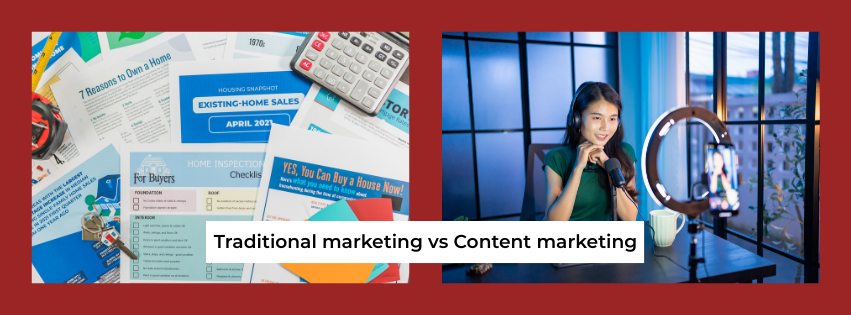
Larger businesses will typically use traditional marketing as it is the kind of content that is pushed into the view of the public. For example, TV commercials, radio ads, print ads, brochures etc. You will see traditional marketing everywhere; on billboards, sides of buses, the ad breaks in the cinema, but they are all high end marketing which require a big budget to reach that large audience.

For the small business, content marketing is the way to go; it involves having a content marketing strategy, which comprises of all types of content being created and then published online in multiple locations. Instead of forcing your content on the public, your content will sit online forever, with the end goal of attracting your ideal audience or customer.

There is of course still a place for traditional marketing – you may want to have an ad in print in a local publication or have a brochure or catalogue for events. Some small businesses also get invited to speak about their business on local radio – and of course you’d want to do that!

Content marketing is different in that it doesn’t concentrate on just advertising your products or services, it’s about drawing your audience in by providing useful information that is helpful and solves problems. Your readers can follow you on social media to read more of your content, or follow your blog, in order to find out more. This helps you gain a loyal audience who trust you…and ultimately buy your products or services. It can also help encourage them to sign up to your email list.      

What kind of content can I share online?

When your audience find your content useful, their connection to you and your brand is strengthened. They will share your content, so that your audience widens further. There are many different types of content – all of which can be posted, shared or used on social media to point to other things you do, such as a podcast on YouTube, your website or blog. These are just a few examples…

  • Your website copy – yes, this isn’t something that immediately springs to mind, but it can be useful to post about something on your website – it might be a particular item in your shop, it could be to point your audience at your services – or even to your about page to find out more about you.
  • Your Blog
  • Videos
  • Podcasts
  • Infographics
  • E-books
  • Printables
  • Quotes
  • Case Studies/testimonials
  • Lists/articles
  • Educational content

The list is endless, but to make your content really work for you, it needs to be optimised for your target audience and it needs to be relevant to the niche you are in.

How do you market your valuable content?

Now you have your content online, what do you need to do to market it?

Website

If you have a website for your business, you can add a blog to it, so you are creating content that people will see when they visit your website.

Email

Do you have a ‘subscribe to email’ button on your website? If not, do it! When you have subscribers, you can send them a monthly email as a newsletter. You can include:

  • Links to any blogs you’ve written
  • Details of new products or services
  • Special offers
  • Send links to videos you’ve produced on YouTube
  • Links to any podcasts you record
  • Links to any articles, news or videos you think they might be interested in (not necessarily ones that you’ve done)
  • Generally talk about new trends in the marketplace, a little bit about you and what you’ve been up to, ask questions make them feel like part of an exclusive ‘club’. 
  • You can also enable buttons so that your audience can follow you on your social media channels

Social Media

Share your content to all your social media pages. You will have different audiences on Facebook to those you have on LinkedIn for example, and again different to those you connect to on Instagram.

  • You can schedule your posts, so you’re not constantly on social media (and therefore getting distracted by other things!).  
  • Share the link to your blog in your profiles on social media.
  • Ask questions linked to your content and respond to anyone who makes a comment. In fact, respond to any comment you get and thank people through messenger or private DM for following you.
  • Share you blog posts as soon as you publish them. The more immediate responses, likes and shares you get, the more credibility your post gets.
  • Share your blog posts more than once…share again the next day, with a different caption and image. And again a week later. This way, you will pick up people you have missed, or who didn’t see your original post.
  • If you notice that an old blog post went well and got lots of engagement, then share that again…not all of your posts, just the ones that had great stats.
  • Posts with images get better engagement, so really think about the images you use to entice your audience in. There are lots of free image sites out there (such as Pixabay, Pexel, Unsplash and Canva) that you can download licensed images for commercial use. DON’T just google images and use one as you could be fined for copyright.
  • Join groups on social media and participate in group discussions, giving advice, answering questions etc. This helps get your name known and helps you get seen as an expert in your niche. They also have ‘share your blog post/business page’ type events, which help get your content in front of a different audience.
  • Although not as popular as they once were, I’d still advise using up to 5 hashtags to help categorise your content for your audience.
  • You can also pay to boost your reach on social media.
  • Write a guest post for someone else’s website or blog – you then tap into their audience.
  • Make sure your blog/website has social media sharing buttons, so your audience can click to go look at your social media sites.

Search Engine Optimisation (SEO)

Choosing the right keywords or phrases will help your content get seen.

  • If you write a blog, include keywords and variations of it throughout the blog.
  • Optimise your social media posts by adding keywords. Just be aware not to stuff too many into anything you publish or it will be seen as spam!

You can find out more in-depth information in my other blog posts that specifically cover this, as it would be too much to include in this post!

Headlines

A headline really matters – the ones that seem to get the most traffic are lists, how to, or a question. Also, headlines that contain numbers, e.g. 101 ways to …….

Emotional headlines also seem to hit the mark too, as well as some of the more controversial headlines!

Images

Using great images can help market your content. Images don’t just have to be photos; it can be GIFs, infographics, graphics or video. These help capture and keep the attention of your audience.

If you have a Pinterest account, make sure your images can be pinned (shared) by other Pinterest users.

If appropriate, also put a caption on any image as this helps with search engines – images alone won’t necessarily be picked up by search engines, but if there is text, they will be.

Revisit and repurpose your content

Revisit your old posts and content regularly. Revisiting content means you can update it with new information, add new images/infographics and maybe add a short video you’ve made on the subject.

You can also repurpose posts into e-books, video or a podcast. You can also use ideas from them to make social media posts.

Conclusion

There are lots of different ways to market your content, but the most important thing to keep in mind is to always have your customer/target audience at the heart of everything you do. Do it for them, aim it at them, and make sure it’s something you know that they will be interested in.

Keep your brand in mind and write in your own particular style – don’t try and copy anyone else. Keep your content original and engaging. Remember, content should always entertain, educate and engage your audience.

Happy content writing and please get in touch if you need help with your content!