Top tips for effective communication with your customers

Communication is key to nurturing and keeping long-lasting relationships with your customers.

For your communication to really work well, you need to know everything about your products or services better than anyone else. Skills such as patience and active listening can make a huge difference, as well as having a very attentive mindset. It’s important to ensure that you respond to all messages, comments on social media, phone calls, live chat, and emails promptly, as a delayed response could make them turn to your competitors.

Why is communication important?

In today’s online world, with so much competition for every single business out there, no matter how big or small, the way you communicate with your customers can make or break your brand.

There are lots of ways you can communicate with your customers, and factors such as 24/7 availability and multiple channels that they can contact you on, are important for customer satisfaction.

You need to be able to help them in real time, give them any updates to your business or products/services, market new products to them and keep them happy.

The four most popular ways to communicate are:

By phone – this is the best way to resolve any issues with your customers that can’t be solve in other ways. Sometimes, when you try to email or message an unhappy customer, the feeling behind your message gets lost and it can come over as abrupt. So, phone is better as nothing is more reassuring than to hear a real human voice, who is calm and can explain any issues. Customers will like that you’ve taken the time to speak to them – it helps to make them feel like they are valued.

By email – This is good for giving information, for example, newsletters. Email is cost-effective and you have an email thread to keep track of the conversation. I speak to my clients by phone once a month to talk about how things are going – and always follow up with email to confirm our conversation and anything we’ve agreed.

Live Chat – you can put live chat on your website, but for me most live chat comes via messenger, where I can talk to my clients in real time. Sometimes, when doing this, it becomes obvious that you need to have a chat by phone, and other times you will find that you can confirm a date or delivery etc this way.

Social Media – social media is great for sharing regular updates with your customers, talking about new products or services, educating them about something you do or your business, and entertaining or inspiring them with quotes or funny stories/memes. Social media is also brilliant for engaging with your customers in a way you can’t do via other communication channels.
Tips to improve communication with your customers

Here are a few tips to help improve the experience your customers have with your business.

The right message

Conveying the right messages or information is crucial for any business. It is your responsibility to ensure that any information about your business, be it around shipping, info on a particular product and its use, turnaround times, pricing etc needs to be accurate, so that you can set realistic expectations from the start.

If you have a website, shop, and social media channels, make sure that the information you give is consistent across the board, as this leads to a positive customer experience with your brand and business. Any information that differs can cause confusion and ultimately, could lose you customers.

Be proactive in your communication

Inevitably, there will be times when a customer is not happy with the service you offer. They might hassle you to get their problem solved and might keep hassling you if it’s taking longer than they expected.

The best way to solve this, and to avoid it, is to be proactive with your communication. Let them know how things are going every step of the way.

Let me give you an example. I used to work for a global insurance company, and at one time was in their call centre. I worked solely on complaints, which could be quite difficult at times. I found the best way to make the customer experience a good one – even though I was dealing with a complaint – was to be transparent, open, and honest, and above all, keep them informed. When a complaint was first made, I always apologised and said that I would investigate it and get back to them. Now, people hear this all the time and often don’t get a call back – this is where I made a difference. I gave them a time and date that I would ring them back…and I made sure I rang them, even if I didn’t yet have an answer. I’d ring and tell them that I didn’t yet know the answer but was hoping to find out by ‘whatever date.’ I’d then agree another date and time when I would ring them to update or give them an answer. Nine times out of ten, customers were happy with this because I’d still taken the time to ring them in person.

This is what I mean by managing a customer’s expectations. That call makes all the difference. The customer knows that you care and that you are doing your best to sort things out for them. They also know that you will keep your promise to ring and update them.

Active listening    

Active listening is about paying attention to what your customers are saying to you. Listen to everything they have to say and repeat back to them anything that is important to remember or know. This proves that you are listening and ensures that you have understood correctly.

Keep a pen and paper handy in case you have to make notes and don’t interrupt them. Don’t be afraid to ask them to repeat something or clarify something, so you fully understand. You don’t want to miss any vital information or details that are important to them.

Whilst you are speaking to your customer, get rid of any other distractions – turn off anything that is likely to interrupt you. If you are speaking on a landline, switch off your mobile, and if you are on your mobile, switch off your landline or put it on answer phone. If possible, take the call in another room. Don’t have any background noise on such as music or TV.

Earlier I said to avoid interrupting your customer. However, there are times when you may have to – for example, if the line is bad and you can’t hear them properly, or you may have to ask them to repeat something if there is a language barrier.

Know your product or services  

This sounds obvious, but your customers will ask you all sorts of things about your products or services, and you need to be prepared.

Know everything inside-out, so you can answer questions with confidence. If there is something you’re not sure about, or something you’d not thought about, be honest and say that you don’t have enough information about it but will find out and get back to them…and make sure you get back to them in a timely manner! Don’t forget!

Try to avoid words such as “I think’’, “it might be, or it could be,” or “maybe it’s xxx.” This doesn’t instil confidence and makes you sound confused or that you don’t know what you’re talking about.

Take your time

It’s normal to feel some frustration when a call is taking a long time, or you are speaking to the twentieth customer that morning. However, for your customer, it is the first time they have spoken to you that day, so they deserve the same polite, helpful treatment that your first customer received.

Take your time to understand queries and give as much information to help solve any queries or complaints.

The call you receive may not be negative – it might be someone phoning to say, ‘thank you,’ or to give a compliment!

Give your customers what they want

All customers are different and have different needs and wants. Whilst one customer will be happy with an email or messenger response, you will have those that prefer to speak to you directly.

If a customer is asking you lots of questions, ask them what they would prefer. Ask questions such as “What is the best way to contact you?” or “Are you happy for me to email or message you, or would you prefer a call?”

In my experience with my business, I get different requests, and some prefer both. I find it easier to explain something complicated over the phone, and then follow up in email. Part of my business is coaching, so that is always face to face via Zoom or video call, but even then, I’ve had someone say they prefer phone and not face to face. So, each customer is different and it’s up to you to find out what they like best and work to that.

Keep a record of what your customers have bought from you before, be it a product or a service, so you have something you can talk about and show them that you remember them. Call them by name, so that it is more personal. And, put yourself in your customers’ shoes and treat them how you’d like to be treated.

Encourage your customer to ask questions

Communication is a two-way process, so encourage your customers to ask you questions. When they ask a question, it gives you the perfect opportunity to, not only answer but to give them information about the various benefits or features of your product/service.

At the end of any conversation, whether by phone, email, or messenger, always ask your customer if they have any questions.

Encouraging questions can lead to more interest in other products or services and could lead to more sales.

Conclusion

Communicating effectively with your customers breeds loyalty. When your customers know that they can contact you easily and that you genuinely care about them, this builds trust. Trust in you and trust in your brand.

Happy customers will refer you to their friends and family and they are the best form of marketing you can have. Communicating them using the channel they prefer helps build that trust and loyalty – in no time at all, you’ll have your own army of marketers, promoting your business for you!

If you need any help with customer communication or would like help with your marketing, please get in touch. I offer a free 30-minute consultation.

Email me at cindymobey@outlook.com or call me 0033 (0) 545 31 13 86.
How the customer experience (CX) is evolving in 2022

The customer experience is every interaction that a customer has with your business, from the very first time they find your website, shop, or social media pages, to every time they comment or like what you do, right up to making a purchase or working with you.

It’s something that continually evolves, and since the start of the Covid 19 pandemic, it’s developed faster than every before. During the various lockdowns, we all had to adapt our businesses to cope with being more visible online…and customers have found that they like the services that businesses started to offer during this time and want it to continue.

For the rest of 2022 and into 2023, there are several things you can do to ensure that your business evolves to match those new customer experience trends.

The Digital Experience

These days people use technology more than ever to find what they want – most of us reach for our phones to look at things we want to buy. We can see what the best products are, compare prices and look at reviews to see which is the best to buy. If you’re a small business and not online in several places, you’re missing a trick.

The obvious one is to have a website. I know that many small businesses have online shops, such as Etsy, to sell their products, but at the end of the day, you don’t own that shop. You must pay high fees and the owners of Etsy could shut you down whenever they want.

Whereas, if you have your own website, you own it. No one can take it away from you and you can put so much more information about your business on it – you’re not just restricted to a shop. As well as being able to tell your backstory through your ‘About’ page, you can also set up an email subscription to communicate regularly with your customers and set up a blog to share information with them. It’s more personal.

Your social media accounts are also useful to gain a following and promote your products or services. You can also promote your website, blog, or email subscription, with links to your website.

Consumers expect you to be on these channels and they are the best way to engage and interact with your customers and potential customers.

Be personal

Another positive for the customer experience is personalisation. They like personalised experiences when they engage with a business. And not just greeting them by name in emails etc, or remembering birthdays, they want more than that. They expect to be able to contact businesses on their terms – using email, chat, voice calls, messaging etc. They want their enquiry answered in a timely way and don’t want to waste their time waiting or having to repeat themselves.

Customer expectations

As things have evolved to a more digital world, customer expectations have grown. And if you make any kind of promise to a customer, they will expect it to happen quickly.

How do you find out what their expectations are? Ask them! Put questions on your social media pages to find out what they like and don’t like.

You could send out a link to a survey…and offer a discount in exchange for completing it.

It also helps to look at your competition to see what they’re doing and how they interact with their customers. If you run the same, or a similar business to that of your competitors, your customers will have similar problems.

Identify customers’ pain points

To turn your customers into fans and advocates for your business, you must exceed expectations. Look at the pain points that your customers have and find out how you can address them with what you do.

Some common pain points include shipping, returns, sizing and being able to easily contact you. By looking at these and other pain points, you can exceed expectations and create very happy customers, who will recommend you.

Your customers put positive experiences above everything else, as you can see from some of the latest statistics below.

The Omnichannel experience

Omnichannel simply means lots of different channels – social media, website, email, chat etc.

To maximise this experience for your customers, ensure that you are consistent across all channels – that branding and the way you speak and interact is the same. And that your customer service is excellent and exceeds expectations on all channels.

Data Security and privacy

Another thing that customers are very aware of these days is data security and privacy. There is so much on the news and online about this that most people know they have certain rights.

The emphasis on data security and privacy is only going to increase over the coming months and years. As your customers share more personal data, businesses must adhere to the General Data Protection Regulations, (GDPR) relevant to the country you trade in, as well as the countries you sell to.

You should ensure that you have a privacy policy and clearly you’re your data practices in that policy. You need to ensure that you are clear about your purpose and processes for collecting and storing customer data.

You need to have your customers’ consent to email them – most email subscriptions include an opt-in, where customers willingly give their name and email address, so they are consenting to you sending emails.

Never share your customers’ data with third parties or sell lists of customers email addresses.

You can find out more about GDPR online for your country, but here are a couple of useful links.

GDPR UK

GDPR EU 

Top tips for a great customer experience

Businesses with great customer experiences have higher customer referral rates and higher rates of customer satisfaction. This means you’re more likely to keep those customers’ loyalty and they’re more likely to come back for more. Word of mouth is one of the most powerful marketing tools you can have – your customers do the marketing for you, saving you time and money.

In today’s market, you not only need to compete on price, but you also need to compete on experiences, that is, your customers want to feel emotionally connected to you and your business.

Here are some of my top tips for creating that great customer experience:

  • Every business should have a mission statement and set goals. Make the customer experience part of your mission statement and have specific goals to enhance that experience.
  • Be friendly – whether you are talking to customers face to face, or via video call or phone, SMILE! Believe it or not, you can hear that friendly smile. If you’re face to face, make eye contact. And always use warm, friendly language and tone of voice.
  • Have empathy for your customers. Do your best to understand them and what they want. Make the experience they have with your business, the best!
  • Provide value – by this I don’t mean that your products should be cheaper than everyone else’s. I mean deliver the best value you can, at the right price for your customers. Make sure your prices are easy to find and are visible – people don’t have to go looking – they’ll just log out. Make the sales process as quick, efficient, and easy as you can.
    Make sure that your shop or website is easy to navigate and doesn’t take ages to load – or you will lose customers.
  • Be easy to contact. This speaks for itself. Make sure that your contact details are on every channel you use…be that your phone number, email address or chat box.
  • Be consistent with everything you do and never stop looking for ways to improve. Listen to your customers, take note of any feedback you get and act on it.
  • Finally, show your appreciation for your customers. Sometimes a simple ‘thank you’ is enough, whether that is face to face or via email.

I hope that this article has been helpful – if you have any further suggestions or have any questions, please feel free to comment below. Alternatively, you can email me at cindymobey@outlook.com or contact me via my website.

Take your marketing from mediocre to marvellous

The one thing that most small business owners have in common is the dream about what their business has the potential to grow into. They want it to be a success and know they can do it if they work hard.

However, sometimes it’s hard to focus on what is important and you sometimes lose the focus on the future and how to keep moving forward. How many times do you find yourself wondering if it’s all worthwhile? How often do you feel like just jacking it all in and doing something else?

You know that in this digital age, especially since Covid raised its ugly head and everyone had to find more innovative ways to reach their customers, that having quality content online that engages your audience is crucial. But that really is only half the picture. You also need to ensure your audience is exposed to this content, and that means building a successful content strategy beyond social media posts.

This week’s blog looks at how you can work ON your business, NOT IN your business, and take it from mediocre to marvellous.

Resolve your mediocre marketing

Mediocre is quite a depressing place to be in marketing. Lots of businesses pay more attention to how they look than what they’re saying, or how they’re saying it. I’m not saying everyone does this, of course, but instead of focusing on what makes us unique, we are all guilty at some time or other of saying what people expect us to say or do.

So, what can you do to resolve your mediocre marketing?

All small businesses have lots of balls in the air. Not only do lots of you have a family to look after, but you also have everyday things to keep on top of too. Some of you are running your small business as a side hustle, as well as holding down a full-time job, and you can find yourself being pulled in all directions. This can lead to a mindset of ‘hoping for the best,’ which in turn can lead to you being unproductive – and it’s exhausting!

One of the answers is to work smarter instead of harder. Here are some things to think about:

Have a plan

If you read my blog regularly, you will know what I’m going to say; you need a marketing plan.

At this point, you might just switch off. Is it because you find the thought of having to plan a bit overwhelming? It’s probably the last thing you want to hear…again!

But not having a marketing plan makes your job harder and juggling all the harder to handle.

If you have a marketing plan, you can focus on the things that are necessary. In ‘The Trend Report: Marketing Strategy 2022, reported by CoSchedule, it was found that people who have a plan to market their business are 313% more likely to report success than those who don’t.

And, although it may seem very overwhelming, it really isn’t.

What should a marketing plan contain?

For starters, it doesn’t have to be 100 pages long – that won’t help you at all. It needs to be clear and short, realistic, and repeatable, as well as easy to understand so you can tweak it as you see fit in future months.

It needs to show:

  • Your Vision/Mission statement
  • The four Ps – products, pricing, place (where you’re going to sell what you do), and promotion (how you’re going to sell your products or services).
  • Market analysis – look at your competitors
  • Target market – who you are aiming your products/services at
  • Your goals or objectives
  • Your promotion strategies
  • What budget you have if any
  • How you’re going to measure the success of your plan

If you would like a simple to follow marketing plan, sign up to my email and receive your free ‘Marketing your small business workbook.’ This will help you get on the right track.

Don’t try to do too much

Trying to do too much can also cause you to do less. For example, I know businesses that are on five or six social media channels. It’s good if you have the time to manage them all, but my experience is that you’re likely to lose your motivation and abandon them one by one.

Trying to be seen everywhere is not easy to maintain long term, especially if your business is just you. So, I would always advise to focus on just a couple of social media, or online channels and do them well.

Be consistent, add plenty of value to your customers and have a goal – what you expect to achieve from your social media activity.

One of those online channels doesn’t have to be social media – it could be email marketing. To build a lucrative email list, it’s advised to have a lead magnet that entices people into subscribing to your email. I realise that email isn’t for everyone, but if your business is steadily growing, you engage with your audience regularly online, (and may be finding this is taking up too much of your time), the next option is to create an email subscription, where you can talk directly to your customers every week or month.  


Not everyone is your audience

I know I’ve posted about this recently on my social media pages, but one mistake that lots of small businesses make is to try to sell to everyone. Not everyone is your target audience, and by trying to target everyone, you risk selling to no one.

You need to know your audience, build a couple of buyer personas and tailor everything to them.

Don’t spend too much money

The word ‘budget’ is something guaranteed to send fear into most small businesses hearts. It’s not one of our favourite words, but it is important. Having a budget, no matter how small, can help your business.

There are so many digital marketing apps it is all too easy to keep subscribing to new apps. But while they might be individually cheap, they add up.

Look very carefully at what you spend your money on. Do you spend a lot on app or analytics tools? I do subscribe to Canva, and it’s worth every penny as I use it every day, but I have recently stopped subscribing to a few, as they were just a waste of money.

It is worth spending money on things you will use and will help you make your business more successful.

Here are a few ideas on what you can spend your marketing budget on:

  • A website (some people prefer to spend on things like Etsy or Shopify rather than a website as lots of the marketing can be done for you, but I feel it’s better to have your own website with built-in e-commerce, as you own it yourself
  • A registered domain
  • Training – so you learn more about things associated with your business
  • Paid ads – this needs very careful consideration to get the right kind of ad
  • If you are service based, you might want to invest in scheduling and measurement tools
  • Hire some professional help, such as a marketing coach, someone to help you with your business/marketing/social media strategy, or someone who can build your website, write blog posts, or set up your email marketing.

Don’t forget about your existing customers

Did you know that your existing customers are your biggest sales opportunity? Happy customers are loyal customers and are five times more likely to buy from again, and four times more likely to act as referrals.

Looking after your existing customers is worth the effort as losing customers who are no longer engaged or hear from you, are more costly. It’s harder to find new customers than it is to keep existing ones.

Keep your customers engaged with your business by offering them gifts, or discounts, listen to their feedback and act on it, or maybe think about creating some sort of loyalty programme.

Stay up to date with technology

This is a hard one, but most of what you do as a small business will be routine. There will be some daily tasks that need to be done to keep your business running smoothly. The more effective you become in completing these tasks, the more time you must work more on your business. For example, instead of physically posting on social media every day, batch make your content for the week and schedule it. You then only have to do this once a week.

Keeping up with the latest tools you can use to help you can ultimately save you time and money.

Mix up your marketing activity

Check out your insights on social media to find out what kind of posts work best for you and what doesn’t. Change the type of posts you do, try, and include things like reels and video, as well as short and long posts. Post your blog articles, and remember to use posts that entertain, educate, engage, and inspire your target audience, as well as selling posts.

Take a step back

In this article, I’m not telling you what to do, but what I am trying to encourage is to take a step back and look at the bigger picture. It gives you time to assess what works and what doesn’t work for you.

It’s very easy to fall into the trap of doing the same things, just because that’s the way you’ve always done it, or because that’s what everyone else does. But in business, time is precious and it’s good to remember to:

  • Create a clear marketing plan so you can focus on essential activities
  • Only concentrate on the social media platform that you love and that you enjoy
  • Sell to a targeted audience rather than trying to sell to everyone
  • Make your budget work for you in the most efficient way
  • Make your existing customers your priority. They will be the ones to buy more, give reviews, and are more likely to refer you to their friends and family

This is basically what a marketing strategy is all about and will help your business go from mediocre to marvellous! If you need help in pulling together your strategy, please feel free to take advantage of my free 30-minute discovery call, where I can give you some tips to help your business

Tracking your 2022 small business progress

I can’t quite believe that I’m writing about your 6-monthly business review already – it doesn’t seem like that long ago, we were talking about Christmas and New Year! And yet here we are in July and thinking about how that first 6 months has panned out. Did you achieve your goals? Are things going as well as you hoped it would?

Contrary to some peoples’ beliefs, the 6-month review isn’t about beating yourself up for not achieving what you hoped you would, it’s more about standing back, looking at what went well, and looking for opportunities to take your business forward to success in the next 6 months.

In December, I published a post ‘How to conduct your small business annual review,’ and this post follows on from that, talking more about analysing how you’re doing.

Let’s look at the money!

OK, first things first, let’s get this bit done first. 2022 has not been a good financial year for anyone – inflation is through the roof, there is a war in the Ukraine, which has influenced fuel prices, and food prices are at an all-time high. Add to that, Covid is still raging away in the background. The world is in turmoil and most families are having to tighten their belts to survive. Small businesses have struggled, and still are, struggling to sell as much as they hoped.

Oh dear, this does paint a rather gloomy picture doesn’t it? I’m sounding a bit like Eeyore from the Winnie the Pooh stories! I do apologise, but the point I am making is that if your business hasn’t done as well as you had hoped back in December/January, there are reasons for this.

The first thing to do is to look at your predicted sales at the beginning of the year and compare with your actual sales. If you have hit your goal, brilliant, that’s great news. Have a look at why you made the sales when you did:

  • What did you do to get those sales?
  • Did you have any special offers running?
  • Look at where each sale came from – how did they find your business? What made them buy your product? Did they give you a review? If yes, look at your reviews to see if anything needs to change, or if their review suggests a new product.

If you didn’t hit your goals, don’t panic! As I said earlier, it’s been a tough year for all businesses this year, small or large. Have a look at what you’ve done and try to find out why it didn’t work. What can you do more of, or do better, to raise your sales figures for the end of the year?

Analysing your small business marketing

The next thing to look at is your marketing. I know, I can hear you groaning from here! I adore marketing and love getting down to the nitty gritty, but it’s my job and my passion and I realise that not all small businesses share my enthusiasm!

So, let’s keep it short and simple:

  • Look at the goals you set at the beginning of the year. What have you achieved and what still needs more work? Have any of your priorities changed over the past 6 months? Do any of your goals need to change, become more challenging, or do you need to get rid of any that just aren’t now workable?
  • Look at your website analytics. You will have highs and lows on your figures. Look at the dates of the highs and see if they correspond with any particular campaign you may have been running at that time. Do the same for the low points. Then you’ll have an idea of what marketing activity gets people to your website. For example, if things were a bit quiet and you decided to do a Tenner Tuesday, for example, what impact did that have on your website stats?
  • Now look at your social media pages – look at the insights page. Most only go back over the past 3 months. Look at what posts were popular, and why they were popular. What made people engage with them? If you look at your top six posts and stories, you should see what draws people in. It could be that you published an educational video, or you went ‘live’ or published something amusing or inspiring. It always amazes me – what I think will be popular isn’t usually among my top four posts.

    Also, be honest with yourself – if you have more than one social media account, are you using them to the best of your ability and using your marketing tactics for all channels? If you find that one particular channel is not hitting the mark for you, you don’t get much engagement etc, you might want to ‘call time’ on that account. There is no point flogging yourself on a channel that just doesn’t work for you and your business. I tried Twitter and just didn’t like it, and it didn’t work well for me. No matter how much I read about using it properly, it just didn’t resonate with me, so I started to ignore it. In the end, I just binned it – it wasn’t for me – end of!
  • What else helped you with your marketing? Are you a member of any networking groups? These hugely help small businesses in my experience. Or maybe you attend networking groups or meetings in person. If you do, think about how the networking helps your business. Did you get more sales through networking?
  • Similarly, if you have attended any fayres or markets, were they worth the investment to go? Did they work for you and your business? They don’t work for everyone, so don’t feel despondent if you feel that they are not for you.

The next 6 months

Finally, it’s time to look forward. You now have the benefit of hindsight – I always say that hindsight is a wonderful thing!

From the goals you have, or have reset, how are you going to achieve them? What marketing tactics are you going to use to get to where you want to be by the end of the year?

If your business relies heavily on sales at Christmas, now is the time to start advertising, creating ads and campaigns that will see you through to the New Year. In general, people start planning for Christmas much earlier these days, so they can spread the inevitable cost. Once winter is here, with the cost of fuel, bills, and food set to rise in the Autumn, now is the time to hit the market with your wares, or at least be prepared to get your marketing tactics in place for the end of the summer.

We know that there is a huge lull in business during the early part of the year, so now is the time to plan whatever buzz you want to create to keep your business ticking over.

With all this in mind, planning is your best friend. Get that notebook out or set up a spreadsheet – however you like to do things. Plan your goals for the rest of the year, and how you will achieve them.

Celebrate!

And lastly, DON’T FORGET TO CELEBRATE! Celebrate all you have achieved so far – pat yourself on the back, give yourself a round of applause and shout about your successes on your social media pages. Any win, no matter how big or small, is a win. Take the chance to be proud of yourself and your small business. It’s all yours and you are the one who works hard to keep it going.

Good luck to each and every one of you.

If you need any help with your marketing, or with reviewing what you’ve done, or are just feeling generally overwhelmed and don’t know which way to turn, give me a shout. I’m happy to help.

cindymobey@outlook.com       

What makes your customers buy from you?

Understanding consumer behaviour

Have you ever wondered what makes some people choose one type of product and another person choose another? For example, why someone would prefer to buy a designer handbag, whereas someone else is happy with one she bought from a local small business. What drives our choices?

Studying consumer behaviour is fascinating, as I’ve found by researching this article. So, what is consumer behaviour?

It’s the study of how people buy, use, acquire and dispose of goods and services. It’s not just about buying either, it could be they acquire goods through bartering, lending or leasing. Behaviour can be affected by how much they use the goods they buy. For example, if someone buys a can of drink, it is consumed just the once, but if they buy a laptop or tablet, it would be used over a period of time. Buying behaviour depends on how much that product is used.

Consumers are also influenced by others, through reviews. If a product has great reviews, or if a consumer’s friends are raving about how good a product is, they are likely to buy it. But, if their friends are really slating a product, or it gets negative reviews, they probably wouldn’t buy it.  

There are several factors that influence how consumers make their buying choices. In this blog post, I’m going to talk about five of them…

  • Psychological
  • Social
  • Cultural
  • Personal
  • Economic

All of these factors can be split down further.

Psychological factors

How someone feels about a particular product when they are presented with it will depend on their state of mind. Their state of mind will determine not just how they feel about the item itself, but also about the brand as a whole.

Social factors

Most of us want to be accepted socially, and this can affect buying habits. In order to be socially accepted, some people will mimic others, including copying what they buy.

Family, friends, work colleagues or other groups will play an important part in the way people see different products or services. These groups all help to influence buying behaviours.

Cultural factors  

Culture is not just defined by a person’s nationality. It can also be defined by who they associate with, religious beliefs or even people living in the same geographical location.

Personal factors

Personal factors include age, occupation, marital status, budget, personal beliefs, values and morals.

Economic factors

Consumers are affected by the economic condition of a country. This is evident at the moment with inflation at an all time high – people can’t afford to buy too many luxuries, as they have to concentrate on paying the bills, putting fuel in the car and buying food.

Economic factors include personal income and how much disposable income is left after everything has been paid each month. It also includes family income – again, what’s left over that the family can enjoy.

Consumer credit is another factor. People have credit cards so can buy goods when they want to. Consumers are more likely to buy luxury and comfort goods if they have access to higher credit, or can pay through a credit card, easy instalments or bank loans. I’m not saying this is good – it’s just a factor.


The Five stages of the consumer buying process

Now you understand the factors that influence the buying process, lets look at the five stages people go through when deciding to buy.

  1. The problem. A consumer notices they have a problem they want to solve. This could be anything from needing to get a new outfit for a special event, to buying a new tap for their sink.
  2. Research – the next stage is to research how to fix their problem. This might be trawling the internet for recommendations, or to look at various sites that sell what they’re after. It might be talking to a friend or family member for their advice.
  3. Find a solution – once they have all the information they need, they can start comparing brands and looking at reviews to help them decide on a solution.
  4. Buy a product – the consumer makes a decision and decides to spend their money on the solution they’ve chosen.
  5. Review the product – some consumers will leave a review about the product they’ve bought – some won’t. Either way, they will still personally review the product and decide whether they would recommend it to others…and whether they’d buy from that brand again.    

The four types of buyers

It’s also worth knowing about the four different types of buyers, so you can market your products or services accordingly. The four types are different, based on what motivates them to buy.

  1. The analytical buyer – this person is motivated by logic and needs to have lots of information. They want to look at all the data on the different brands and different types of products available before making an informed decision.
  2. The amiable buyer – this person is warm and friendly and just wants everyone to be happy. They can often be stumped by having to make big decisions, especially if there is a perception of a win/lose outcome.
  3. The driver buyer – this type of buyer is really concerned with how others view them, and whether they should follow the trend setters. Drivers are most concerned with their appearance rather than the relationships that are formed during a transaction.
  4. The expressive buyer – this buyer is driven by relationships. They hate the feeling of isolation and don’t like being ignored during a transaction. They like to feel as though they are your most important asset.

This being said about the four types of buyer, it’s difficult to put everyone into one category – people will often fall into a combination of the four.

Conclusion

As you can see, consumer behaviour is influenced by many things; psychological, social, cultural, personal and economic.

It’s also worth knowing the buying process and the types of buyers – this can help you figure out how you can reach and influence the people that are most likely to buy your products.

If you’d like to take a more in-depth look at your customers and target market, get in touch for a free discovery call.

Is Mr. Procrastination knocking on your door?

What is procrastination and how can you deal with it?

Procrastination is where you delay or postpone something…not necessarily because you don’t want to do it, but you just keep putting it off. It can show itself in a simple way – such as keep pressing the snooze button on your alarm to avoid getting up. But when it starts to interfere with your work, you need to take action.
It can occur for several reasons: poor time management, lack of organisation, low motivation, inability to concentrate, unrealistic expectations of yourself or your business, personal problems, negative beliefs about your capability, low self-confidence, perfectionism, or anxiety and fear related to failure and success.
Everyone who has a business will have experienced procrastination at some point, but it can become very debilitating if you lose control of it. So, what can you do? You need to know why you procrastinate before you can address it.

Reasons why you may be prone to procrastination

Your business may not be making progress as quickly as you’d like

When you first start your business, you are full of enthusiasm, it’s exciting and you are positive about where you’re going and how you’re going to get there. Your body releases dopamine when it experiences excitement…and that feeling is what fires you up and keeps you going in the beginning.
But after a while, as with any business, you will hit a few lows, and this can have the knock-on effect of making you feel things aren’t as good as they were. Negative thoughts can start to creep in…
• Are you going to get rewarded for all the hard work you’ve done?
• Is all this work worth it?
• Will you ever make it really successful?
And so, Mr. Procrastination knocks the door, and it’s very easy to open the door and let him in.

You just don’t know where to begin

Procrastination can also rear its ugly head when you start to feel overwhelmed by your business. You have seemingly endless to-do lists, your goals seem to be slipping away, and it all seems just too much of a mountain to climb.
You may notice that you start to only concentrate on the things you like doing, rather than the things that are urgent and important. By doing this you are in danger of not focussing on what will move your business forward…instead you stay smack bang in the middle of your comfort zone. But then your business starts to stagnate, and this is where procrastinating can be a danger to the future of, what was, an exciting prospect.


You’re scared you’ll make the wrong decisions

This is a very common reason. After all, we are only human, and we all live in fear of making a wrong choice. Some of you may feel that if you do make the wrong decision, you could ruin what you have already, so you either do nothing, or do things in a very haphazard way, which can be more damaging to your business…and to your mental health.
You may have heard the phrase, ‘you don’t fail, you learn.’ I know I have used this myself, and it’s true, but it’s better to try and avoid that feeling of failure as much as you can. It’s inevitable that you’ll make mistakes – everyone does, and some spectacularly (!), but it’s the fear of failing that is more debilitating that the actual failure!
It might be that you really worry what other people might think, and you care about other peoples’ opinions. It’s great to aim high, so long as you can remember that none of us is perfect.


You just hate a particular task

When you run your own small business, there are loads of tasks to get done. You only have yourself to rely on and this can lead to stress, especially if some of the tasks are dull or just plain boring.

Now, if you can afford it, you could outsource those irritating tasks to someone who does them for a living – get yourself an online assistant.

However, when you have a small business, especially if you’ve not been going for long, it’s unlikely you’ll have the money to invest in this kind of help straight away.

How can you overcome procrastination?

First, ask yourself some questions. Most of the time we know why we are letting Mr. P in. If you don’t know where you are with your business, you won’t be able to get to where you want to be.
• Are you setting yourself unrealistic goals?
• Are you putting unnecessary pressure on yourself?
• What are the consequences of NOT getting this done? (Whatever it is)
• What are the benefits of getting it done?
• What is getting in the way?
If you can answer these questions, you can start to plan what to do to stop the procrastination.

Here are a few tips

• First, forgive yourself. It’s happened and you need to let it go and move on.
• Secondly, look at your working environment. Is your desk a mess, with paper all over the place? Tidy up before you start, make sure you have a glass of water and that you’re comfortable.
• It might seem that everything is urgent or important, but the truth is, many things can be adjusted, or deadlines moved back. A good strategy to coping is something called The Eisenhower Matrix.

This is where you break down your tasks into Urgent/Important, Urgent/Less Important, Less Urgent/Important, and Less Urgent/Less Important. If you can categorise your tasks into these different areas, you can see where you need to focus your time and energy.
• One you have all your tasks categorised – take one of the tasks you hate and break it down into the steps you need to follow to complete it. Write it down.

Then break each step into a smaller task and give yourself a timeframe to complete it. Write it down! For example, you could set your alarm for immediately before lunch – when your alarm goes off, switch off all distractions and just do that first step. Then reward yourself with a nice lunch. Breaking a task down into more manageable chunks really helps you to concentrate and just get the job done. And you have a reward to look forward to.
• One of the most important things to remember to avoid procrastination is to remove distractions. For example, I work from a desktop. I know that if I leave Facebook on, I’ll see it flashing if I get a message. I can’t ignore it – I just can’t! I must open it – then I’m distracted and can easily lose an hour as I’ll start scrolling. The same applies to email or any other social media site. Switch off your distractions, so you can totally focus on the task in hand.
• For each task you decide to do, look at it and decide how long it’s going to take you. Give yourself a challenge, for example, I’m going to complete this task in 1 hour and 20 minutes. Then next time you must do this task, challenge yourself to knock off 10 minutes from that time. You’ll feel more of a sense of achievement if you deliver ‘on time’ – even if it’s your own set time!
• Think about what time of the day you are more effective. I know that I work better, harder, and more quickly in the morning. As soon as I stop and have lunch, I seem to relax and can find it hard to concentrate. So, I do the things that are the hardest, or that I hate doing most in the morning. I know I’m more likely to get it done before lunch than I am afterwards.

Conclusion

Procrastination can be a tough cookie to crumble, so be prepared. You will have the odd relapse, but it’s about learning to recognise the signs that procrastination is near. If you can learn to manage your procrastination, you will be able to reduce your stress, build your confidence and build your business.

If you need help to get your business organised, or don’t know where to start to sort out your priorities, drop me an email or message.

cindymobey@outlook.com or click here to send a message.

The Art of Persuasion

What is the art of persuasion? It is the ability to get others to see things as you see them, and it’s a key need for businesses of any size. From encouraging your customers to buy your products or services, to showing how your products or services are NEEDED by your target audience, the power of persuasion is key. And this is where marketing your business comes in.

I’ve recently read an article about Dr. Robert B. Cialdini, who wrote a book called ‘Influence: The Psychology of Persuasion’ in 1984. This feels like a long time ago now, but the ideas and principles he talks about in his book are even more relevant today, from a business perspective, than they were back then. In fact, the book and its principles has been hailed as crucial to marketing, especially around the area of converting people to customers. So, I thought I’d investigate this further, as I’d never heard of him.

Cialdini’s ‘6 principles of influence’ are:

  • Reciprocity
  • Commitment/consistency
  • Social proof
  • Authority
  • Liking
  • Scarcity

Do some of these sound familiar? Social media wasn’t a ‘thing’ back then, but we all know the term ‘social proof’ these days from our dealings with social media.

More than 30 years after publication, these six principles have been adapted to Internet Marketing, specifically around conversion rates. So, let’s dive in!

Reciprocity

This is about giving something to get a little something in return. According to Cialdini, this first principle of persuasion states that human beings are wired to return favours and pay back debts – to treat others as they’ve treated us. For example, if someone sends us a Christmas or Birthday card, we feel that we have to reciprocate – it’s almost a sense of social obligation.

But it is possible to use the desire to reciprocate to influence the behaviour of others. To do this, you need to give someone an unexpected gift – the value of the gift is unimportant, it’s about the act of giving. So, how does this work in business?

I’m not suggesting that you give all your customers a gift and expect something in return, it’s about the principle. For example, you have an email that you want people to sign up to – if you offer an incentive, some sort of gift or freebie, this will encourage them to sign up. If you write a regular blog and give really valuable information to your audience, when you put a call to action at the end asking them to sign up to your email, they are more likely to do so as they enjoy your blog and would like to hear from your more regularly.

Similarly, if you share consistent, regular, useful content, then when you launch a specific course, publish a book, or talk about your coaching, people are more likely to sign up.

Commitment

This is around people wanting their beliefs to be consistent with their values. For example, if someone thinks of themselves as a healthy, fit person, they are more likely to eat and do things that would be deemed as healthy.

So, from a business point of view, if you can convince potential customers to act a certain way, or think a certain way, they’ll be more likely to do that again in the future. For example, if you take cake into work for your co-workers and get a huge, positive response telling you how delicious it is, you’re likely to do that again – and eventually become known as the ‘cake baker.’

You can do this with business. I’ll use the email example again. If someone signs up to your email newsletter to get the freebie that you are offering, they will receive your weekly or monthly emails. Once they have signed up, they’ll likely start seeing themselves as customers and will eventually convert to a customer. All I would say about this is that it’s very important you don’t take advantage of them and manipulate the situation.

Consensus – Social Proof

This is evident on social media. It’s about feeling validated based on what other people are doing. We are all basically unsure of ourselves and identify with the people around us. If you work in an office and your co-workers offer to stay late to help with something urgent, it’s very likely that you’ll do the same.

If you see a restaurant advertised by a photo of their food photographed by one of your friends, with a caption saying how lovely it was – it’s extremely likely that you’ll want to try it too.

We humans are social by nature and generally feel the need to conform to the groups we belong to. This can also be used in business.

Here’s a great example. Hotel guests have the right to clean towels every day, but the cost of laundering is huge, so hotel owners would prefer it if their guests reused their towels. It has been found that a simple sign that says, ‘8 out of 10 hotel guests choose to reuse their towels’ is more effective and persuasive than a sign that says, ‘Reusing your towels helps the environment.’.

Authority

Generally speaking, it’s the tendency of humans to obey figures of authority – even if they’re not right. If someone wears a uniform, it’s even more likely we’ll accept what that person says – for example, police officer, Dr, nurse.

That’s why a lot of big brands bring in celebrities to advertise their products or services. Celebrities are influencers – they have an influence on the fans that follow them. And you’ll see toothpaste advertised by someone in a white coat pretending to be a dentist – but we don’t challenge that, we just accept it.

People who are authoritative, credible, and knowledgeable experts in their particular field are more influential and persuasive than those who are not. Cialdini recognised that the reason for this is that authority and credibility are some of the core building blocks of trust, so when we trust people we are more likely to follow them.

From a business perspective, building trust and credibility with your customers is crucial, but it’s also possible to build some of that authority and credibility through the recommendations of your satisfied customers. So, always a good idea to ask for a recommendation or review. And if you give them a recommendation, it’s very likely they’ll reciprocate and recommend you!

Do you see how that works?!

Liking

Does it really matter if you like someone or not? According to Cialdini, it affects the chances of you being influenced by that individual. It’s human nature that we’ll be much more likely to like people who pay us compliments, or like those who have similar interests to us.

This is something that marketing campaigns definitely take advantage of. The people they use in their ads are specifically chosen to appeal to their target market. The more the potential customer identifies with and likes the person, the more likely they are to be influenced by them.

To make this work in business, you simply need to be liked by those around you…networking helps with this, and we do it without even thinking about it. We see small businesses that we like and automatically pay compliments and start building relationships. But this does take time, you need to nurture and build those relationships before you can try to influence anyone.

I think out of all six powers of persuasion, this was the one that, once analysed, I was most surprised by! This is something most of us do in normal everyday lives.

Scarcity

Scarcity is about believing something is in short supply…so you want it more.

We’ve probably all been taken in by this one at some time or other. It’s that FOMO thing (fear of missing out). We’re more likely to buy something if we’re told it’s the ‘last one available’ or if a special deal is about to end soon.

Companies use this all the time. I’ve seen it most recently on a popular airline site. I was persuaded to buy my seat now, as the prices are likely to go up later – a kind of ‘lock into this price now’! It’s a great marketing ploy!

However, I would avoid doing this if it’s fake. Customers will see through you if you’re offering limited supplies or expiring discounts if you do this often.

Conclusion

These six principles that illustrate the art of persuasion can help us with small, practical, and even cost-free changes that can lead to big differences in our ability to influence and persuade others in an ethical way – so long as they are not abused!

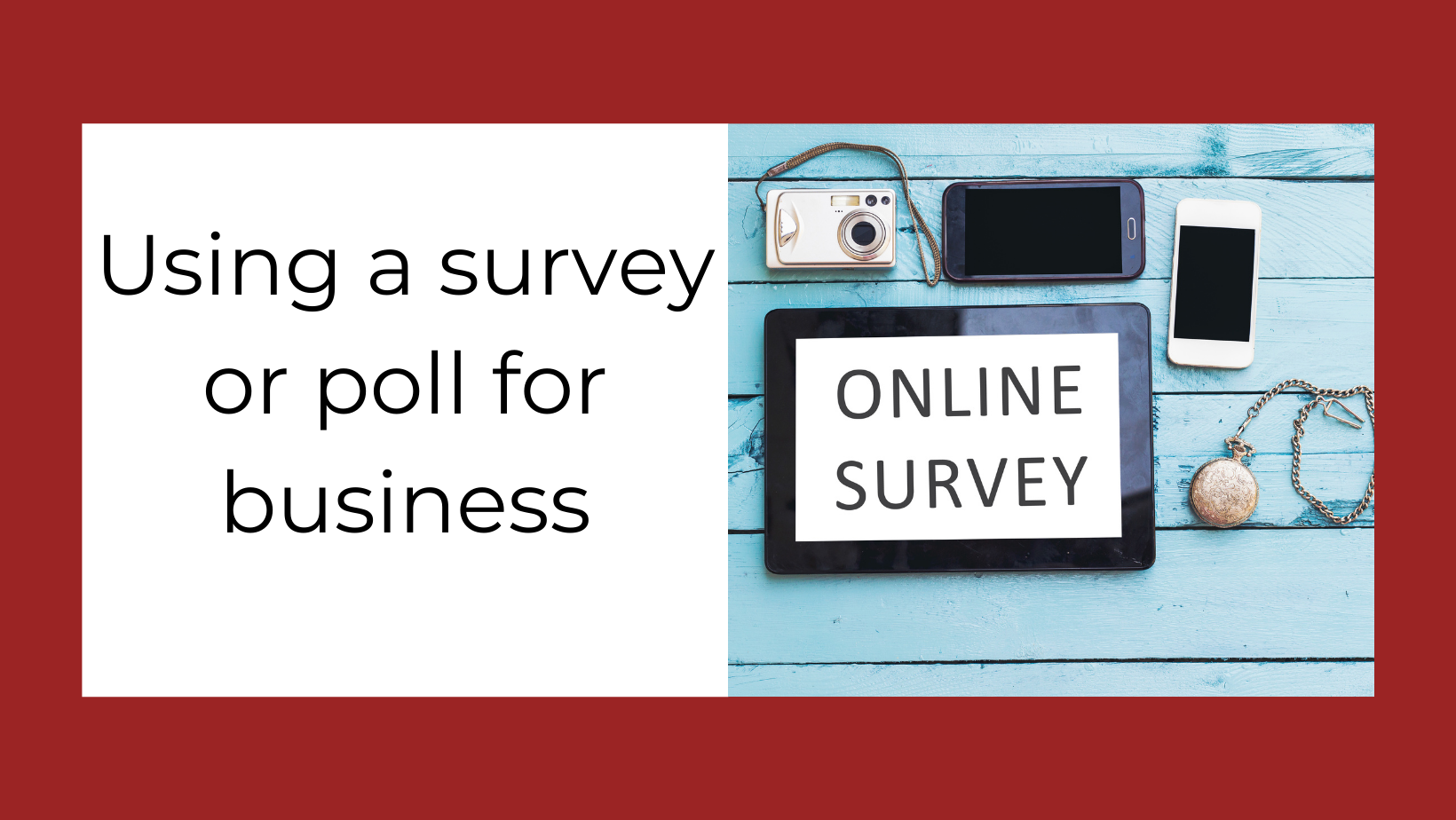
Using surveys or polls for business

Using a survey or a poll is great way to understand what your customer wants. The answers you get can give you an insight into what your customers think of you and your business; what kind of service they want; and it gives them a chance to share their perspectives with you. If your survey or poll is engaging, then your customers are more likely to participate and spread the word about you.

The way I see it, surveys/polls have four main objectives…

  1. Getting feedback from existing customers about products or services that you have provided. Ask them if the product or service could be improved or if there was a way it would work better for them. You can use this to improve your services or extend your product line.
  2. You can use a survey to get testimonials from your customers. What worked well for them and why? You can then ask them if you can use their comment in your advertising or on your website/social media page.
  3. To find out what your customers want – is there an issue that needs solving…one that they’d be willing to pay for? If you know exactly what your customers want, you can develop products or services to fit their needs. This shows that not only do you listen to what they say, you act on it.
  4. They can help you find out what current buying trends are.  Online spending has been growing since lockdown, and an online survey or poll are two of the best ways to find out what your customers are thinking, how they spend and why they spend…and what they are spending their money on. If you ask the right questions,  you can gather this kind of information fairly easily.   

What questions do you ask?

There are many you could ask and I’ve listed some areas you might want to think about. When you are creating your questions, think about what you want to achieve…are you looking for ideas for new products or services? Are you wanting to know what needs to be improved? Here are some ideas and pointers that might help you… 

  • If you’re doing a poll, you might want to just stick to one question. You could do a series of polls over a number of weeks on a social media network.
  • If you are a blogger, you could ask your customers what subjects they might be interested in…for example if you are a beauty blogger, you might find that several of your customers have the same problem that you could address with a blog, such as ‘how to apply mascara properly’ or ‘what are the best products for sensitive skin?’ Answering questions helps set you up as an expert in your field.
  • Segmenting your customers will help you reach the right audience with the right message. A simple example…if you run a garden centre and you send out a regular newsletter, you could ask what plants your audience are interested in. Some may be interested in herbs and fruit – another in climbing plants – someone else in vegetables and flowers. You can then use this information to better target your marketing and communications.
  • Get feedback on your website…is it easy to navigate? Can your customers find what they’re looking for? Are there any areas that could be improved or any products/services they’d like to see you sell or offer?
  • Are you thinking of setting up an event? Events take up a huge amount of time and effort from planning to execution, so before you invest your time and money, you could create a poll or survey to find out what kind of event they’d like. Give several options and include an ‘other’ answer, as they may come up with something you hadn’t thought of.
  • Competitions – you can use a survey to host a competition. For example if you make cakes, you could put several pictures of cakes you have made and ask, ‘Which cake do you think deserves Cake of the Month’? This also serves to show potential customers what you can do and gives you the chance to show several different kinds of cakes you do. And for the competition aspect, you could offer a 10% discount to the winner. Which you draw at random from the participants.  
  • Finally – get a fun aspect in there! Polls in particular don’t have to be serious – if you just want to engage with your customers, ask a question. This could be something as simple as showing two of your products, labelling them A and B, and asking which one your customers like the best. Or you could ask, ‘What is your favourite ice cream flavour’, or ‘What is your favourite thing about travelling?’ Often, these kind of questions spark  interest and a conversation. I would advise not to ask anything controversial and avoid politics, current affairs or religion,!

Once you have your survey or poll, post it on your Facebook or Instagram account, or put it on your website. If you want specific information from your existing customers, you could include the survey or poll in your newsletter or on email.

If you do put your survey on your website, don’t do it so that it pops up the minute someone visits your site, as that can be irritating and can be seen as intrusive.

Final Hot Tip!

Everyone likes a reward, so offer some kind of incentive for your customers if they complete your survey. Give a free report or an e-book, or offer them a discount on the next purchase they make from you. Offer a further discount, or a free item, if they recommend five people who buy from you.

Good luck, and if you have done this with your business, let me know how you got on!

How to grow real followers on Instagram

In the early days of Instagram, it was the norm to buy followers, but although this might boost your followers in the short term, it’s a waste of time, as they aren’t your REAL followers – and they’re usually not your target audience. Real followers on your Instagram account are the people that engage with you and your business, love your brand and care about what you post.

There are more than two billion active users on Instagram, which makes it one of the top four social networks worldwide.

The statistics

These stats are current (2024) sourced from https://www.demandsage.com/instagram-statistics

Instagram is the third most popular social media platform worldwide

  • Monthly active users (MAUs) – 2 billion globally
  • Instagram daily active users (DAUs) – 500 million globally
  • Instagram stories reach 500 million per day
  • 49.4% of Instagram users worldwide are female, while 50.6% of Instagram users are male
  • The majority of Instagram users worldwide (62.3%) are between 18 and 34 years old.
  • 7 out of 10 people on Instagram check out stories daily, and nearly 9 in 10 Instagram users post stories daily.
  • 62% of people are more interested in a brand after viewing it on Instagram Stories
  • People spend an average of 29 minutes a day on Instagram

These stats are pretty mind-blowing, and I find these two stats particularly interesting.

26.43% of Instagram users have less than 1000 followers – that’s a big percentage – more than a quarter of all Instagram users!

At the same time, 49.94% of Instagram users have 1000 to 10,000 followers, which is also surprising! So, around 75% of Instagram users have 0 – 10,000 followers. So, this says to me that we really shouldn’t get hung up on the number of followers – we’re doing OK!

How to use Instagram for your business and grow your real followers  

As with any social media account, the downside is keeping track of everything, especially if you’re running your Instagram account as only a small part of your business. It can be very time consuming.

  1. Make sure you are using an Instagram business account. If you’re not yet doing this, either start a new business account or switch from a personal account to a business account.
  2. Have an Instagram strategy. The first part of any strategy is to know your target audience – the people to whom your post and marketing is aimed at.

    – Look at who already buys from you
    – Check the insights on all your social media channels to find out who follows you – what are their age group, their demographics, psychographics and geographics. Read my previous blog on finding your target audience for more information.
    Research your competitors to find out if your audiences vary and why.
  3. Set goals and objectives. You need to think about how Instagram can help you achieve them. Make sure your goals are SMART – Specific, Measurable, Attainable, Relevant and Timely.

    Once you know what your goals are, you can focus on the different aspects of your strategy to lead your followers through the various stages of the customer journey.

    – Awareness of your business and brand  
    – Engagement with what you post, which you can measure by the number of likes, comments, and shares.
    – Conversion – how many people click through to your website, follow your CTAs (calls to action), click on your blog posts or your online shop, or subscribe to your email newsletter. This also covers any people who respond by clicking on your paid ads if you use them.
    Customer – this stage is based on the action that customers take, such as buying, repeat customers, retention of existing customer, recommendations etc.
  4. Plan your content in advance. This doesn’t have to be on a particular app, you can just plan it on paper or on a simple word document or spreadsheet.

    Once you know who your target audience is and you know what your goals are and how you want to achieve them, you can plan your posts, stories, reels, and videos in a more structured way. Having a plan means you can include dates or events that interest you – the big ones such as Christmas, Easter, or Halloween, as well as things that interest you, such as Hug your pet day, or National Cupcake Day. Just do a search on Google to find a relevant list of these dates and decide which ones you want to highlight – or check out my FB/IG pages as I put a list of these dates up monthly.

    I also plan my content around the 80/20 rule – 80% of posts are about engaging, entertaining, educating and inspiring my audience – and 20% is about selling my services. You could choose to do a series of posts around a particular theme. For example, if you make something, you could run a series of ‘how to’ posts, using short video clips, and instructions with photos. These fall into all the 80% category!

    You can use video, memes, quotes, quizzes, ‘this or that,’ ask questions…the list is endless. And all of them are engaging your real followers and making them want to see more from you.
  5. Publish at the right time. You can look at your insights to find out when your followers are online and looking at Instagram. This tells you what days of the week and what time of day your followers are most active. Post at those times to get the most engagement.
  6. Create a fabulous bio. This is the first impression people get of you and your business, so make sure it tells your audience exactly who you are and what you do. There is very little time to make that good first impression. Show them why they should follow you. You only have 150 characters to do this, so keep it to the point and include some of your personality. Add a CTA, so people know what to do next – this could be a link to your website, blog or to your Linktree, where they have a choice of which link they’d like to go to next.

    For business, you should use the profile image – either a good shot of yourself or your logo – it’s up to you.

    Also, make use of the Story highlights. This is where you can have your stories organised into different collections – this could be one collection of products, about you, FAQs, hints, and tips – again the list is endless.
  7. Always share high quality content. Instagram is a highly visual platform so it’s crucial to organise your posts so that your audience will be able to instantly recognise that it’s you. There are several different grid layouts to choose from. Just search on Google for grid layouts and there are several great articles on the different types you can use. Using your brand colours and a good aesthetic will really help your business stand out from the crowd.

    Look at your competitors, look at businesses that are completely different to you and see what they do and how they organise their posts. Once you have decided, you can batch make posts and schedule them, so you don’t have to think about it too much once it’s done.
  8. Always write a caption. I do see several businesses that post fabulous images, but no caption. To me, the image doesn’t always mean something unless there is a caption. The caption explains your image in greater detail. Even if you’ve done a brilliant carousel post, where people swipe across several posts to find out more and more info, a caption is still needed to give a bit more information, or to ask a question to keep your audience engaged. Captions make your images more meaningful.
  9. Use stories. A survey carried out by Facebook in 2018 found that 58% of the participants became interested in a brand or product after seeing it in a story. It’s a great place to tell your brand stories, share reviews, share a bit about yourself and your business. You can engage your audience by using the many different features of stories, such as stickers, polls, etc. You can also use video and background music. If you’re consistent with your stories, you can get your audience into the habit of watching them regularly…and if they love what you do, they’ll be looking for your stories every day.
  10. Be consistent. You will hear this all the time, but whether you post every day (and you don’t have to), or post three times a week, make sure you are consistent, so your audience knows when you expect your posts.
  11. Always respond to comments, tags, or mentions. If someone takes the time to comment on a post or share your post and tag you in it, it’s only polite to acknowledge that fact. Always reply to comments and always reply to DMs. Taking the time to personally reply makes your audience feel valued. It can be time consuming, but it is so worth it. Another tip is to respond to the person by name if you can – it makes it more personal.
  12. Promote your Instagram account on your other channels. Instagram may not be your most popular channel, so if you have an established following on another channel, promote your Instagram account on that. Your regular followers will want to support you on Instagram as well. Try and vary the content between channels, so you are not constantly posting the same content…or at least do it in a slightly different order!
  13. Collaborate with other businesses. You can agree to engage with each other’s posts and share content to your stories. It does have to be relevant to your business, but this is a good way to get to other followers from a similar business to yours.
  14. Measure your success. When you use Instagram for your business, it’s really important to track your progress. Look at your insights to find out what kind of posts your audience is most interested in – what gives you more engagement.

    Look at how Instagram is helping you achieve your goals, and why some things work, and some don’t. It’s all a learning curve. Instagram’s insights only track the last 30 days, so you need to do this regularly and keep a note so you can compare future figures and facts.

Like all social media channels, Instagram is great for your small business if you use it properly and are consistent in what you do.

If you’d like to have a coaching session on Instagram, or would like a review of your profile, send me a message, or email me at cindymobey@outlook.com