Building your SEO strategy – Part 2 – Creating Content

Creating your SEO content

Following on from my last blog post, Part 1 – Preparing your content, you’ll know about keywords and how to research them and how to research your competitors and the keywords they use.

Now it’s time to put this into practice. By content, I mean anything from website pages to blog posts and even social media posts. In fact, anything that can be found online that someone out there could be searching for. And you’ll be using some of those keywords that you have researched.

  • You can either create something along the same lines as your competitor that is better than they’ve created.
  • Or you can create something completely different.

I prefer the latter and create something completely different – mainly because I know this will make me stand out more, and because I know my audience and know they like the kind of content I writer – in that I try to keep it as straightforward and easy to understand as I can. I write SPECIFICALLY for you – my readers!

How do I know what to write? Because you tell me! I take notice of comments and posts that you put on social media or listen to what you tell me when I speak to you face to face or via messenger. I try and notice the marketing things you’re struggling with, and I ask questions to find out, and often give options, so I know that what I write about will be interesting or helpful to you.

So, let’s make a start with yours…

What is SEO friendly content?

SEO (Search Engine Optimization) friendly content is created so that it helps the search engines, such as Google, rank it higher. This doesn’t mean stuffing it to the brim with keywords, it just needs to help search engines find, understand, and connect your content to the right users for the content you’ve written. 

Although keywords are important, you’ve guessed it, there’s much more to it than that! If your content is optimized well, it helps with the user experience and encourages the user to stay on your website or blog for longer, so giving you higher browsing times and engagement rates – and so helping you rank higher on search engines!

How to make your content SEO friendly

Let’s look at some of these in turn…

Create valuable content

This is not necessarily creating what you want to, but creating content that speaks to your reader, content that is valuable to them and caters to their specific needs or questions they’ve asked you.

You may have seen the odd post from me and from others you follow, where a post will simply say – ‘Ask me anything.’ If you post something like this, you will get many random questions, such as ‘what’s your favourite colour?,’ or ‘what music is on your playlist?’

But, you will also get valuable questions about your business, which will give you ideas for social media posts and blog posts – and new ideas for your business, which you will then need to add to your website.

I digress – Google’s algorithms favour this high quality, valuable content, so the more value you provide, the longer people will stay on your website or content.

Example

For example, say you are interested in baking and want to share a recipe for spaghetti bolognaise. The title you’ve chosen is ‘How to make tasty spaghetti bolognaise.’ Now, you will get some people who will click on this but try going for a slightly different angle ‘How to cook authentic Italian spaghetti bolognaise.’

This not only more appealing, but it also gives you options. You could write about the history of that dish, and you may know someone who is Italian who loves to cook, and who would be happy to be interviewed about their particular recipe and how it came to be in existence – it might be an old family recipe they’d be willing to share. This gives a story to your content, which is much more engaging.

Headlines and sub-headers

Headlines and sub-headers are great for SEO optimization. It not only enables your reader to skim your article or webpage, but the sub-headers also help them find what they’re looking for and makes it easier to read. And people tend to share things that are easy to read.

It also helps the search engine bots to recognise headlines and helps them understand more clearly what your content is about.

Having your keyword(s) in your heading or sub-heading also helps – just make sure you don’t stuff so many in that your headings or content becomes less easy to understand or messy.  

The Hook

Whilst I’m on the subject of headings and sub-headings, you also need to think about the ‘hook’ that will draw people into your article.  Using engaging words or numbers in headings has been proven to pull people into an article. So, if you had a title such as, ‘Facts about pasta,’ you could use ‘5 facts about pasta that you didn’t know’. This grabs the attention of the reader and they’re curious about those 5 facts they didn’t know! Just be sure to keep a keyword in there too.

Readability and the format of your content  

SEO is also about keeping the attention of your readers for as long as possible, so make sure the format of your content is easy on the eye. Use images, short paragraphs, bullet-points, and sub-headings so their eyes are drawn to different things. Or, if you’re writing something instructional, set it out in steps to make it easier to follow.

If you use images, optimize them by adding alt text or describe the image. This help with SEO, but also helps people who are sight impaired to understand what your images are. Use a keyword if you can, but it needs to make sense!

Add CTA Buttons

It’s always good to add a CTA (call to action) button too, so your readers know what to do next. This could be in the form of ‘Buy now,’ ‘Learn more,’ or ‘Pop over to my website.’ This makes it easier for readers to take the next step.

Add links

There are different kinds of links you can add to your content – more so for blog posts or webpages.

Backlinks – these are links that send your reader to another article or page on your website that is relevant to the content they’re reading.

External links – these are links to other peoples’ website or content, which is really helpful to ranking your content higher, especially if the links are to high-quality, reputable sites.  

If you quote stats, state where readers can find the source for those stats – usually a link to the relevant research website.

All links give your content credibility with SEO and the better your links, the higher your page will rank in search results.  

Length of your content

Advice about the ‘right’ length of content is something that changes frequently. It used to be that articles of 300 words or less were best, and that the more posts you publish, the more traffic you’d get.

These days, search engines give a higher priority to article that are longer with more quality. So, the latest advice is articles of 1,500+ words and published less often. Apparently, the reason for this is that Google tries to give priority to posts that provide more thorough answers to the questions and searches they get from their users.

You can find out which of your articles get most engagement from your analytics – which are visited the most and which are read for the longest period of time. And you can also see which generate the highest conversions – for example sign ups to your newsletter. This is how you find out what works best for you.

AND finally…

  • Make sure your website is mobile friendly and that the format looks good across all devices.
  • Ensure that your pages load quickly – when people click on your website or blog content, they won’t hang around waiting for it all to load, it needs to be there asap. A good web hosting provider will sort this out.

I hope you’ve found this article useful and not too involved – I’ve tried to keep it as easy to understand as I can.

Good luck with making sure everything you write on your blog or website is SEO friendly and if you need any help, feel free to contact me.

You can also sign up to my newsletter, where you will receive more great marketing tips and get 102 ideas for social media posts.

Building your SEO strategy – Part 1

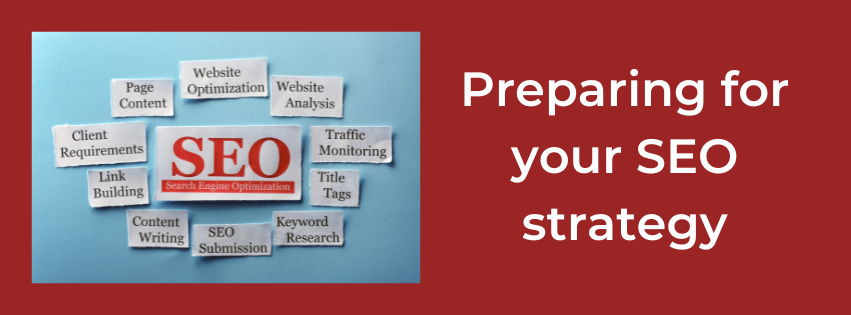
Preparing for your SEO strategy  

Whether you have a small business or are part of a bigger corporate, SEO (Search Engine Optimization) is a must for your website to help you rank higher on Google and other search engines.

Building your SEO strategy sounds complicated and may make you want to immediately zone out and not read more – but trust me, I’m going to try and keep it simple! It’s really just a plan!

Your SEO strategy is simply the process of organising your website’s content to improve your chances of appearing in search results – a way of maximising your opportunities to get organic traffic from search engine results pages, (SERPs).

Having a strategy or plan, helps you keep on track when you create your content. It helps you see that you need to create content that people are looking for and searching for, rather than creating content you think they’re looking for, or posting what you want to post.

When you just react and post without a plan, your content will appear unorganised and scattered – this is when search engine bots have a problem indexing your site, understanding exactly what you do and therefore, have a problem ranking your pages.

BUT WE CAN FIX THIS! However, as it’s such a big subject, I’m going to do this over a few blog posts, so you don’t feel too overwhelmed!

Steps to helping create an SEO strategy.

Here are few simple steps to follow:

Make a list of keywords.

This is always the first step to take. Use Google search to help you with this. OK, let’s go with an example…

You make candles – you sell them at markets and on your website – and you also use social media. You make all sorts of candles for all sorts of occasions, some standard that people can buy and some bespoke.

Your keyword search starts with Google – type in candles or put the word twice (as I did – candles candles).

Google will then suggest loads of options, such as:

  • Beeswax candles.
  • Votive candles
  • Scented candles
  • Four candles (!!! This made me smile – if you know the Two Ronnies sketch)
  • Birthday candles
  • Cake candles
  • Soy candles
  • Specialist candles
  • Candles near me

You’ll know that these are good keywords to use for SEO as they come straight from Google and so you know this is what people are already searching for.

You will find that short-tail keywords (search words using just one word – such as ‘candle’) are more popular as most people will start with just one word when looking for something specific.

Long-tail keywords (such as ‘candles for special occasions), won’t be as popular in the volume of people looking for them, but they tend to be generally easier to rank for and obviously attract people who are searching for something more specific. 

I’d say type in several different words and short phrases into Google and see what comes up – try and have a list of at least 10 keywords.

You can then check them in a keyword checker (there are some free sites out there, such as  https://www.wordstream.com/keywords or Ubersuggest) which will give you the number of people searching that keyword and whether they’re low, medium or high volume.  

Look at Google’s first page.

Once you’ve got your list of keywords, type them one at a time into Google search and look at the first 10 entries that come up.  This shows you the businesses that currently rank for that keyword, and the kind of thing (maybe a list or a business itself) that people are looking for when using that keyword. Make a note of what comes up in the search and what kind of things, such as lists or blog posts that come up.

Analyse your competitors. 

Most of us will know who our main competitors are, but to find out who Google thinks your competitors are, you can use a free tool, such as Semrush, to help you. You simply type the URL of your website into their search, then click on ‘Domain overview’ and scroll down where you’ll find a further search called ‘Main organic competitors.’ If you click on this and then click on ‘view all,’ you will get loads of information about keywords. It will show a list of all your competitors, plus the most common keywords that you share, as well as telling you how much traffic those keywords pull in.

Where you see a lot of common keywords, you’ll have your list of at least 4-5 competitors.

Keyword gap

You can now use the Semrush ‘Keyword Gap Tool.

The ‘gap’ refers to the keywords that your competitors are ranking for, but that you’re NOT ranking for.

This tool will help you identify those gaps, so you can then use them on your website or blog, therefore optimising your existing content with those keywords – or creating new pages to use them.

To use this tool, you simply put the URL of your website and then the URLs of four of your competitors and press ‘compare’ and scroll down to ‘all keywords details for…’ and click on the ‘missing’ tab. You’ll get a huge list and then it’s up to you to sort through which of those missing keywords would be relevant to your business and to your website. 

There are lots of other uses that Semrush can help you with in analysing your competitors and your website, so it’s worth going on and having a play – and it’s really interesting!

These are the first few steps for SEO and will help get you prepared to look at your SEO strategy. Next time we’ll look at how to use this new-found knowledge to help you rank on Google.

If this all feels a bit too overwhelming, I can help you with your SEO strategy through 1:1 coaching. Just contact me to find out more.

Hashtags FAQ

If you run your own small business, you probably use social media sites to promote your products or services. We all know that Search Engine Optimization (SEO) is important in promoting your website and blog content, but what about HASHTAGS? Do they help?

What are hashtags?

Originally hashtags were used to help filter and organise conversations on Twitter, but they are now used on all social media platforms. A hashtag is the sign # followed by a phrase such as marketing, so would be #marketing. It’s a category that posts relating to that subject can be streamed into; anyone can use it for their content, be it a blog post, Instagram or Facebook post.

How can I use hashtags on social media?

A really easy way to get started is by using popular hashtags. One hashtag that I see regularly on Facebook and Instagram is #throwbackthursday or #tbt. This is used as a weekly theme by some Facebook groups where people and brands share posts, or experiences from the past. For example, they may post their first ever product.

There are different hashtags depending on what niche your business is in. For example if you are in the fitness business, you might use #fitnesstips #fitinspiration or #gymspiration to name a few….or if you are in marketing, you could use #marketingtips #marketingstrategy. There are thousands to choose from and research on what are the best hashtags for you to use for your business is crucial. If you go into Instagram and click on the search icon, you can type in a hashtag you think would suit your business – for me it might be #marketingtips. Then that hashtag group comes up, with hundreds of the most popular posts that have used that particular hashtag. Doing your research in this way can help you to decide which hashtags to use (if you are a small business with a small to moderate following, you don’t want to use a hashtag that has over a million posts, as your post is unlikely to be ranked under that hashtag. I try to stick to a variety, some that are under 50k – some 50k-100k – some 100k-500k and then others that are over 500k posts up to 1 million.

How many hashtags should I use?

How many you use depends on what social media platform you are posting on.

  • X (formerly Twitter) allows space for hashtags, but advise using no more than two.
  • Facebook advises using between three and five.
  • Instagram – you can use up to 30 hashtags, but most accounts use around the 10 mark. It’s up to you – I tend to stick to between 3 and 5.
  • TikTok don’t really advise hashtags as they can look spammy, but if you do, no more than three to five – but they should be used with purpose.
  • LinkedIn advises a maximum of three per post.
  • Pinterest state you can use up to 20 hashtags per Pin description, but it is advisable to use no more than 10.

So what do hashtags do for my business?

Hashtags are a great way to build your brand, boost a marketing campaign or sales campaign, and launch a competition or to just keep in touch with your target audience.

Using hashtags on Instagram and Facebook can really increase awareness of your business and engagement with you and your products/services.

They are an effective way to build your brand, for example use them to launch new products/services, share your promotional material or for just generating interest in what you do.

Hashtags are also great for creating a buzz with your website, spreading news and information about new products, events that you’re involved in or just creating hype for your business.

How do I find the right hashtag words?

It really is as simple as putting a search into Google. Just type in ‘popular hashtags for XXXXX’ whatever business you’re in – fitness, food, crafts, artist, and so on… a list of hashtags will come up. If you are using them on Instagram, as soon as you type the first hashtag, you will also see a list of other similar tags which you can also use. Try and avoid really long hashtags. When writing posts using hashtags, don’t forget to put links to your website as this will encourage more traffic.

Can hashtags help me find my target audience?

Yes, they can! For the purpose of this question, I’m going to talk about Instagram.

When you’re posting for your particular niche or business, you need to find the keywords that will be specific to your business. So, a generic term like ‘photographer’ or ‘blogger’ just won’t cut the mustard. You need people to be able to find out more about you, so for example on my Instagram account, I will post #marketingincharente as I am a Marketing Consultant and I live in the Charente…you get the idea! Or if you are a café, you could specify something on your menu, #fullenglishbreakfast and maybe the town you’re in. It’s more specific.

Being specific is what will help your target audience find you.

How should I use my hashtags?

Use a mix of hashtags on your posts to give yourself the best chance of being discovered and getting ranked on that particular hashtag. Here are some examples of the kinds of hashtag categories you can use:

  • Your industry – #smallbusiness #handmadebusiness
  • What you sell – #candles #babyclothes #smallbizmarketing
  • Your specialty – #vegancandles #naturalfabrics #marketingtips
  • Who wants to buy – #homedecor #babyshower #socialmediastrategy
  • Location – #candleslondon #babyclothesuk #marketingcharente
  • Event hashtags – #mothersday
  • Daily hashtags – #manicmonday #throwbackthursday

    The reason you use all these different types of hashtags is to keep your content in view for as long as possible. The most popular will bring a brief flurry of activity, then the moderately popular hashtags will kick in and your content will stay active on those for a few hours. Then your more niche specific hashtags will be noticed.

    Of course, you will also receive activity from your followers, so you are still reaching out to your existing potential customers, as well as new ones.

    Can I set up my own hashtag?

    The simple answer is ‘yes, you can!’

    But, there is a but! You cannot legally own a hashtag. If you find one that hasn’t been used, which will take a lot of research, you can register it. However, even registering the hashtag will not stop other people from using it – it’s not like owning a website domain. Registering just means you’ve staked a claim to that hashtag and adds you to the hashtag directory, where you can go into a bit more detail as to what the hashtag is for…you can write a description.

    How do I register my hashtag? 

    Once you have found a new hashtag relevant to your business, you can register it on sites like Hashtags.org

    As soon as you have registered it, use your hashtag ALL THE TIME! Use it a lot…as much as you can! At first you will be the only one using it, but after time you will find others using it for articles, posts or blogs that talk about the same subject.

    Do hashtags help with SEO?   

    Again, the simple answer is ‘yes’. Hashtags are basically keywords, so they help you to categorise your content and help social media users to find it. Using hashtags in your social media posts will give you more opportunities to have your content in Google search results.

    Finally, just be aware that hashtag use varies greatly with each social media platform so you need to be mindful of which platform you’re on!

    Happy Hashtag Hunting! Let me know how you get on, and if you find hashtag research all a bit overwhelming, give me a shout and I can help you with your hashtag strategy.