
There is so much to do when you have your own small business and the most difficult thing that my followers tell me about is how hard it is to get sales. There is no ‘one size fits all’ answer, but a sales funnel is a way that can help push your potential customers in the right direction.
A sales funnel gives you a structure to encourage your potential customers through, on a journey which is designed to turn them into happy customers. There are lots of ways to do this, but I’m going to explain in this post how to create a simple, but effective funnel that anyone can use.
What is a sales funnel? 🥴
A sales funnel is simply a pathway you want your potential customers to take on their way to loving your products or services enough to buy them. It’s about moving them from first finding your business, to them taking their first action.
It’s called a funnel because, like a funnel, the number of potential customers will decrease as they move through each stage, so you’re left with the ones that want to buy from you.
Before you think about your funnel, you need to think about two specific questions:
- What is the most important problem that your products or services solve for your customers?
- What is the first step you want potential customers to take?
No matter what you do, you will solve a problem for your customers:
🍔 You’re a restaurant – your customers are hungry – you provide the solution.
🧵 You make greetings cards – your customers want a card for a specific occasion – you provide the solution.
💻 You provide a marketing coaching service – your customers need help and guidance on how to market their business – you provide the solution.
🎄 You have a crafting business and make Christmas items – your customers need to decorate their house/tree/cake for Christmas – you provide the solution.
I could go on, but I’m sure you see where I’m coming from.
What is the first step you want potential customers to take? You may want them to go to your website, browse your online shop, engage with your social media posts, read your blog posts, or subscribe to your newsletter. All these things contribute to you getting to know potential customers and leading them on their journey.
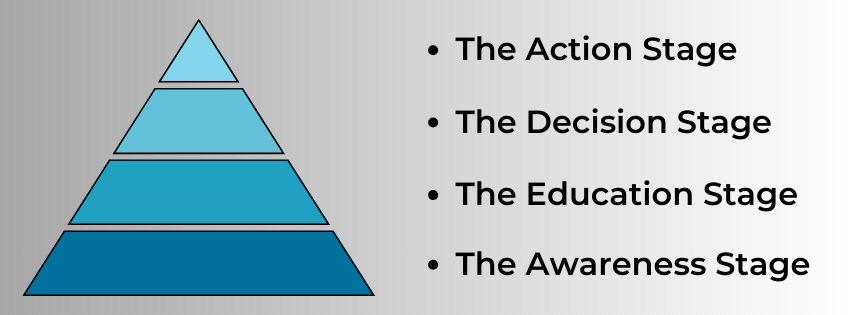
The four stages of the Sales Funnel
There are four different stages in the sales funnel:
- The Awareness stage – where you are focusing on attracting potential customers. This is about promoting your business – putting out good content on social media sites, where you can highlight your expertise in what you do – be it creating products or offering a service.
- The Education stage – this is where you capture leads and really build relationships with those potential customers, by demonstrating how you solve their problems. This is where you want them to see that you are an expert in your field. Whether you:
– write ‘how to’ articles to help your audience.
– take the most beautiful photos that mesmerise your audience (and sell them on canvas, on mugs, on cards, magnets etc).
– video yourself creating your product so your audience can see the exact process you go through.
Through these things, you’ll show your potential customers that you are an expert at what you do, you know what you’re talking about and that your products or services can help them. - The Decision stage – this is sometimes also called the engagement stage because this stage is where you truly engage your audience to take one action. If your sales funnel is working, your audience will take one small step closer to a sale. That one little ‘yes’ can bring you closer, but you must lead them there. This is where a call to action often comes in. You TELL them what you want them to do next. That could be:
– sign up to your newsletter.
– read another of your blog posts.
– watch a video
– contact you
– go to your online shop or website
– follow you on SM – giving them details of all your socials
Once they say ‘yes’ to one decision, they’re likely to say ‘yes’ to others. - The Action stage. Just like the title suggests, this is where your potential customers take positive action and become customers. Your leads have converted to sales! This is sometimes known as the Conversion stage. During this stage, your customers will buy your products or services, or buy your online course, opt-in to your email list, request more information from you about your product or service or book a call.
Conclusion
Sales funnels always sound very complicated, but they’re not if you follow these simple steps. 😀 You may have to adapt some of it to suit your particular business, or depending on what you want your end goal to be. I’ve used the end goal for this funnel to be ‘make a sale’ but you can use the same principle for any other goal you’d like to achieve with your business.
If you still think this is a bit overwhelming and need help in putting a plan in place, I can help you with this through a couple of coaching sessions. 👩🏫
Get in touch if you want to find out more, or if you want my help.
 The Write Way
Pingback: Planning your first simple sales funnel | The Write Way