If you write content, you’ll know how long it takes. It’s not just about the time and the money, but as a content creator, you put your heart and soul into everything you write.
This is where the 4 Rs of content marketing comes in. It puts the oomph back into what you’ve written before and gives it a whole new lease of life.
So, let’s take a look at those 4 Rs of content marketing:
Repurpose
As a content creator, you’ll have written hundreds of blog posts or articles and, in order to reorganise that content, you need to take a long, hard look at that older content. How can you repurpose some of your content and make it into something else?
Repurpose content
You could tie some blog posts together and make an eBook that you can sell, or give away as part of a lead magnet. You could make an infographic, or break down a post into several parts and make social media posts. And the great bit about that is that you’ve already done all the hard work to produce the content in the first place – it’s just about repurposing it into something new and fresh for your audience.
Retire
Sometimes you will come across an old piece of content that is just past its sell-by date! It might be that things have moved on and it is no longer relevant, or it could be that it just wasn’t something that performed well and probably still wouldn’t.
The other thing to look at is, ‘is this still relevant to my target audience?’ If it isn’t something that they would care about, it’s time to retire that content.
Revamp
I’ve talked about retiring old content that is out of date and no longer relevant to your target audience. However, you don’t want to simply delete or archive that content, as it may have good links attached to it or great SEO (search engine optimisation). Have a look at ways that you may be able to replace it with something more vibrant and current…revamp it!
It could be that you can rewrite some of it – has technology moved on, so you can update some of the information that is out of date? Can you add new statistics? Don’t forget to also add new images and bring your design up to date, so it’s more in keeping with how you do things now.
Everything you write, or have written in the past, has its value, so updating is a very worthwhile exercise. Simply put a note at the top of the article, blog or whatever, saying when the article was first published and noting that it’s been updated with new information.
Readability
Do you read other peoples’ content? I’m sure you do, but most of us only remain focused on something for a few minutes, unless it is something we are personally interested in. The internet has so much information, with loads of articles on similar subjects, that choice for your reader is vast.
So, ensure that your readers stay on your page. But how?
Make your content easy to read and easy to scan for information. Use bullet points, small paragraphs, headings and sub-headings and numbered lists. This breaks up the text and makes it easier to read.
Call to Action
Don’t forget to put a CTA (call to action) at the end so they know what to do next and you could offer an incentive to go somewhere else on your website, such as a freebie that takes them to an opt-in to your newsletter. For more useful articles on marketing, please visit my blog.If you need some help with writing creative content for your blog, website or social media posts…or if you’d like help creating your lead magnet, please feel free to email me – cindymobey@outlook.com
According to the Content Marketing Institute, “Content marketing is a strategic marketing approach focused on creating and distributing valuable, relevant, and consistent content to attract and retain a clearly defined audience — and, ultimately, to drive profitable customer action.”
Content marketing isn’t anything new, and those that still prefer the more traditional marketing route would probably argue that content should be just to advertise. But content marketing is one of THE most important parts of marketing for small businesses today. Your business will be left behind if you don’t use it.
I’m not saying that traditional marketing shouldn’t be used anymore as there is obviously still a place for it. Here are the differences!
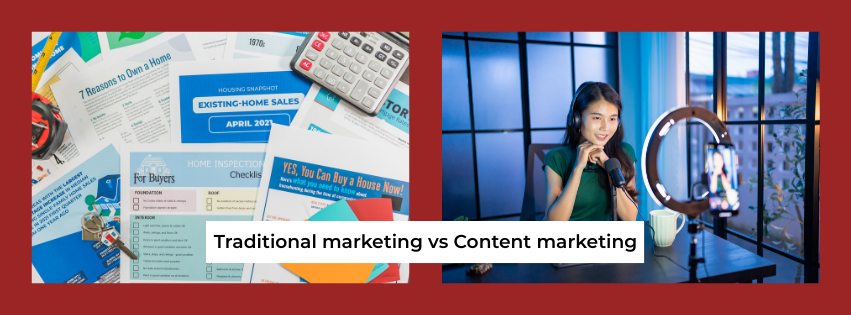
Traditional marketing vs Content marketing
Larger businesses will typically use traditional marketing as it is the kind of content that is pushed into the view of the public. For example, TV commercials, radio ads, print ads, brochures etc. You will see traditional marketing everywhere; on billboards, sides of buses, the ad breaks in the cinema, but they are all high end marketing which require a big budget to reach that large audience.
For the small business, content marketing is the way to go; it involves having a content marketing strategy, which comprises of all types of content being created and then published online in multiple locations. Instead of forcing your content on the public, your content will sit online forever, with the end goal of attracting your ideal audience or customer.
There is of course still a place for traditional marketing – you may want to have an ad in print in a local publication or have a brochure or catalogue for events. Some small businesses also get invited to speak about their business on local radio – and of course you’d want to do that!
Content marketing is different in that it doesn’t concentrate on just advertising your products or services, it’s about drawing your audience in by providing useful information that is helpful and solves problems. Your readers can follow you on social media to read more of your content, or follow your blog, in order to find out more. This helps you gain a loyal audience who trust you…and ultimately buy your products or services. It can also help encourage them to sign up to your email list.
What kind of content can I share online?
When your audience find your content useful, their connection to you and your brand is strengthened. They will share your content, so that your audience widens further. There are many different types of content – all of which can be posted, shared or used on social media to point to other things you do, such as a podcast on YouTube, your website or blog. These are just a few examples…
Your website copy – yes, this isn’t something that immediately springs to mind, but it can be useful to post about something on your website – it might be a particular item in your shop, it could be to point your audience at your services – or even to your about page to find out more about you.
Your Blog
Videos
Podcasts
Infographics
E-books
Printables
Quotes
Case Studies/testimonials
Lists/articles
Educational content
The list is endless, but to make your content really work for you, it needs to be optimised for your target audience and it needs to be relevant to the niche you are in.
How do you market your valuable content?
Now you have your content online, what do you need to do to market it?
Website
If you have a website for your business, you can add a blog to it, so you are creating content that people will see when they visit your website.
Email
Do you have a ‘subscribe to email’ button on your website? If not, do it! When you have subscribers, you can send them a monthly email as a newsletter. You can include:
Links to any blogs you’ve written
Details of new products or services
Special offers
Send links to videos you’ve produced on YouTube
Links to any podcasts you record
Links to any articles, news or videos you think they might be interested in (not necessarily ones that you’ve done)
Generally talk about new trends in the marketplace, a little bit about you and what you’ve been up to, ask questions make them feel like part of an exclusive ‘club’.
You can also enable buttons so that your audience can follow you on your social media channels
Social Media
Share your content to all your social media pages. You will have different audiences on Facebook to those you have on LinkedIn for example, and again different to those you connect to on Instagram.
You can schedule your posts, so you’re not constantly on social media (and therefore getting distracted by other things!).
Share the link to your blog in your profiles on social media.
Ask questions linked to your content and respond to anyone who makes a comment. In fact, respond to any comment you get and thank people through messenger or private DM for following you.
Share you blog posts as soon as you publish them. The more immediate responses, likes and shares you get, the more credibility your post gets.
Share your blog posts more than once…share again the next day, with a different caption and image. And again a week later. This way, you will pick up people you have missed, or who didn’t see your original post.
If you notice that an old blog post went well and got lots of engagement, then share that again…not all of your posts, just the ones that had great stats.
Posts with imagesget better engagement, so really think about the images you use to entice your audience in. There are lots of free image sites out there (such as Pixabay, Pexel, Unsplash and Canva) that you can download licensed images for commercial use. DON’T just google images and use one as you could be fined for copyright.
Join groups on social media and participate in group discussions, giving advice, answering questions etc. This helps get your name known and helps you get seen as an expert in your niche. They also have ‘share your blog post/business page’ type events, which help get your content in front of a different audience.
Although not as popular as they once were, I’d still advise using up to 5 hashtags to help categorise your content for your audience.
You can also pay to boost your reach on social media.
Write a guest post for someone else’s website or blog – you then tap into their audience.
Make sure your blog/website has social media sharing buttons, so your audience can click to go look at your social media sites.
Search Engine Optimisation (SEO)
Choosing the right keywords or phrases will help your content get seen.
If you write a blog, include keywords and variations of it throughout the blog.
Optimise your social media posts by adding keywords. Just be aware not to stuff too many into anything you publish or it will be seen as spam!
You can find out more in-depth information in my other blog posts that specifically cover this, as it would be too much to include in this post!
Headlines
A headline really matters – the ones that seem to get the most traffic are lists, how to, or a question. Also, headlines that contain numbers, e.g. 101 ways to …….
Emotional headlines also seem to hit the mark too, as well as some of the more controversial headlines!
Images
Using great images can help market your content. Images don’t just have to be photos; it can be GIFs, infographics, graphics or video. These help capture and keep the attention of your audience.
If you have a Pinterest account, make sure your images can be pinned (shared) by other Pinterest users.
If appropriate, also put a caption on any image as this helps with search engines – images alone won’t necessarily be picked up by search engines, but if there is text, they will be.
Revisit and repurpose your content
Revisit your old posts and content regularly. Revisiting content means you can update it with new information, add new images/infographics and maybe add a short video you’ve made on the subject.
You can also repurpose posts into e-books, video or a podcast. You can also use ideas from them to make social media posts.
Conclusion
There are lots of different ways to market your content, but the most important thing to keep in mind is to always have your customer/target audience at the heart of everything you do. Do it for them, aim it at them, and make sure it’s something you know that they will be interested in.
Keep your brand in mind and write in your own particular style – don’t try and copy anyone else. Keep your content original and engaging. Remember, content should always entertain, educate and engage your audience.
Happy content writing and please get in touch if you need help with your content!
The Content Marketing Institute, which is an online resource for information on everything marketing related, defines content marketing as…
“Content marketing is a marketing technique of creating and distributing valuable, relevant and consistent content to attract and acquire a clearly defined audience – with the objective of driving profitable customer action”
The key word here is ‘valuable’ content; content that will speak to your customers, content that they want and need, maybe information that solves a problem they have. In order to do this, you need to know your existing customers and research and get to know your prospective customers, so you can deliver that all important content. It may take some time to get it right, but when you do, you will have the opportunity to expand your business, build your reputation and ultimately be known as an expert in your field.
Once you can provide the right kind of content, it brings much more to your ‘table’.
More traffic to your website
If you can solve a problem that your customers have and write about it on your website, when potential customers search online for a solution, they will visit your site. Depending on what you do, that could lead to a sale or a request for your services…and they are likely to return to your site in future.
If you can find a way to tailor your content to your target customer’s needs and wants, they will trust you and you will get repeat business.
More sales
When a person finds a site they like, that speaks to them personally, or they feel that it speaks to them personally, they will return again and again. And if they are returning, they are more likely to turn into customers. As everything is online these days, we all turn to the internet if we want to buy something; I like to read about what I want to buy first and find out as much as I can about that product before I buy it. I am more likely to buy from a business that knows what they’re talking about and one that seems to know my needs.
Enhances your brand
It sounds a bit rude to say this, but it is fundamentally true – people are generally interested in themselves, in their likes and needs. This isn’t about being selfish, it’s human nature. When someone first looks at your website or interacts with your business, they are not in the least bit interested in your brand, no matter how hard you’ve worked on it. They are more interested in what you can do for them. If you provide something that makes their life easier, less stressful, and cost-effective and generally entertain them, they will then become interested in your brand as they will see it as something they relate to.
If you are consistently publishing new, unique content on your blog or website and then promoting it on social media, more people will get to see your name and start to relate to the things you write about. If they like what they see, they’re more likely to tell their friends and so your audience starts to grow and they become more aware of your brand.
Content marketing is cheaper than other forms of marketing
The title of this last section basically says it all. If you can research and write your content yourself, it is more economical as you’re not spending money on getting someone else to do it for you. You’ll also learn so much from the research you do, that you’ll find more content as you go.
When you publish your content on your blog or website, make sure that you promote it on every social media site that you have…with maybe a jig around of the title or introduction. You can also contribute to larger sites to get your name out there.
Finally, with content marketing, you are attracting customers to you because they’re interested in what you have to say…and ultimately they will come back again and again.
If you want to influence your audience to your way of thinking and to look at your products or services, you must provide them with something they want or need, be their solution, show them that you provide valuable content and that you value their custom.
Images courtesy of 1-3 ) Stuart Miles, 4) David Castillo Dominici 4) Stuart Miles at FreeDigitalPhotos.net








 The key word here is ‘valuable’ content; content that will speak to your customers, content that they want and need, maybe information that solves a problem they have. In order to do this, you need to know your existing customers and research and get to know your prospective customers, so you can deliver that all important content. It may take some time to get it right, but when you do, you will have the opportunity to expand your business, build your reputation and ultimately be known as an expert in your field.
 Depending on what you do, that could lead to a sale or a request for your services…and they are likely to return to your site in future.
 business, they are not in the least bit interested in your brand, no matter how hard you’ve worked on it. They are more interested in what you can do for them. If you provide something that makes their life easier, less stressful, and cost-effective and generally entertain them, they will then become interested in your brand as they will see it as something they relate to.
 When you publish your content on your blog or website, make sure that you promote it on every social media site that you have…with maybe a jig around of the title or introduction. You can also contribute to larger sites to get your name out there.
 The Write Way